The Lectures · Chapter 9 · Part III — The Geometry
Magnetism & Inertia
One prop, two shapes, twenty minutes. This is the lecture where Ken Wheeler builds his entire universe on a tabletop: an hourglass, a paper hyperboloid, a wire torus — and a claim that poles, attraction, space, and time are all misreadings of one geometry. We walk it end to end in his own words, with his props on camera and every claim typed and cross-linked.
~65 min listen1 lecture · 3,177 words of tape · every one on this pageUpdated 2026-08-14
00 · Start here
Before he speaks
What this lecture assumes: nothing but patience — it is his ground-floor geometry lesson, the one later lectures lean on. What it introduces: the torus (his donut of magnetism), the hyperboloid (his hourglass of stillness), and the plane of inertia between them — then uses them to dissolve poles, attraction, repulsion, space, gravity, and time. Where it sits: Part III of the series, the geometry that Parts I and II argue you need.
He opens by claiming the entire visible universe holds its shape 'only due to magnetism' — so what does he think a magnet actually IS, if not a thing with two poles that attract and repel? Twenty minutes later he has answered with two shapes and a white line, and fired gravity on the way.
How to read this chapter: three voices share the page and never blend. The specimen boxes are the lecture verbatim — auto-captioned from the tape, mangles and all, sliced never retyped; the ▶ on each box plays him saying it. The teaching between boxes is us: plain English, no allegiance. And the register notes keep the books: when a claim is his, it's marked his; when it's testable, refuted, or standard physics wearing his vocabulary, it says so. His claims get his best case and honest typing — that's the deal the whole series runs on.
Welcome to chapter nine — and if you're starting the series here, you picked the right door. This is the lecture Kavin flagged first: twenty minutes, one table, and Ken Wheeler's entire field geometry assembled by hand in front of the camera. The deal for this walk: every word of the lecture appears on this page, in his order, verbatim off the tape. Between his words, we teach — plain English, honest registers, receipts. By the end you'll hold his whole answer to one question: if a magnet has no poles and no pull, what is it? Let's let him open.
Part III · The walk · 1/16 · 00:02–01:24
A universe of fields wearing a costume of stuff
Here's the door he walks you through in the first ninety seconds, and it's the biggest claim in the whole lecture: everything you can see is a field first, and a magnet is where he thinks the costume slips.
His opening move is enormous. He claims that one hundred percent of the visible universe — everything from atoms to galaxies — holds its shape and its volume only because of magnetism. His image is a balloon: matter is the rubber skin you notice, magnetism is the air actually holding it open.
Then he names the obstacle, and honestly it's a fair one. We're physical creatures. We eat physical food, grab physical door handles, and so our minds default to matter — to things you can count. But fields, he says, aren't things. They have, on his telling, no quantity to count and no quality to point at. The one concession he makes: you can pin a number on a field if you watch it over time — which, he notes, is exactly what Maxwell's famous field equations do. They describe field behavior across a time interval, not what a field is in itself.
Keep that distinction — what a thing does versus what a thing is — because the entire lecture lives inside it.
Here's how he opens, word for word off the tape:
HIS WORDS — auto-captions, verbatim · 00:02–01:24
Okay. Well, 100% of the visible universe is such strictly and wholly and only due to magnetism. That which gives air if you will to the balloon of uh from the microscopic and the atomic to the macroscopic is solely and proprietarily and only due to magnetism.Translation: whatever gives atoms and objects their volume — their 'inflatedness' — he credits entirely to magnetism. That's the balloon-and-air picture.So then becomes the uh the conundrum of humanity being physical beings dealing with physical things, eating physical food and dealing with our physical cars and our physical jobs and grasping out with things with our physical hands and other physical objects. We are only able to think of things from the premise of physicality. We only have the ability to think in terms of matter of what can be quantified. Then we're left with the issue that 100% of the universe is fields and fields are not particles. They cannot be quantified. They have neither quantity nor quality.In plain terms: you can't count a field or hold one. He says our matter-shaped minds are the wrong tool for the job.Now certainly we can give definition or qual qualification to a field only with a time variable. Maxwellian field equations or expressions of field interactions and quantifications only over a given period of time.Meaning: Maxwell's equations — the ones your phone's antenna designer uses — describe what fields do over time, not what they are. He accepts them at that level.
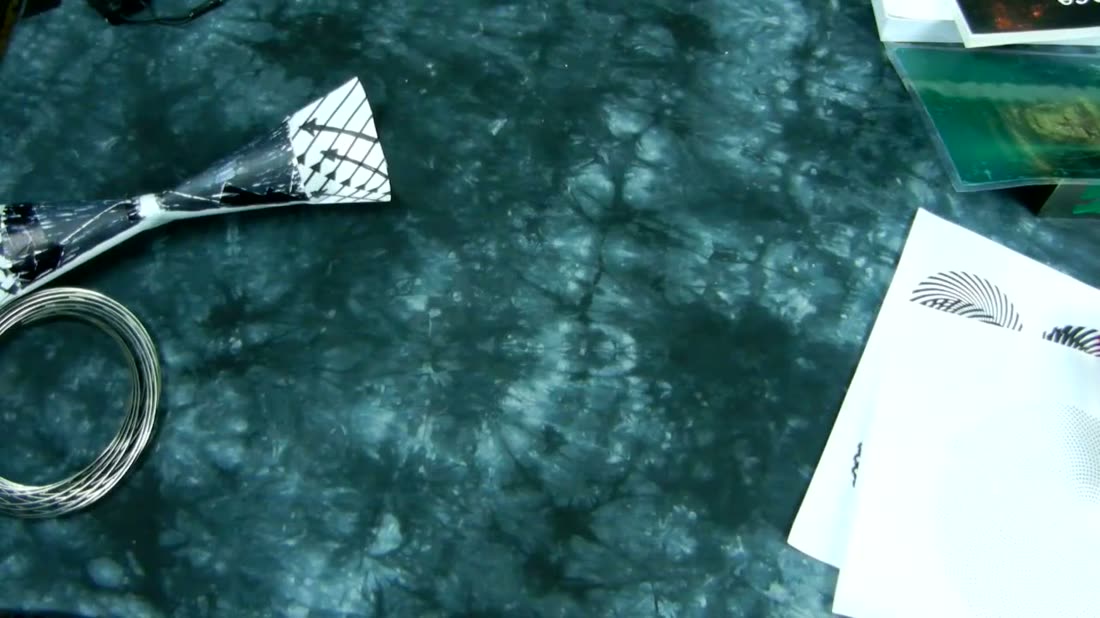
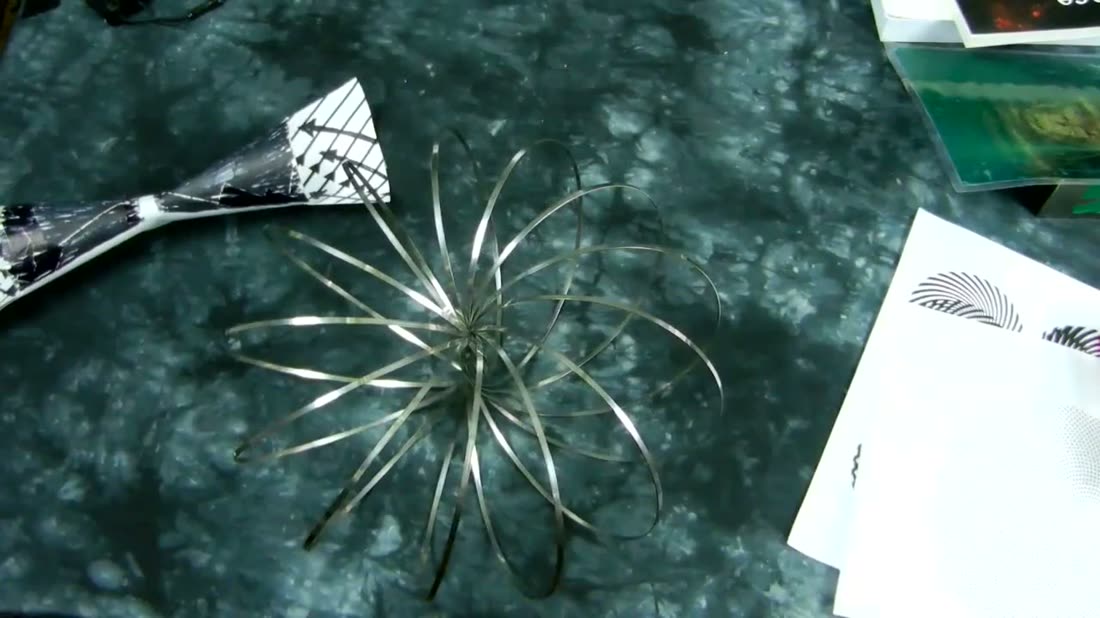
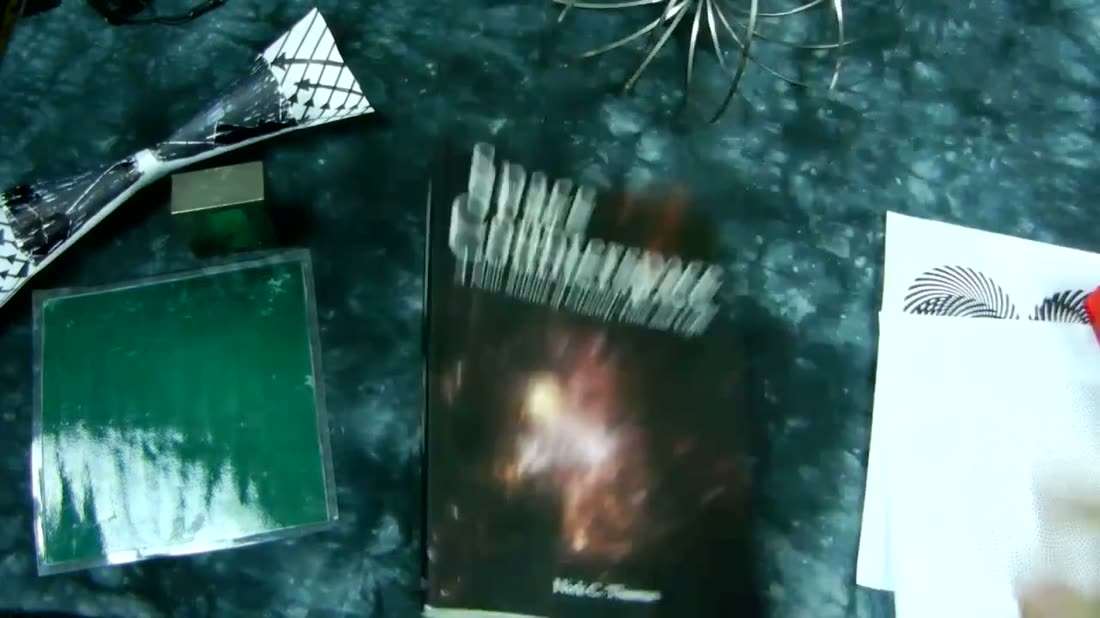
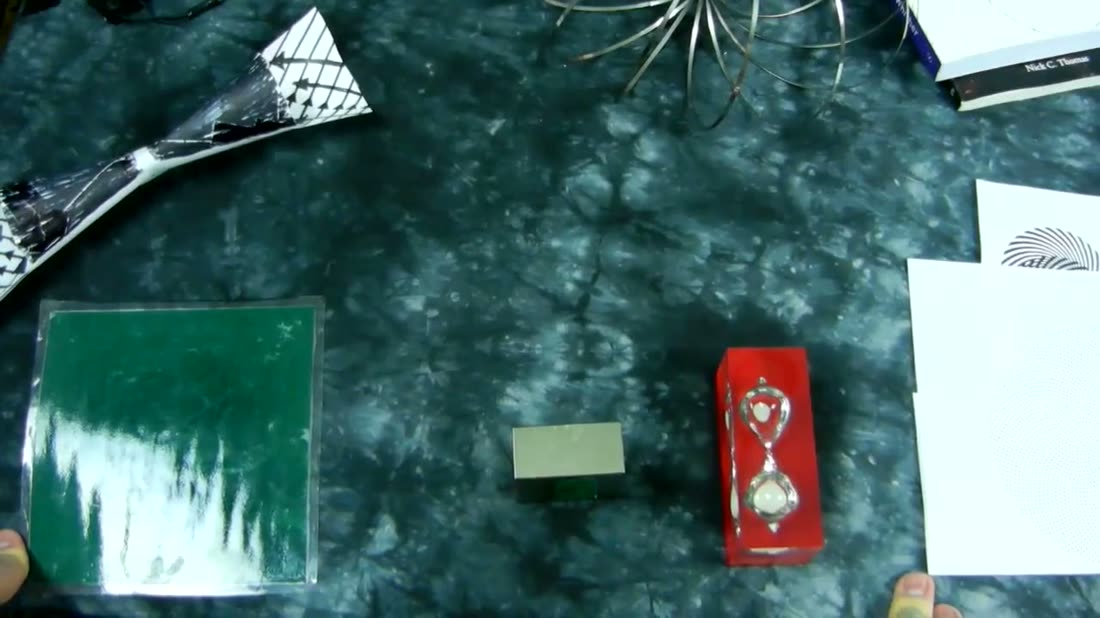
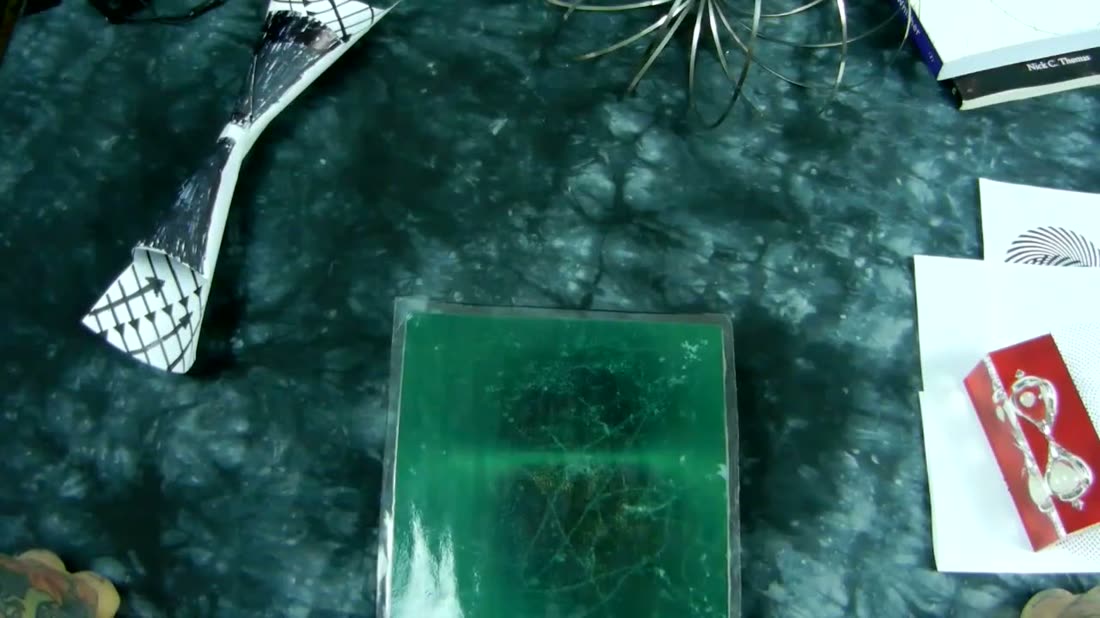
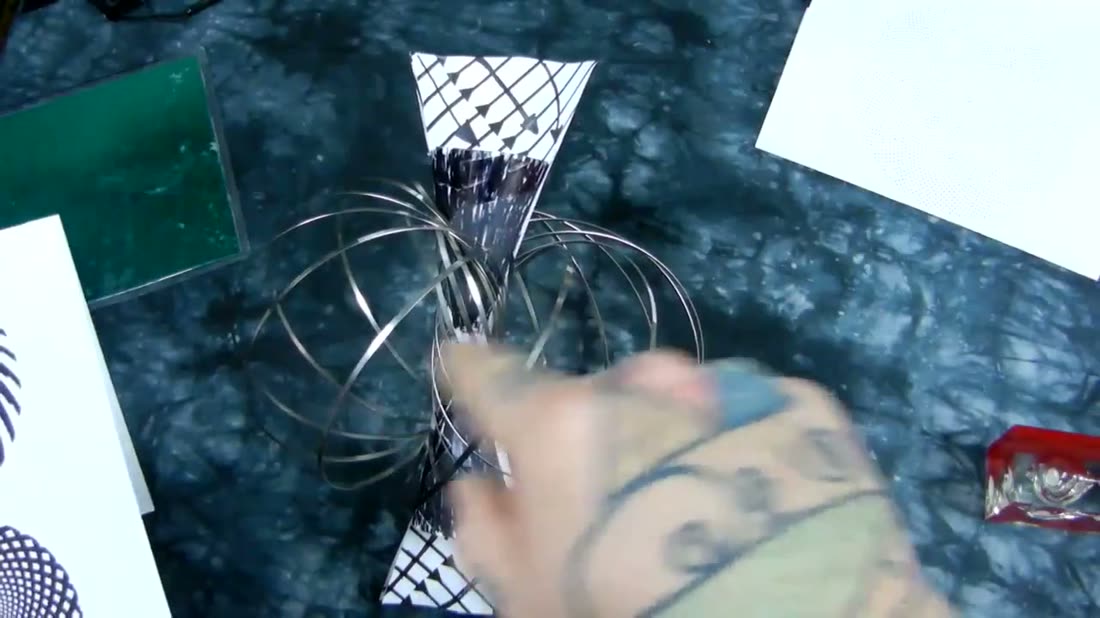
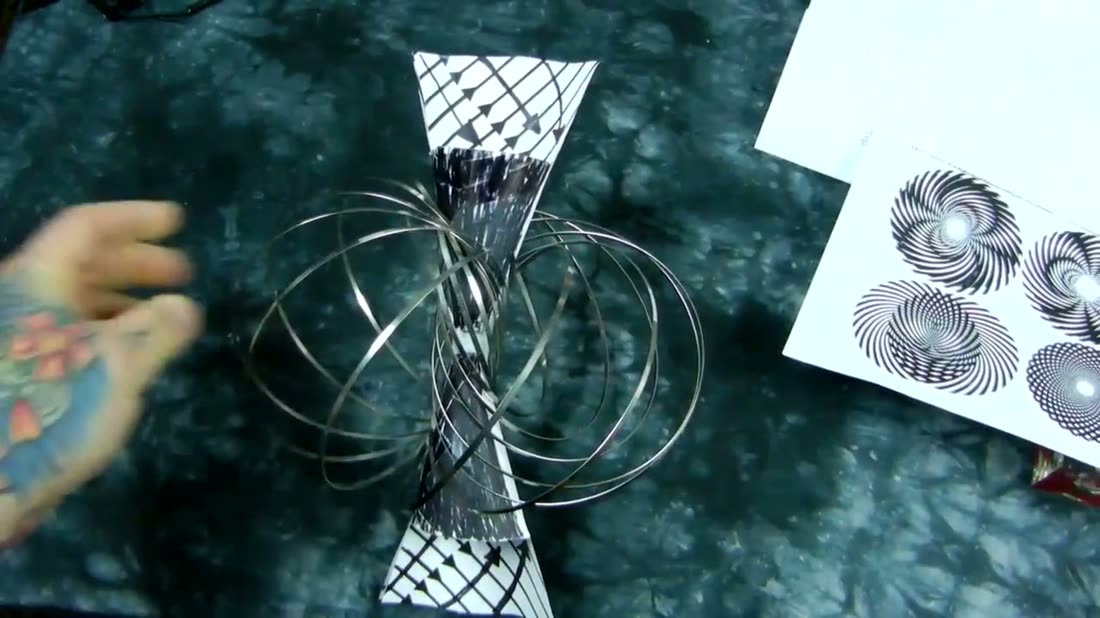
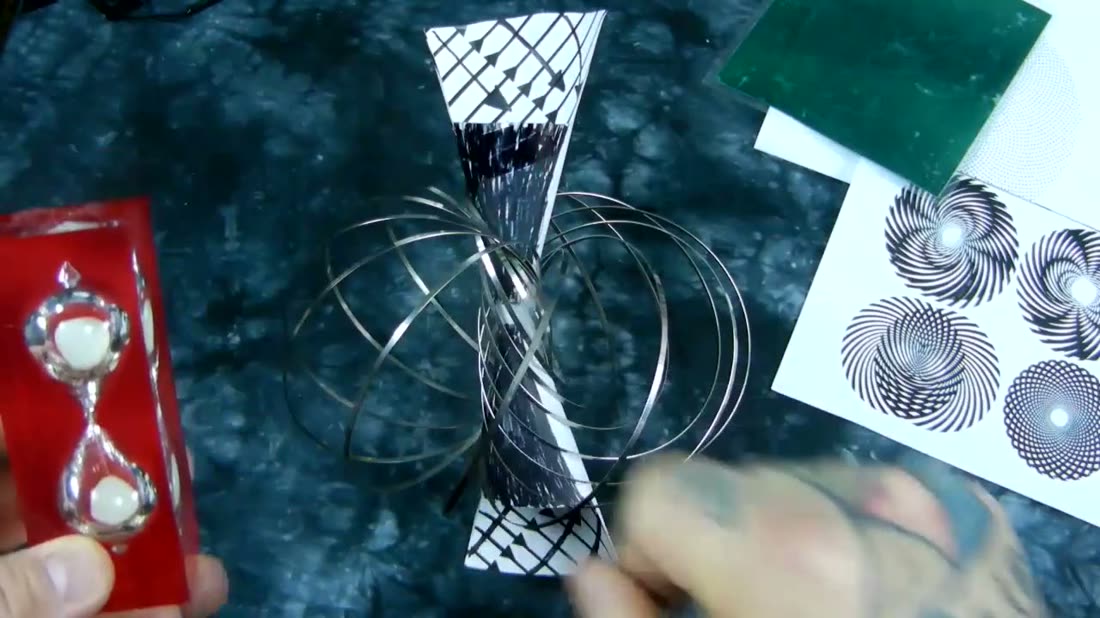
[00:02] His table at minute zero: the wire torus, the hyperboloid mesh, the pattern prints, the books. Every prop in this lecture is already on stage.[00:47] The wire coil pulled open into what he calls the toroidal bloom — the balloon of the visible universe, in steel.
Notice what he's done: before showing you a single magnet, he's moved the ground under your feet — matter is now the guest, fields are the host. Our main Wheeler document unpacks this exact inversion in the Field concept, and his 'you can't quantify a principle' move is retroduction, his signature method — his own name for reasoning backward from an observed effect to the one cause it demands. Everything else in this lecture is him cashing this opening claim.
Register note: His claim, his framing. Mainstream physics also puts fields at the bottom of the stack — but quantum fields, not his magnetism-first version. The overlap is real; the ownership is not.
If someone asks you at dinner, just say: He opens claiming every solid thing you see is a field holding its shape.
Part III · The walk · 2/16 · 01:24–02:30
Nature's only two moves
So if fields are the host, what runs them? His answer is the simplest machine imaginable — nature has exactly two moves — and this is where his favorite instrument makes its entrance.
He tells you he found an equation — years before he ever saw a ferrocell, the field-viewing instrument you're about to meet — built on one conviction: nature is not insane and doesn't carry a calculator. She runs on a single binary. Force and motion on one side; inertia and acceleration on the other. And catch his usage before it trips you: inertia, in his mouth, means rest itself — the stillness things return to — not the textbook's resistance to a push. Everything you will ever see, he claims, is one of those two moves or the trade between them.
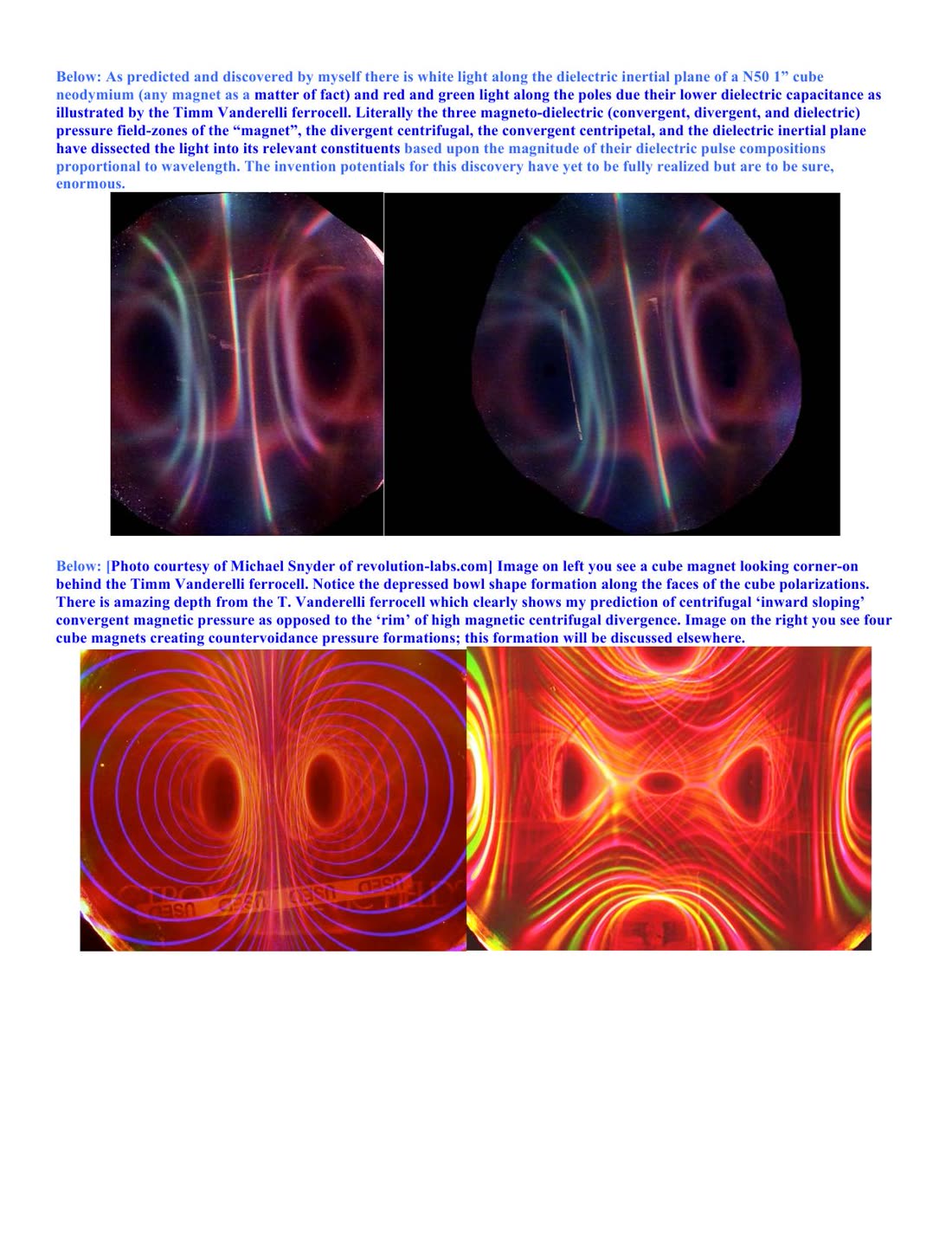
The instrument he mentions, the ferrocell, matters for the whole series: it's a thin cell of ferrofluid — oil with microscopic magnetic grains suspended in it — between glass, lit from the side, that renders a magnet's field as visible light patterns. When he puts a magnet under one, he sees what he calls a spirograph-like toroidal bloom — a donut of light with petals. His claim: that's not a picture of magnetism, that's magnetism, caught in the act.
And then the honest catch, which he says out loud: seeing the torus doesn't mean you understand it. We can photograph the shape at every scale and still not know what a pole is.
His words, straight off the tape:
HIS WORDS — auto-captions, verbatim · 01:24–02:30
So, but what are we talking about a field in principle? Now, long before I ever discovered the invention of the pharaoh cell by my buddy Tim, I uh discovered an equation and I knew that mother nature worked off the premise that mother nature is not insane, for lack of a better term. Mother nature is not a crosseyed hooker on crack. Nor does she have a calculator. She only understands one thing and one thing only. A binary principle of force and motion and inertia acceleration.The captions stumble here — his pairing is 'force-and-motion' versus 'inertia-and-acceleration.' Two teams, two jerseys. Hold that; the whole geometry hangs off it.Force and motion. We have volume. Okay, this is exactly what you'll see underneath the ferro cell. Okay, you'll actually see this spyroraph like toroididal bloom.'Spyroraph toroididal' is the caption mangling 'spirograph-like toroidal' — a donut-shaped light pattern with looping petals, like the toy drawing tool.Okay, obviously. So now we understand magnetism. Well, no, we don't. We know that magnetism is a Taurus at the atomic scale and we can also see it underneath the fereral cell.'Fereral cell' is the captions garbling 'ferrocell' — ferrofluid between glass plates that makes a magnet's field visible as light. It's his microscope for fields.We can even see it to a certain degree so far as the delineation between the north pole and the south pole of this magnet.
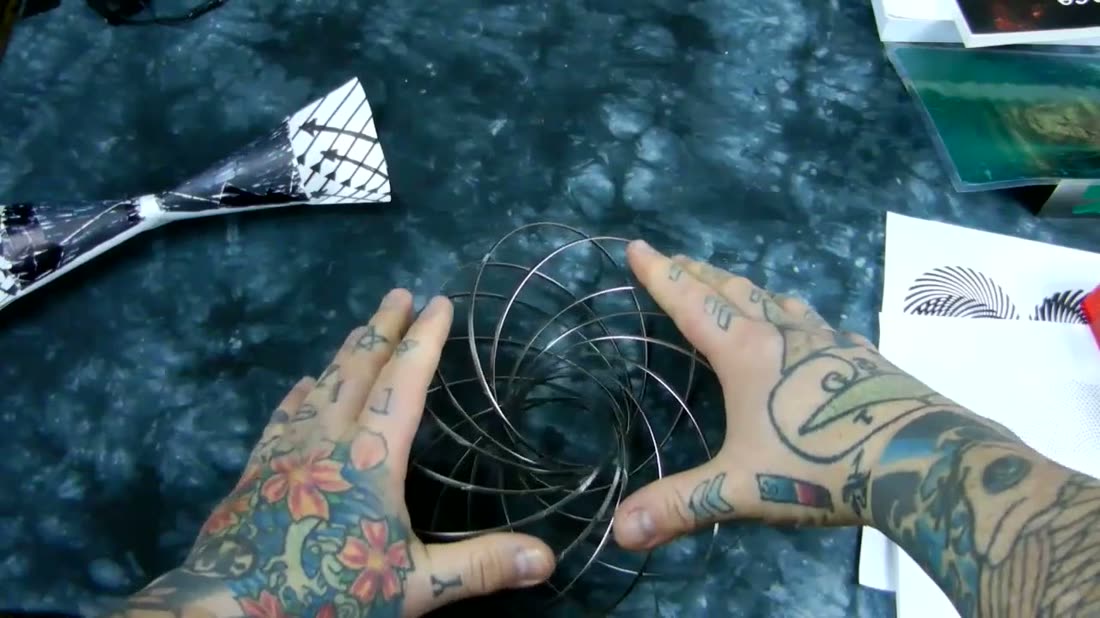
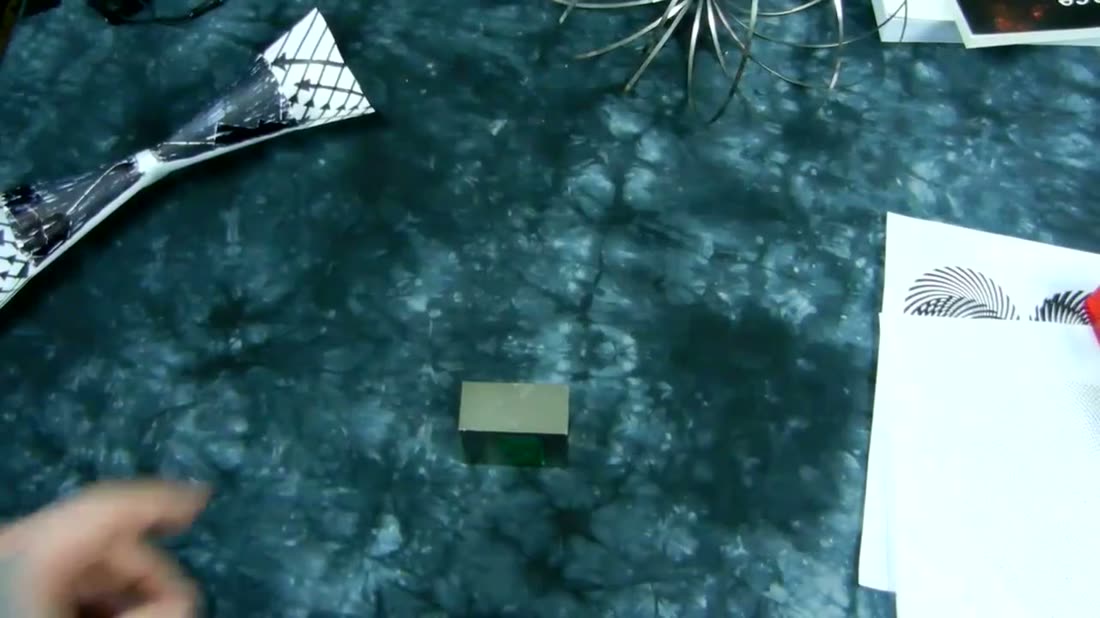
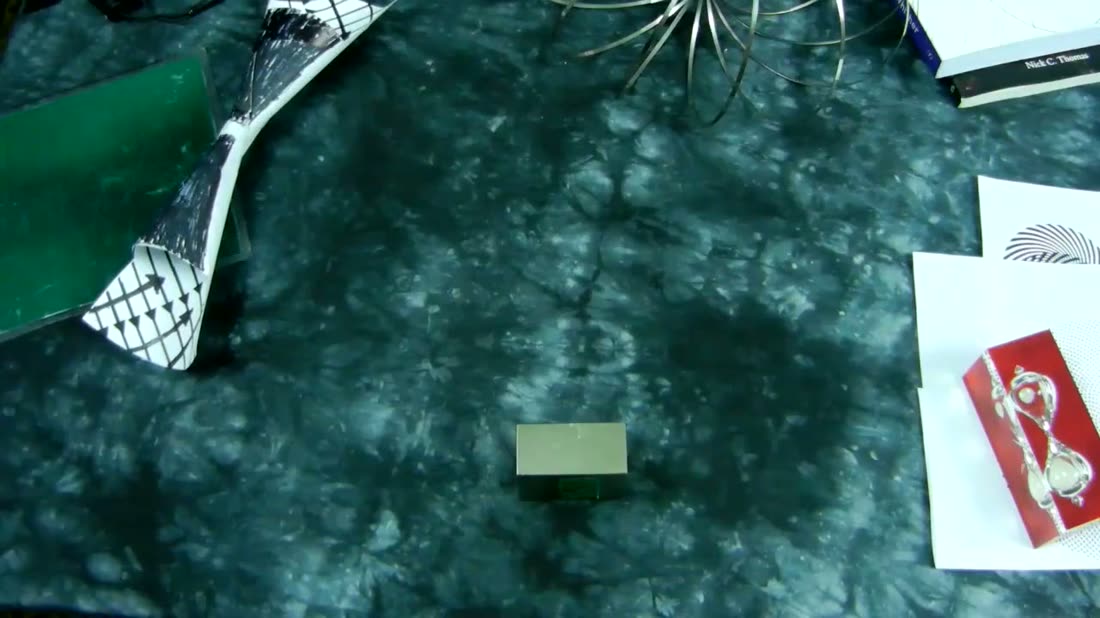
[02:02] The same coil stretched between his hands: one object passing between torus and hourglass — his binary, held.[02:27] The magnet in question — a plain cube, about to be put under glass.
That binary — force-and-motion versus inertia-and-acceleration — is the engine under every claim he'll make for the next eighteen minutes. Our main document covers the instrument itself under Ferrocell, including what mainstream optics says those light patterns actually trace. He's about to point at a real magnet and find the border between the two teams.
Register note: The 'equation' is asserted, never written out in this lecture. The ferrocell pattern is real and photographable; what it proves is the contested part — mainstream optics reads it as light through stressed ferrofluid, not a portrait of the field itself.
If someone asks you at dinner, just say: His whole physics is one binary: force-and-motion versus inertia-and-acceleration. Nothing else.
Part III · The walk · 3/16 · 02:30–02:56
The white line in the middle
Now he picks up an actual magnet and points at the thing this entire lecture is named after — a thin white line across its waist.
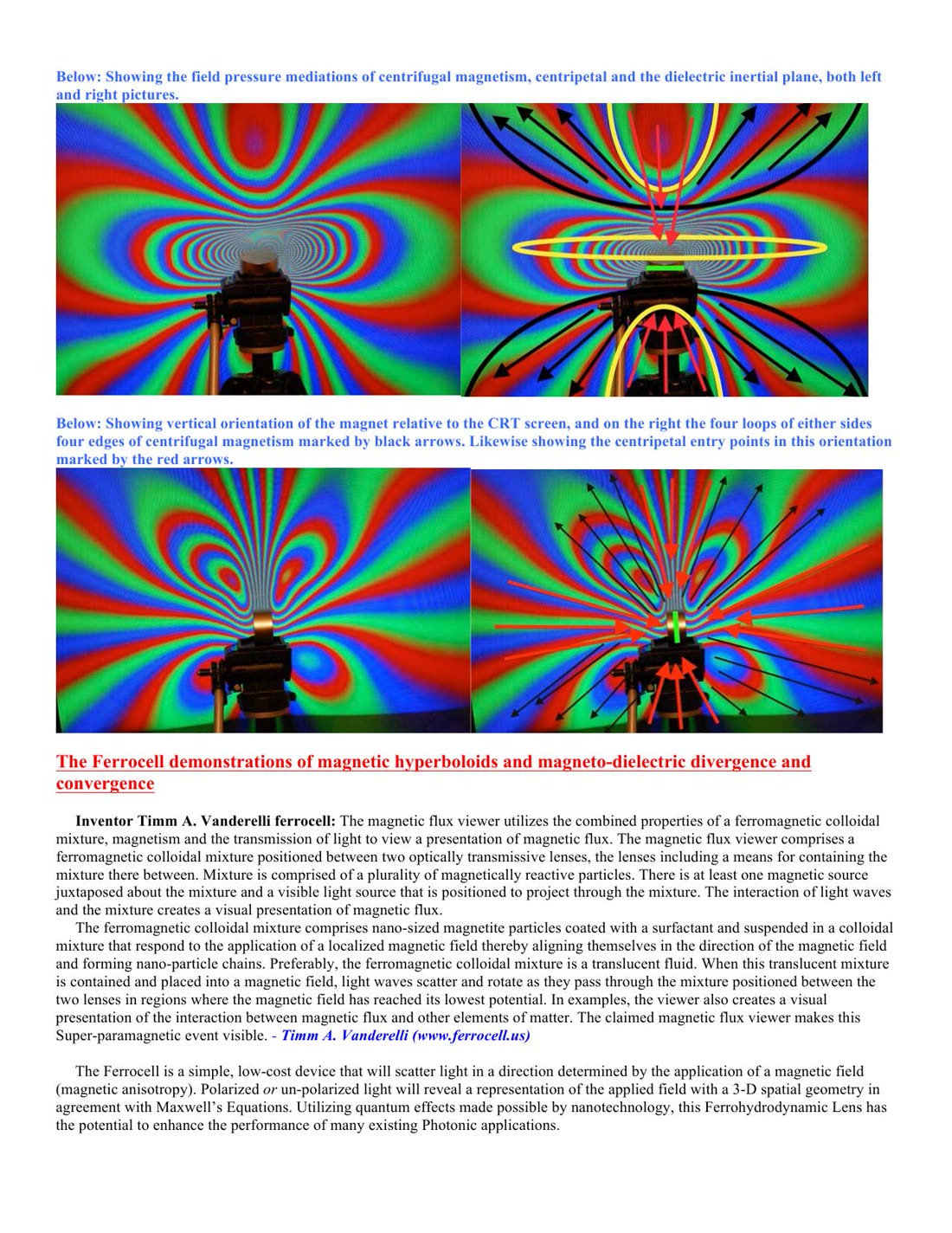
Hold a magnet under a ferrocell and there's a bright dividing line across the middle, between the two poles. Everyone else calls that the boundary between north and south. He calls it the main character.
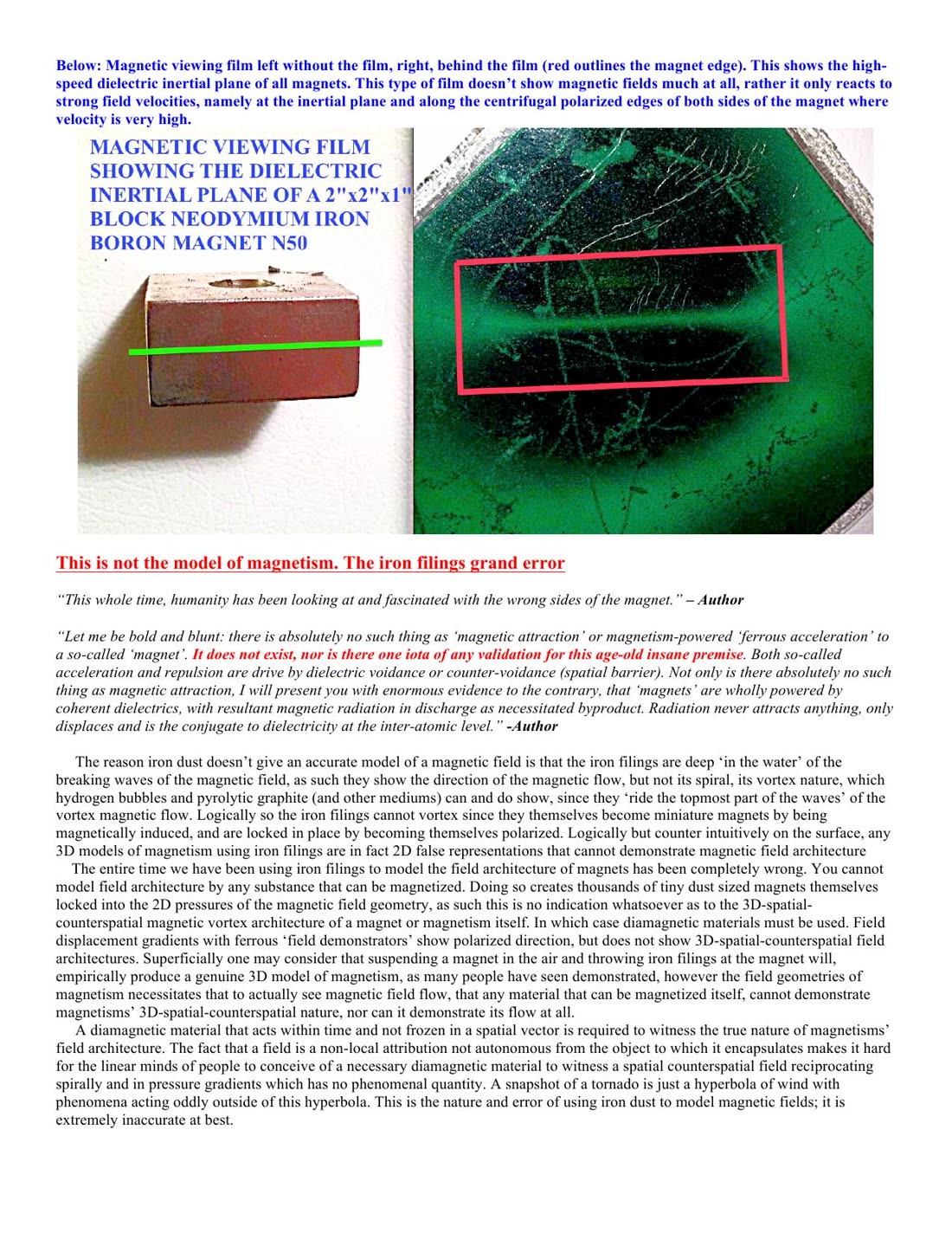
That line, he says, is the plane of inertia — the plane of rest. A flat sheet through the magnet's equator where, on his account, there is no magnetism at all. Zero. And in the same breath he drops the line that sounds like pure provocation: a magnet doesn't have polarity. The poles you've been taught to name are, to him, effects. The still plane in the middle is the cause.
He grants immediately that this is hard to talk about — it's 'metaphenomenal,' beyond the phenomena — because you're trying to define the still point by the motion around it.
Off the tape:
HIS WORDS — auto-captions, verbatim · 02:30–02:56
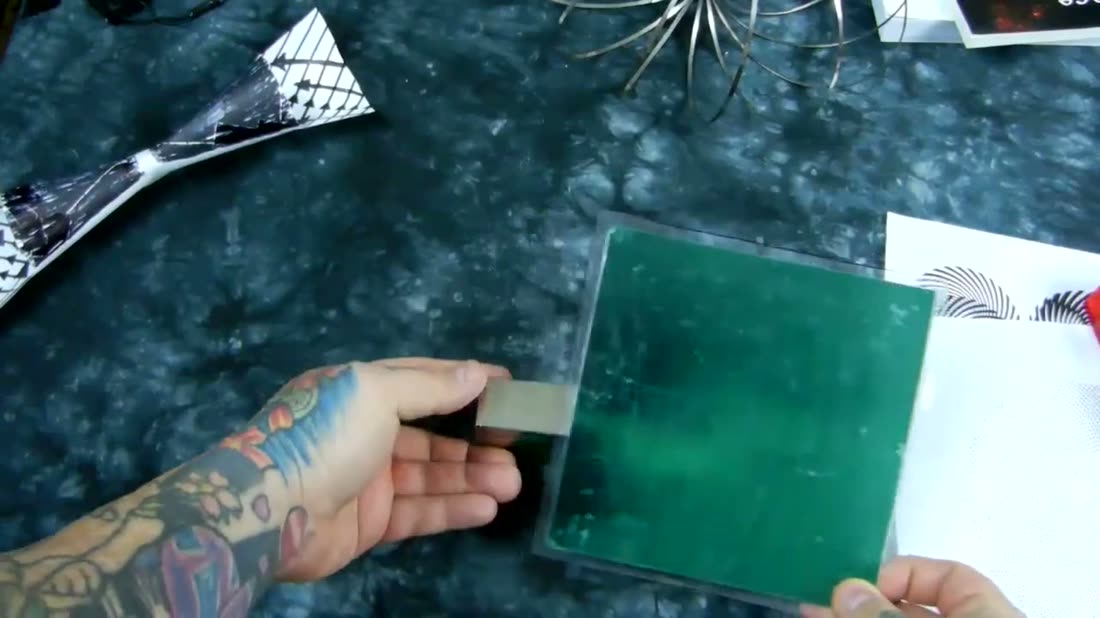
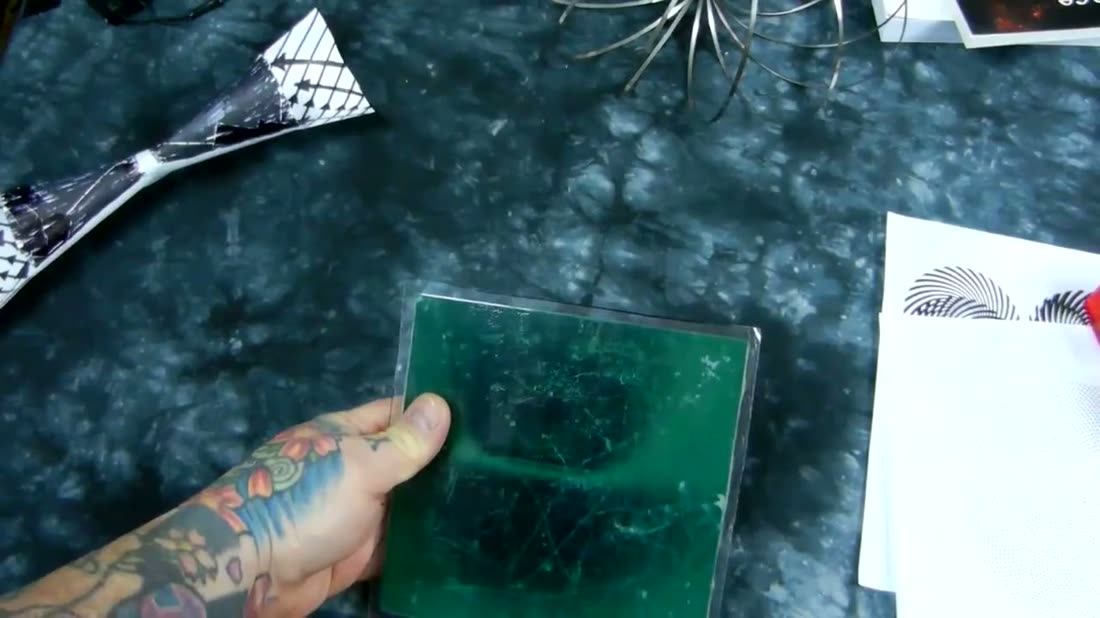
Now, a magnet doesn't have polarity. Well, that's kind of hard to explain, isn't it?He means poles aren't fundamental — they're what the geometry does at its ends. The quiet middle is, for him, the real magnet.Here you can see the dividing line of any and every magnet right there in the middle. That white little line. Here we have the north pole. Here we have the south pole. Here we have the plane of inertia, theThe plane of inertia: a zero-magnetism sheet across the magnet's waist. In his system it's team two — pure inertia — showing through.plane of rest. Okay. Now, it's always hard to give definition to what is metukitian or metaphenomenal.
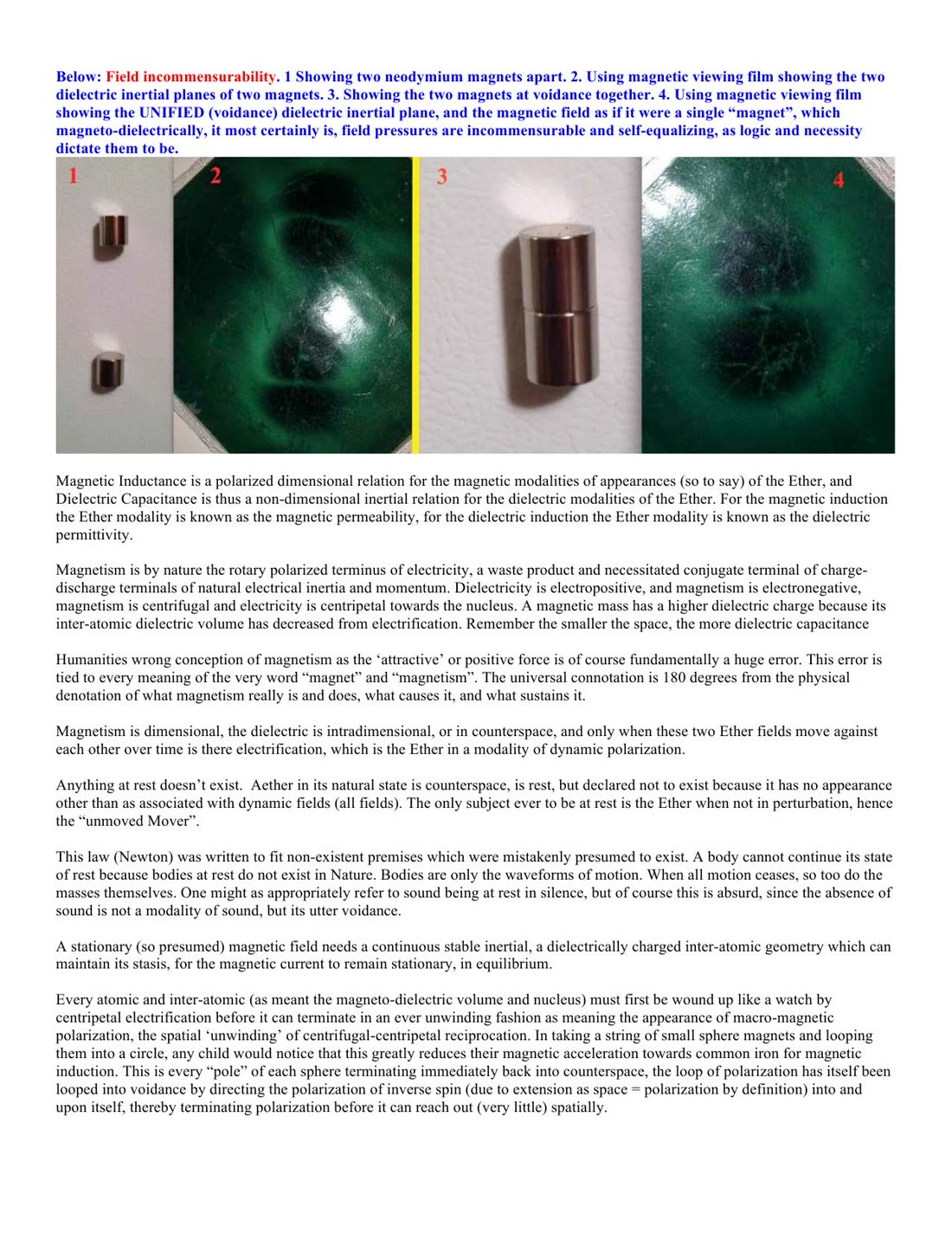
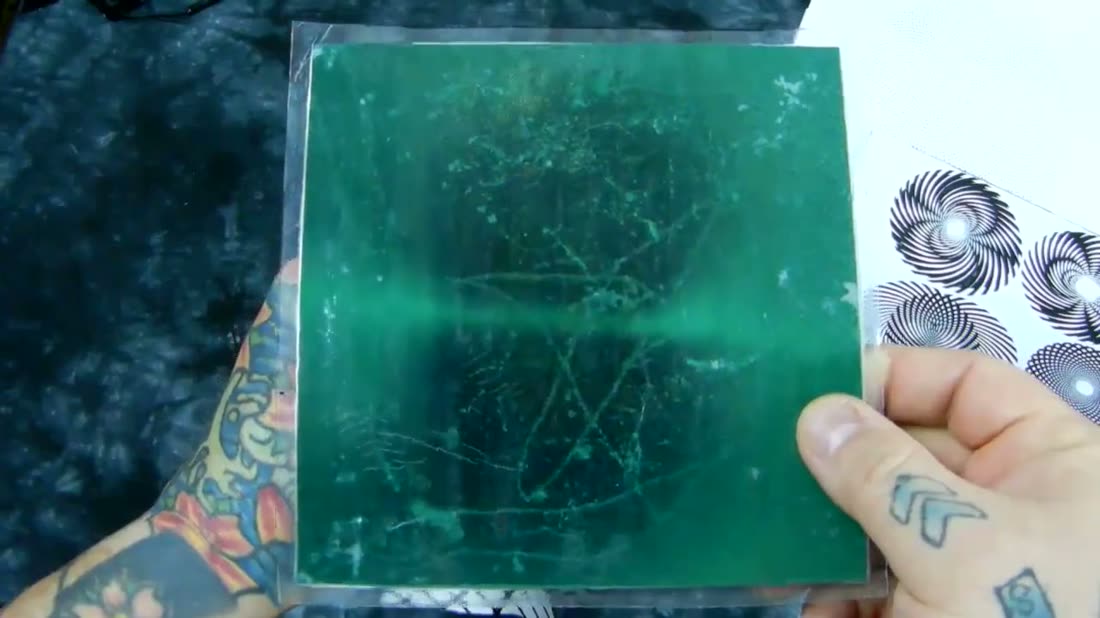
[02:37] The magnet meets the ferrocell: ferrofluid between glass, about to render the field as light.[02:47] The ferrocell held to camera — field lines swirling around the dark mid-line he calls the plane of inertia.[book, p. 25] From his book: a neodymium block magnet photographed beside its labeled mid-plane — the white line, annotated. source ↗[book, p. 173] Book plate: ferrocell photos of an N50 cube with white light pooling along the dielectric inertial plane. source ↗
Remember the two teams from a minute ago? He's just claimed you can see their border on any magnet: field in motion above and below, pure rest in the plane between. Our main document treats this as the Plane of Inertia concept — and everything from here to the end of the lecture is him building the geometry that makes that line necessary rather than incidental.
Register note: That a field-free mid-plane appears in ferrocell imagery is observable. 'A magnet has no polarity' is his re-description of standard geometry — the mid-plane between poles is textbook too; the metaphysical promotion of it is his.
If someone asks you at dinner, just say: The white line across a magnet's middle is, he says, the real magnet — the poles are side effects.
Part III · The walk · 4/16 · 02:56–04:10
Geometry before geometry
To explain a line that isn't really a line, he reaches back two and a half millennia — and throws two textbooks at the camera on the way.
His claim here: the Greeks — he names Euclid — knew there was a geometry before geometry. Before you can draw anything, you need a point. And a point, he insists, is a human abstraction. Nobody has ever produced one. Same for a line. In his field geometry there is only what he calls a point-line: it takes a line to make a point and a point to make a line — neither exists alone.
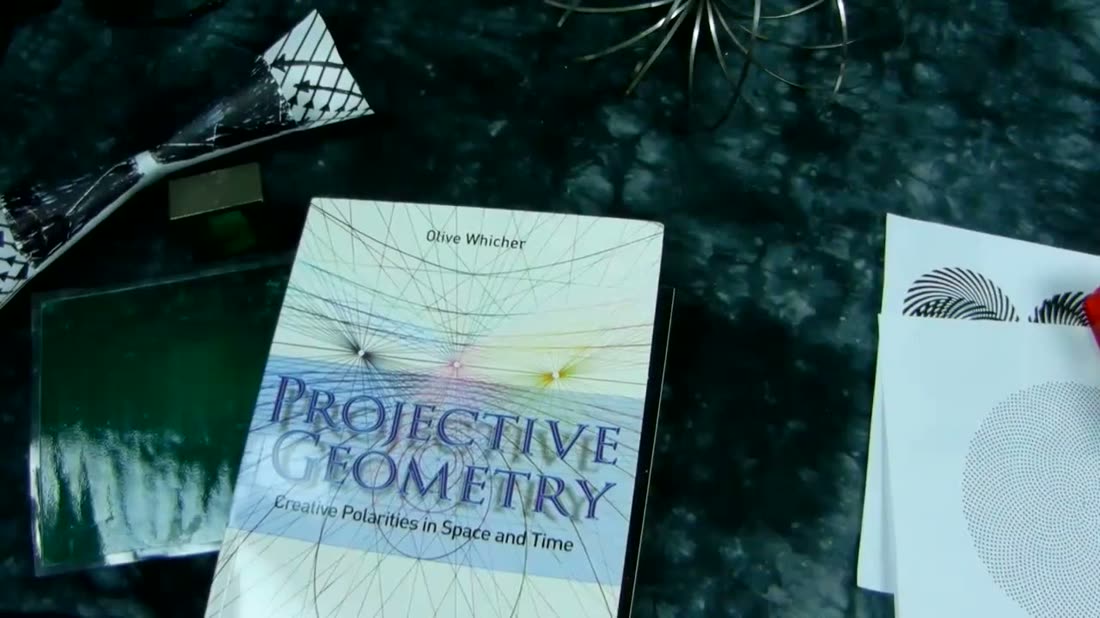
Mid-argument he holds up two books with visible contempt and affection at once: one on counterspace — the geometers' name for an inside-out domain you reach through a point rather than travel across — 'not really a great book, nobody understands counterspace' — and a huge one on projective geometry, the branch of math where parallel lines meet and where what's infinitely far away can be treated as a place. Those two subjects are the water this whole lecture swims in.
Then he sets the trap the next four sections will spring: fine, you say a magnet has a north pole and a south pole. Define pole. Not describe — define. He's about to argue nobody ever has.
His own words:
HIS WORDS — auto-captions, verbatim · 02:56–04:10
And then we're talking about a principle that even the Greeks understood and even Uklid pointed out the geometry that existed before geometry.'Uklid' is the captions garbling Euclid. The 'geometry before geometry' is his gloss: relationships that exist prior to any drawn point or line.So what are we referring to? Not really a great book. Nobody understands counterpace. Nobody understands inertia. Projective geometry. Same thing. Huge [Applause] book. So what are we talking about? Before any geometric could be made, we first have to start with a point. But a point is a human abstraction. Say, well, that's a point. No, there's no such thing as a point. We're talking about field geometry. We're talking about loss of inertia. There is only a point line. There's no such thing as a line or a point. Takes a line to make a point and it takes a point to make a line.His 'point-line': neither is real alone; each only exists as the other's limit. Dots and rulers are bookkeeping, not nature.We're speaking about cartisian coordinates two-dimensionally or threedimensionally. There's no such thing from the premise of field theory as a point or a line. and there's only a point line.So Cartesian coordinates — the x-y grid from school — are, to him, a filing system laid over a universe that never uses one.Then we have to get into the definition of what defines polarity. What do we mean by a pole? Well, a magnet has a north pole and a south pole. Well, no, it doesn't. What do you mean? Of course, we know a magnet has a north pole and a south pole. Now, we have to dig a little bit deeper intellectually.
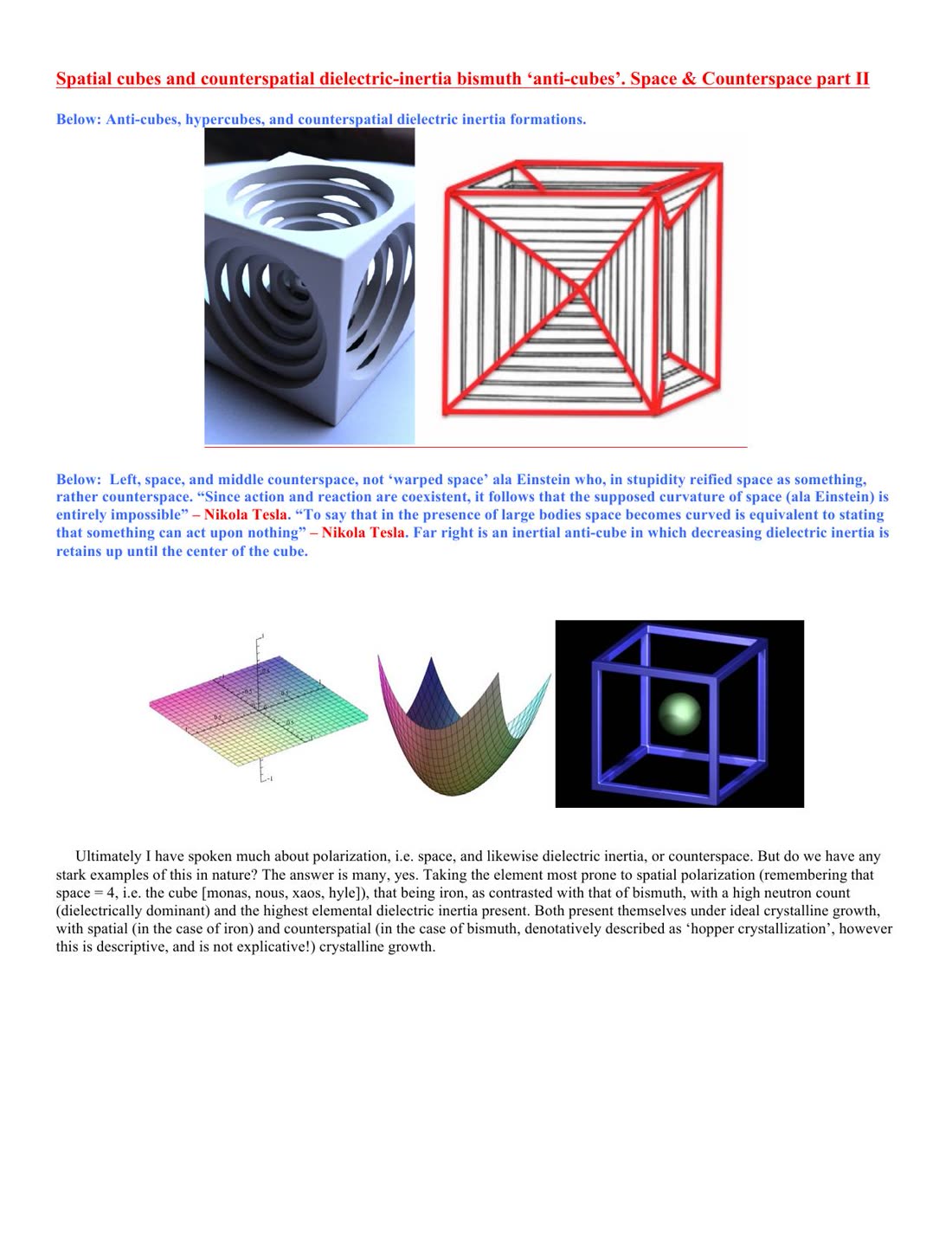
[03:07] Exhibit one: 'Space and Counterspace' — the book he waves while saying nobody understands counterspace.[03:22] Exhibit two: Whicher's 'Projective Geometry' — the 'huge book' behind his geometry-before-geometry claim.[book, p. 103] Book plate: a spatial iron cube beside its red-wireframe 'anti-cube' — his picture of space versus counterspace. source ↗
This is the lecture's method section: he's disqualifying the vocabulary — points, lines, poles — before offering his own. It's via negativa, the elimination-first reasoning our main document covers under Retroduction. And the two books aren't props by accident: counterspace and projective geometry are exactly the mathematics his hourglass is about to smuggle in.
Register note: That points and lines are abstractions is respectable philosophy of math. Projective geometry is real mathematics; his use of it is interpretive, not derivational — no theorem gets proved in this lecture.
If someone asks you at dinner, just say: He says points and lines are human inventions — nature only draws with both at once.
Part III · The walk · 5/16 · 04:10–04:55
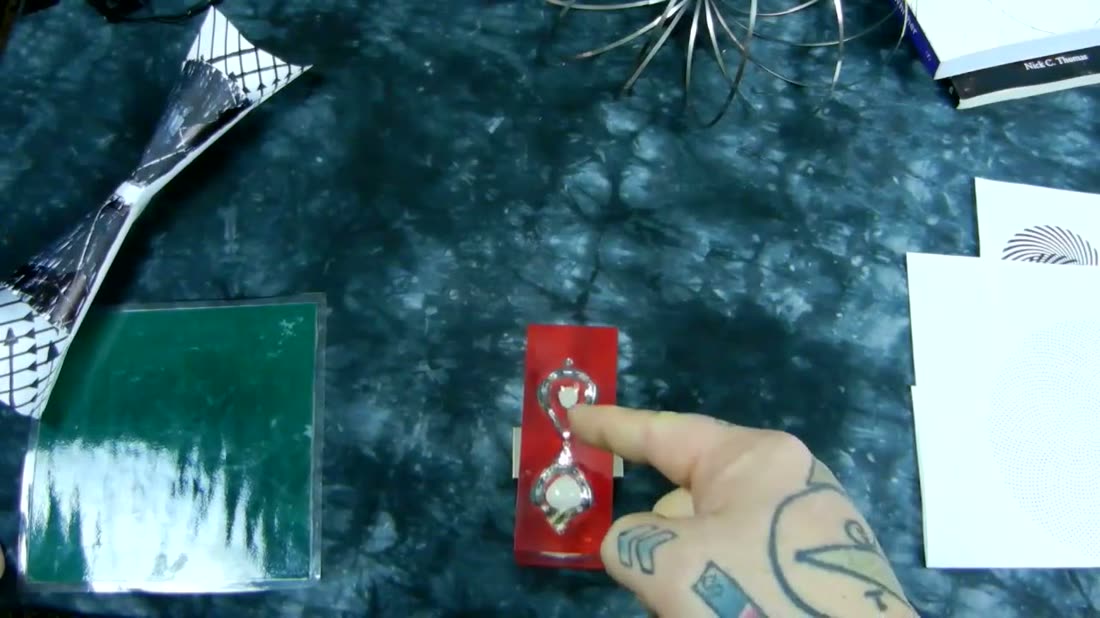
The hourglass
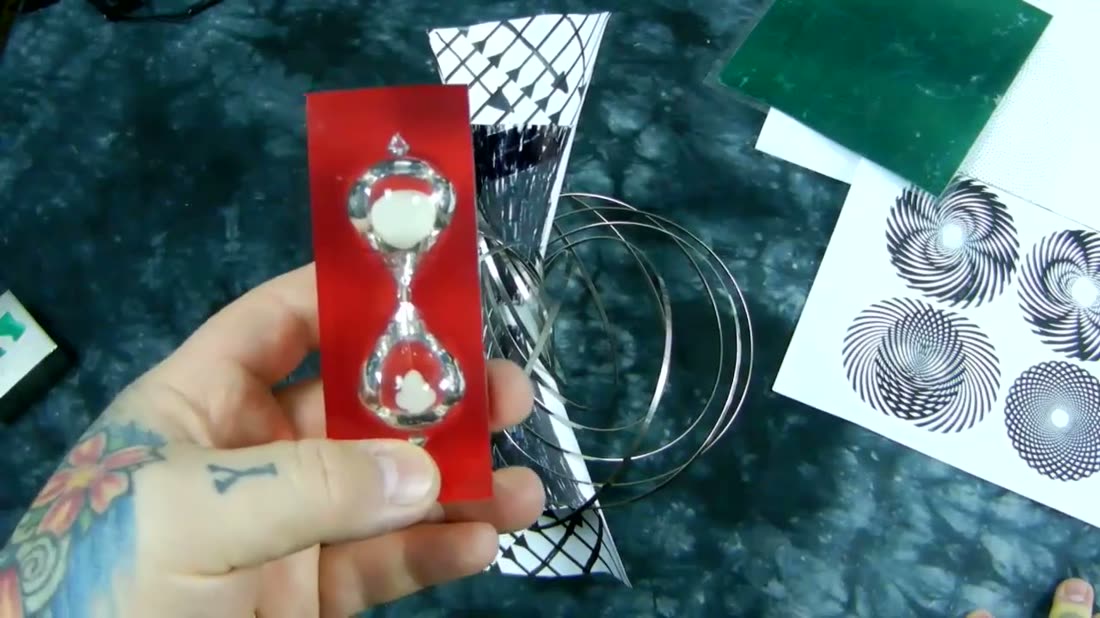
He's just told you that points, lines, and poles are abstractions with nothing under them — so he reaches for the one household object whose middle really is a working nothing: an ordinary hourglass. Best teaching prop in the lecture; steal it for dinner parties.
He picks up an hourglass and makes one observation that carries the next fifteen minutes. Look at where things happen: sand falls in the top bulb, sand piles in the bottom bulb. Time, on his reading, lives in the bulbs. But right at the waist — the pinch where the glass narrows to almost nothing — there is no falling and no piling. No force, no motion. If you shrank that waist to an infinitely small point, you'd have a place where, on his reading, time doesn't pass at all.
Why does he need this? Because humans, he says — kindly, for once — only understand things through structural models they can walk around in their heads. The hourglass is his structural model for the magnet: two active bulbs, one still waist. Hold the shape; he's about to rename every part of it.
What you're seeing: The hourglass, animated — watch what happens at the waist.
From the tape:
HIS WORDS — auto-captions, verbatim · 04:10–04:55
What we're looking at is something just like this. Okay. Now, an hourglass is a re really neat little analogy and a visual model since human beings only understand things if you give them conceptual structural models to base their comprehension around and then they're able to work their way back and deduce or abduce the nature of what something is. Just as an hourglass, we only have time in either bulb right here in the center. We have no time.The captions run two thoughts together: time passes in each bulb; at the center pinch, nothing moves — so for him, no time there at all.We have no force, no motion. If we were to think of this as an infinitely small point of inertia, point once again being a human abstraction, itHe keeps flagging his own props: even the 'point' at the waist is a stand-in. What's real, he'll say, is the stillness it marks.means nothing. We have the exact same thing here.
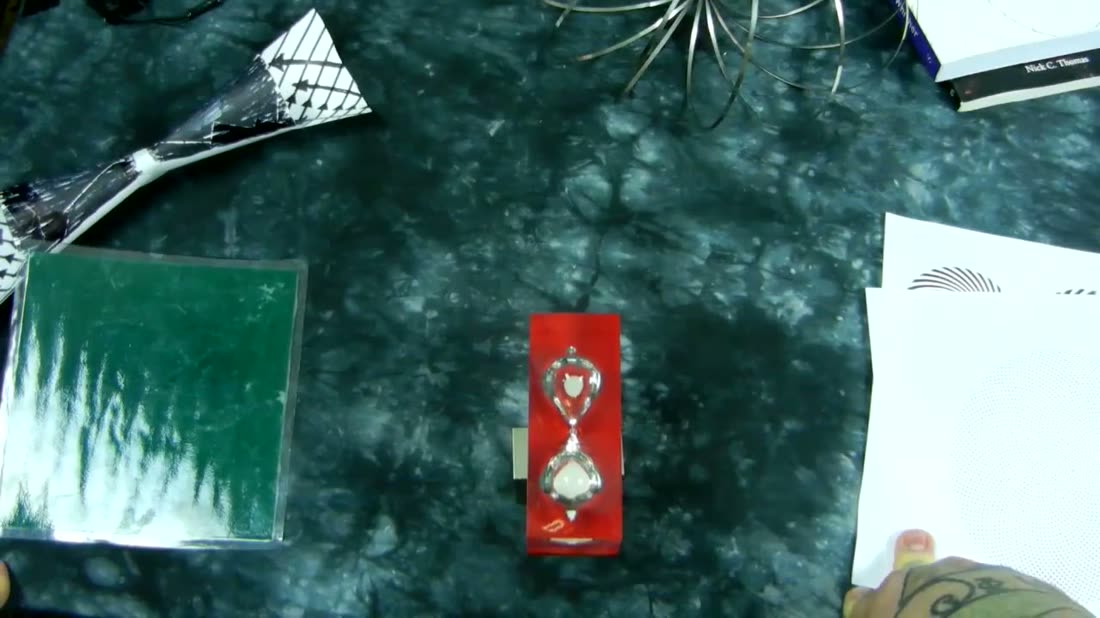
[04:17] The best prop in the lecture: an ordinary hourglass. Time in the bulbs, nothing at the waist.[book, p. 43] The hourglass, formalized: his double-cone diagram of magnetic versus dielectric pressure zones. source ↗
Map it back: the bulbs are force-and-motion — team one. The waist is inertia — team two. And the white line on the magnet from two sections ago? That's the waist. One prop, and his whole binary suddenly has a shape. Next he has to tell you what surrounds the hourglass — and that's where he picks his biggest fight, with space itself.
Register note: The hourglass is an analogy, offered as one. The claim it carries — that a magnet's mid-plane is a genuinely timeless, motionless region — is his metaphysics, not a measurement.
If someone asks you at dinner, just say: His hourglass: time lives in the bulbs, and the pinch in the middle sits outside time.
Part III · The walk · 6/16 · 04:55–06:48
Space is a shadow
Before he can put a shape around the hourglass, he has to demolish what you think surrounds everything — and he does it with a snake that was never there.
His claim: space is nothing. Not nearly nothing — nothing. Space, he says, is the absence of inertia, the way a shadow is the absence of light. And no field ever terminates in space, because there's nothing there to terminate in.
To make 'nothing acting like something' feel real, he reaches for an old Indian philosophy classic: the rope and the snake. In ancient India a snakebite was a death sentence, so everyone walked in fear of them. A man sees a rope in the dusk, takes it for a snake, and drops dead of fright. What killed him? A snake that never existed. The rope-snake became the standard example of the unreal having real effects — and that, Wheeler says, is exactly the job 'space' does in modern physics. His second image is harsher: someone naked, cold, and wet freezes to death 'in a shadow.' The shadow didn't kill them. You cannot reify an absence — cannot make a thing out of a lack. Philosophers have a word for such a lack — a privation — and it's the word his own summary reaches for.
So when Einstein curves spacetime, Wheeler hears someone bending a shadow. And he claims Tesla heard it the same way — calling the idea that space has properties which act on matter ludicrous.
Here's the whole passage — it's the most quotable stretch of the lecture:
HIS WORDS — auto-captions, verbatim · 04:55–06:48
Now we're going to have to define space and counterpace. No field is ever terminated in space. Space is nothing. Space is the absence of inertia.This is the thesis of the section: space isn't a container, it's a lack — like a shadow or a hole. Everything else here is illustration.You cannot give reification to something that doesn't exist. The ancient Indians and Greeks understood this perfectly. At least the philosophers did. The Indians would love to talk about the ropes snake analogy back then. If you got bit by a snake, you know, you got no cure. You're going to die. You're going to suffer and then you're going to die. And so, everybody was scared to death when they went out to the bushes to take a dump or a piss that they were going to get bit by a snake because you're going to die. And then they would talk about someone seeing a piece of rope in the dark or the dusk, mistaking that for a snake and an old man having a heart attack or being scared to death, being scared to death or even dying. Well, why did the person die? Well, he saw a ropes snake. The ropes analogy is really famous in u Indian philosophical context for talking about that which does not exist affecting something else.The rope-snake: the unreal can still kill you, if you believe in it. His charge is that physics believes in its rope-snake — space.But what we're talking about is a privation. Okay? Space is nothing. It is literally the absence of inertia. Like saying someone that's naked, cold, and wet is in a shadow. They're going to freeze to death because they were in the shadow. It's like what killed them? Well, the shadow killed them. They were naked, cold, and wet. Well, shadow is not anything. We cannot reify absence.'Reify' means treating an absence as a thing. His rule: shadows, holes, and — he claims — space can be talked about, but never assigned powers.Okay, nobody can logically, intelligently, philosophically, and in a formal debate reify absence. Okay, it's not possible. We can't say that something that didn't didn't exist killed somebody. It's like saying that unicorns or pixie dust, you know, caused someone to vanish or, you know, fall off a cliff. I mean, is equally absurd. So, we can't speak about space as properties. And Tesla said this as well. He called Einstein's notion that space is having properties that does something or act on anything is ludicrous.Tesla did mock curved space in a 1932 New York Herald Tribune piece. Wheeler is quoting a real position — from before the modern evidence for general relativity arrived.And of course Tesla was right.
[05:07] The whole argument on one table: magnet, hourglass, ferrocell — matter, model, and instrument.[book, p. 181] Book plate: space-and-time (top bulb) against counterspace (bottom bulb) — the metaphysics drawn as an hourglass. source ↗
See the move: if space is an absence, then anything physics attributes to space — curvature, expansion, fields living 'in' it — must belong to something else. His candidate — named everywhere else in his corpus, though notably not tonight — is the ether; the still waist of the hourglass is where, on his map, the absence is total. Our main document types this claim honestly: gravitational lensing and GPS clock corrections are real measurements his shadow-story has to re-explain one by one. He never does so in this lecture — flag it and file it.
Register note: Typed claim: 'space has no properties' collides with tested general relativity predictions — a testable difference, and the tests have gone against him so far. The rope-snake logic is genuinely ancient (Advaita Vedanta); his application of it to spacetime is his own.
If someone asks you at dinner, just say: His line: you can't blame a shadow for a death, and you can't give empty space superpowers.
Part III · The walk · 7/16 · 06:48–07:52
Enter the hyperboloid
Now the hourglass gets its real name — and in the same breath, gravity gets fired.
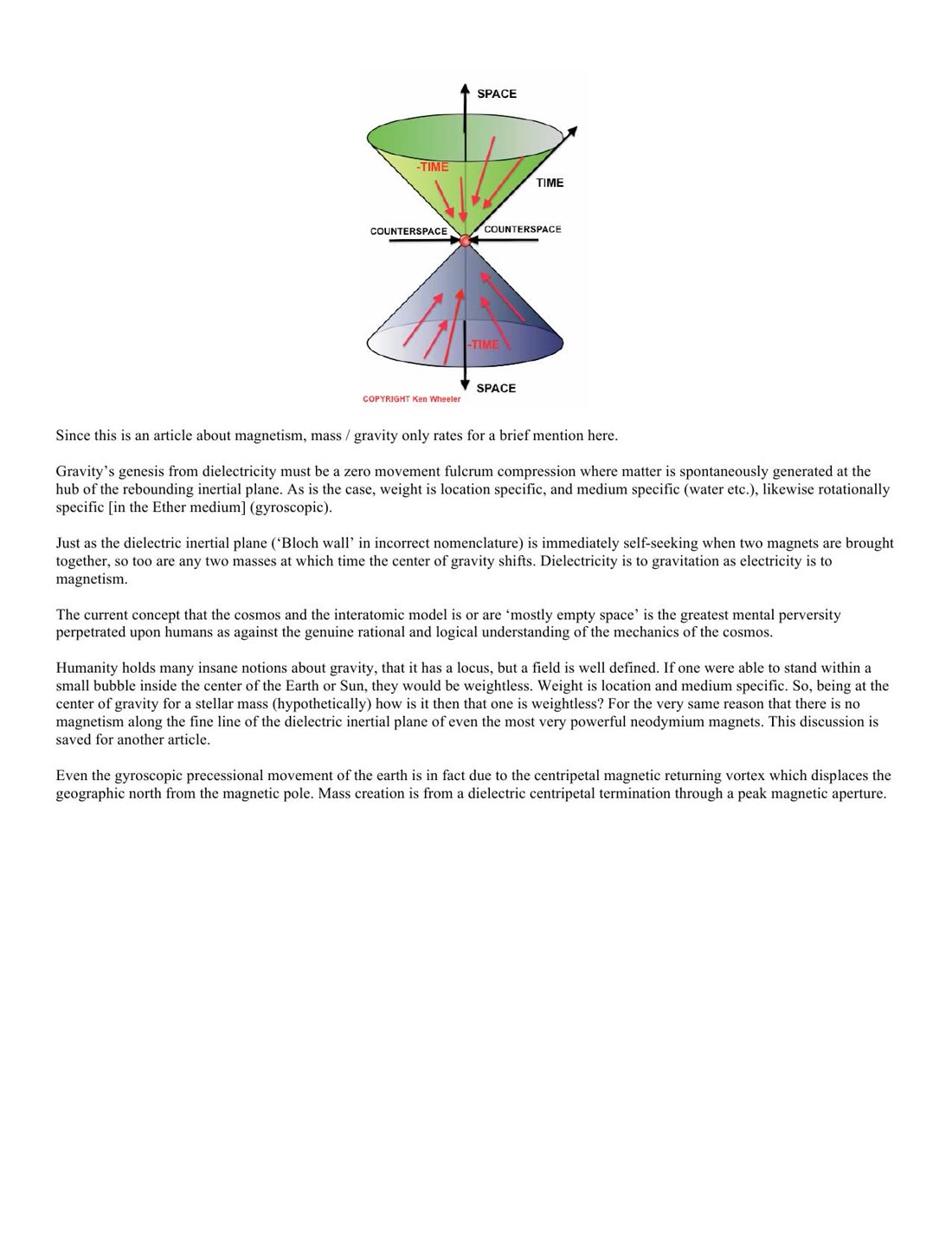
The shape he's been miming all lecture is the hyperboloid: a smooth hourglass-of-revolution, two flaring horns meeting at a narrow throat. Outside the throat, he says, you have space, time, force, and motion. At the throat's center: the null point of inertia — nothing at all, in the most loaded sense he can give the word.
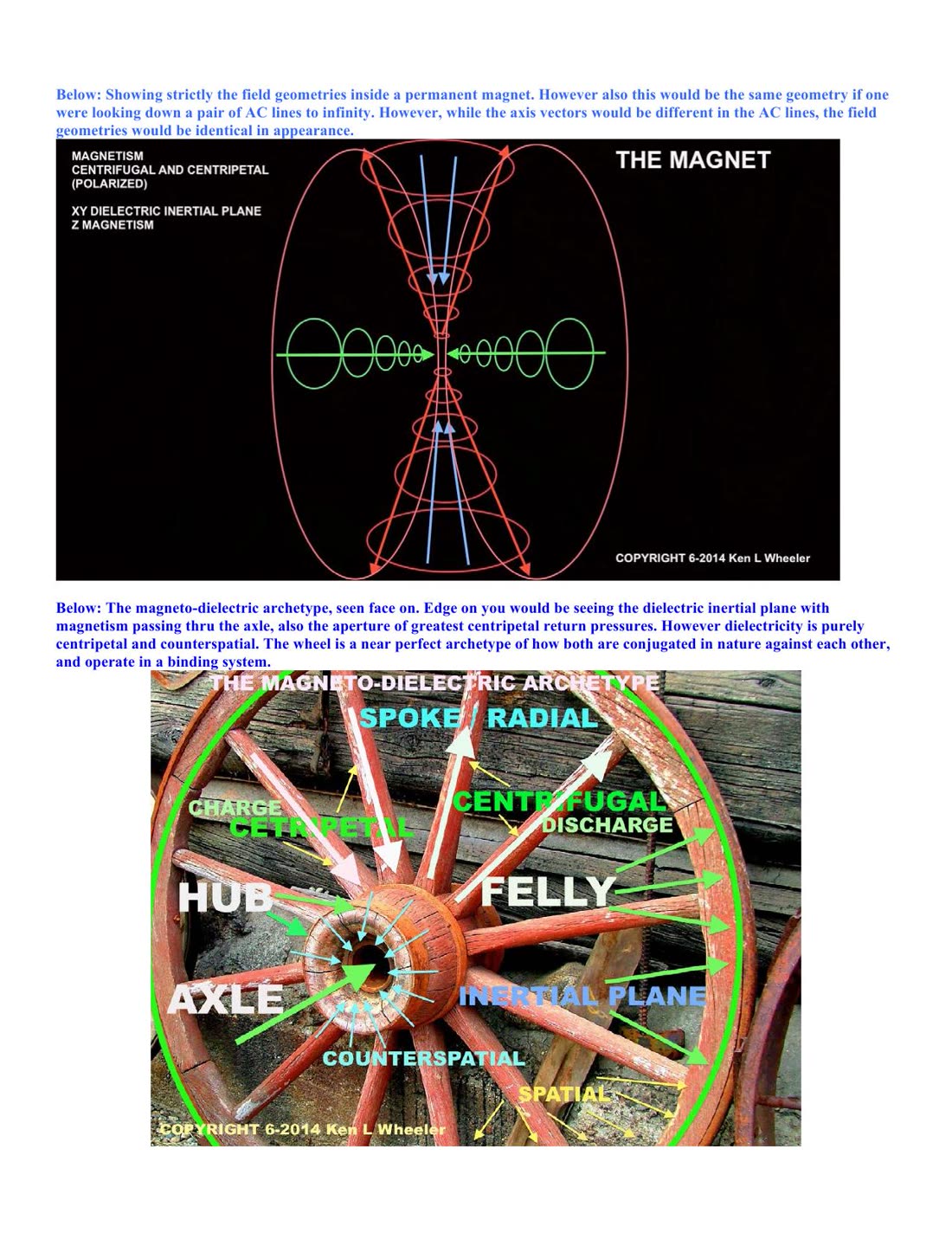
Then he maps it onto the magnet directly. On his map, the plane of inertia runs through the throat, and along it, he says, there is zero magnetism. His thought experiment: imagine a bubble at the exact center of the Earth. At the heart of gravity, there is no gravity — everything pulls outward equally, so nothing pulls at all. The magnet's middle, he claims, is the same kind of place.
And then, almost as an aside, the lecture's most quotable heresy: gravity doesn't exist. Things fall — he's not denying apples. But gravity as an autonomous force is, on his account, nothing other than dielectric acceleration: the same centripetal, inward-pulling behavior he says explains 'magnetic attraction.' One mechanism, two costumes.
From the tape:
HIS WORDS — auto-captions, verbatim · 06:48–07:52
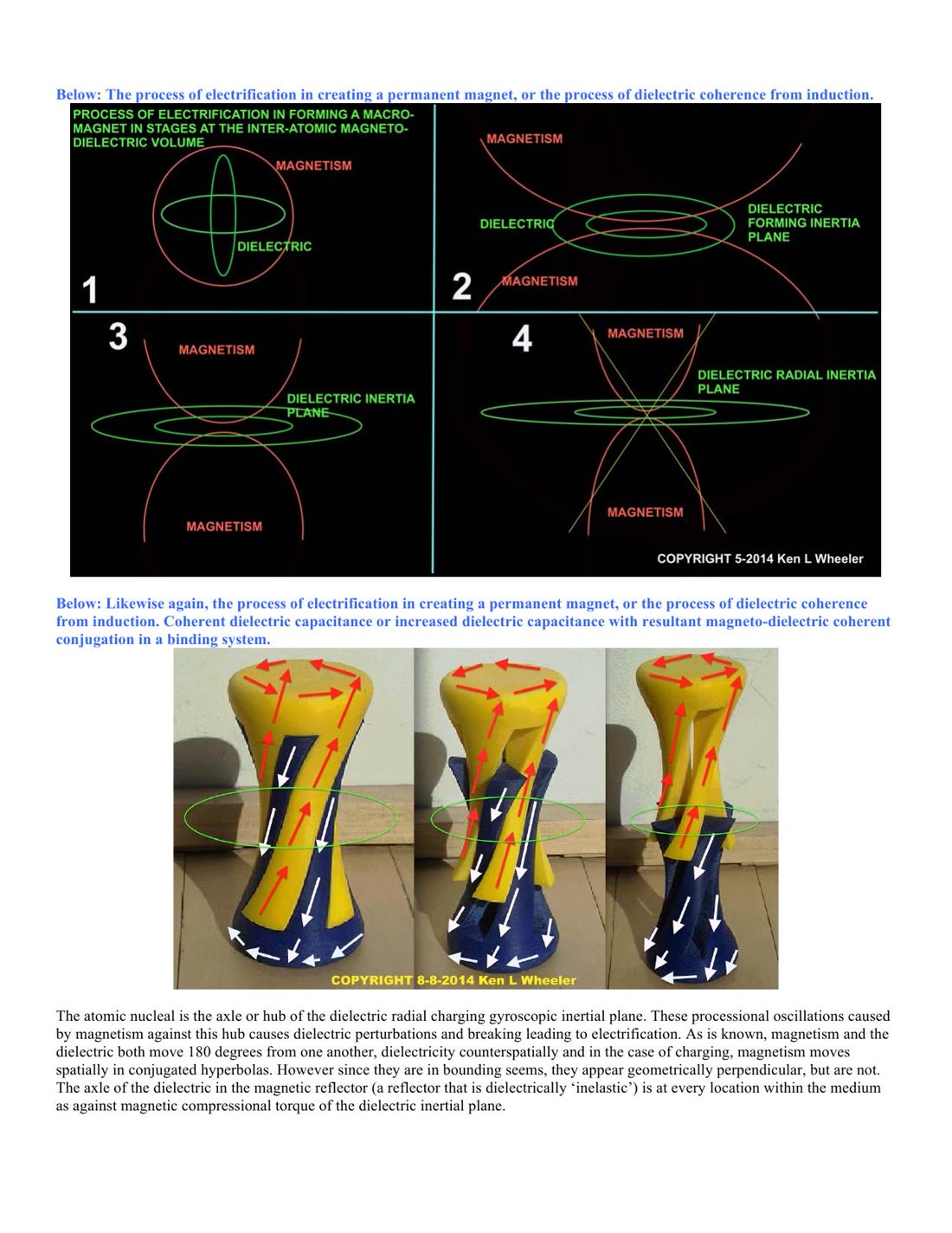
Here we have the shape that's exactly like this. It's the hyperbooid. You're going to have to understand what projective geometry is. And this is really really difficult for human beings. We have the hyperbooid. Over here we have space, time, force, and motion.'Hyperbooid' is the caption's spelling of hyperboloid — the hourglass made smooth. Geometry fact: spin a hyperbola and this is the surface you get.And right here in the center we've got nothing. We've got the null point of inertia. Now, so what defines magnetism or a magnet? There's the plane of inertia right along the middle right there where there's zero magnetism. Is like if you were able to go into a bubble in the very center of the earth. Okay, imagine that were possible. At the very center of the heart of gravity, there is no gravity.This part is actually mainstream: at Earth's center, gravitational pull cancels in every direction. He's using an agreed fact as a ramp to a disputed one.Of course, gravity doesn't exist. That which we call magnetic attraction is nothing other than dialectric acceleration. So'Dialectric' is the caption's dielectric — his name for the inward, charging counter-field to magnetism; mainstream physics uses the word only for insulating materials. His claim: falling and magnet-snapping are one inward acceleration.gravity of course exists in the contemporaneous sense that we understand that something falls or you're going to fall and die or an apple falls stuff falls to earth but gravity is an autonomous force or field does not exist it is nothing other than dialectric acceleration that which we call magnetic attraction.
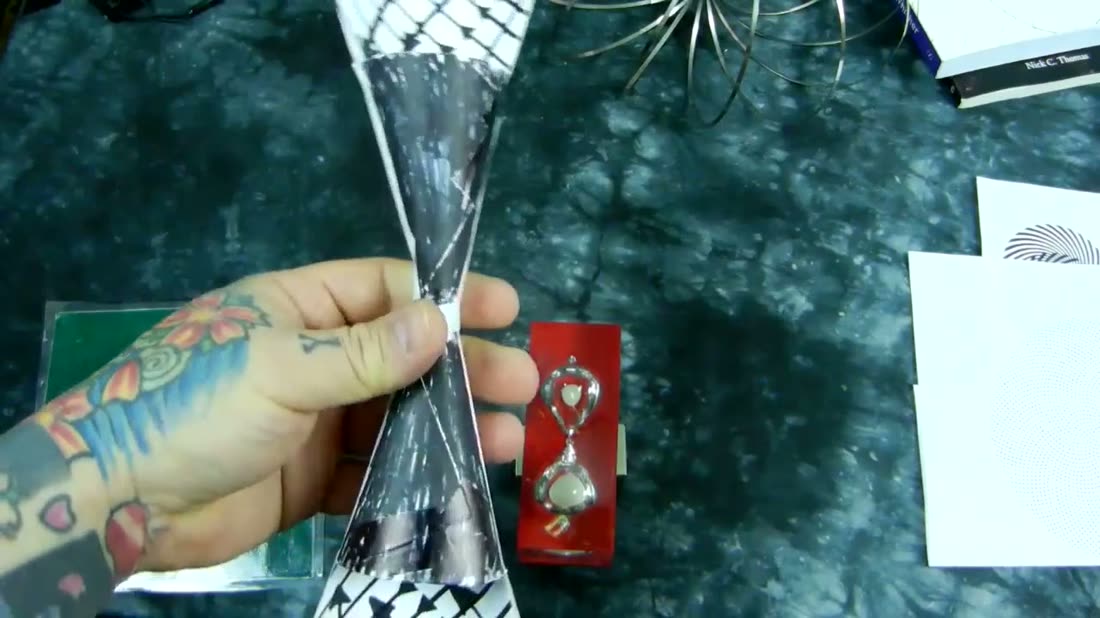
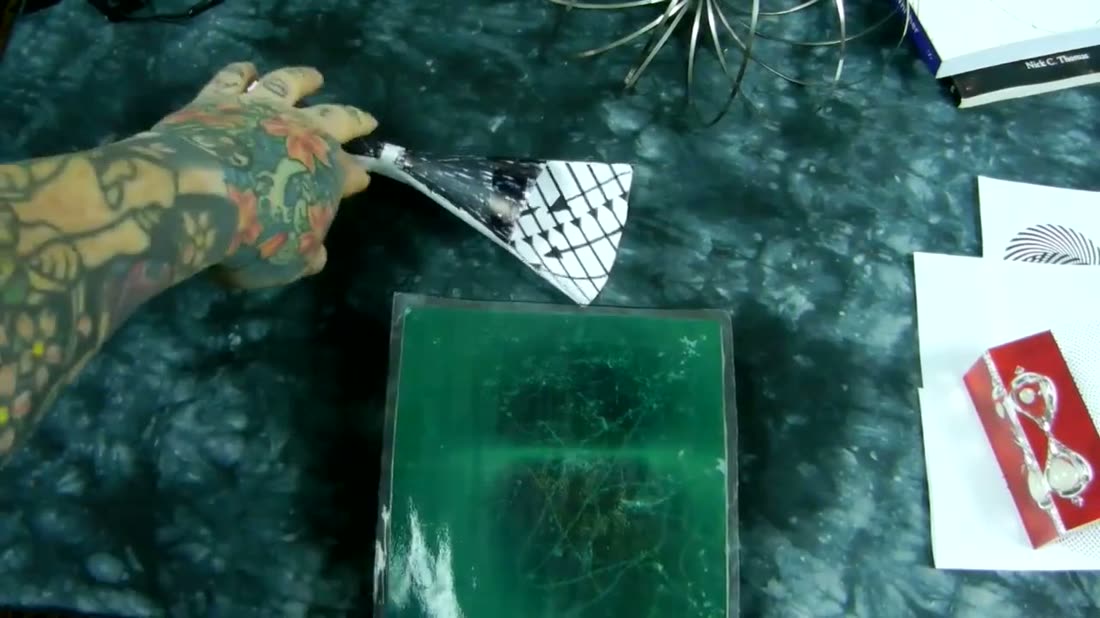
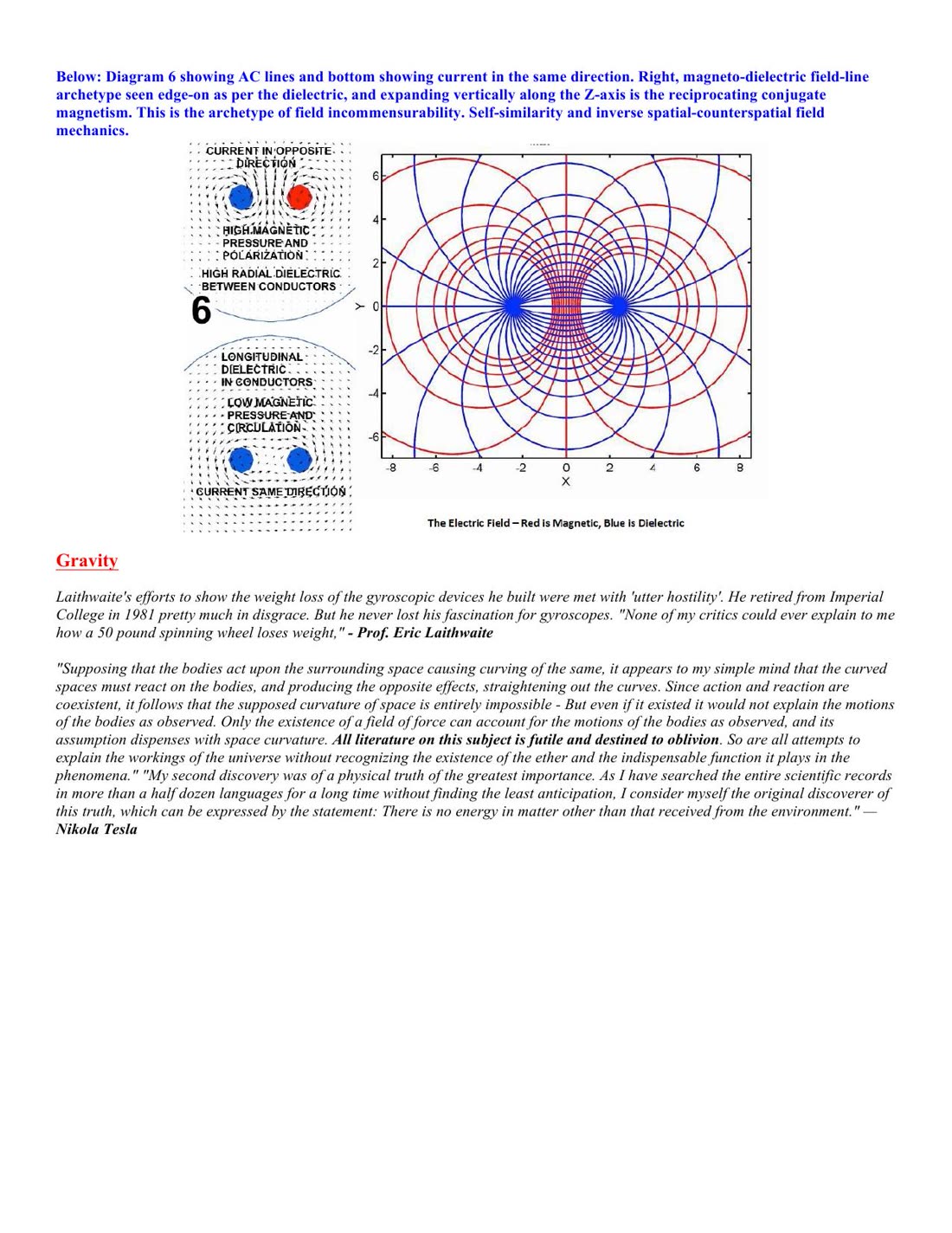
[06:52] The hyperboloid arrives: a checkered paper hourglass-of-revolution, the shape he says a magnet actually is.[07:02] He points from the paper hyperboloid to the hourglass charm — same shape, he says, same reason.[book, p. 179] THE MAGNET — the canonical plate. Red torus, blue axial flow, green inertial plane. His caption notes the same geometry serves a pair of AC lines: remember that for section thirteen. source ↗
This is the lecture's hinge. The hourglass was a toy; the hyperboloid is a commitment — a specific geometry he'll now defend as what a magnet is. And 'gravity is dielectric acceleration' is one of the few claims in his whole corpus with experimental teeth: our main document's claims register types it testable and traces what it would take to check. From here on, every demo is him pointing at this shape.
Register note: Typed claim: gravity-as-dielectric-acceleration is a testable difference — it predicts gravity should respond to dielectric conditions, which standard physics denies and current measurement does not show. The Earth's-center fact he leans on is textbook Newton.
If someone asks you at dinner, just say: At the heart of gravity there's no gravity — and he says the magnet's middle is the same place.
Part III · The walk · 8/16 · 07:52–08:53
Nobody has defined a pole
Armed with his shape, he now circles back to spring the trap from section four: go ahead, define 'pole.' He's been collecting books, and he says none of them can.
His boast: he owns every book on magnetism in existence, and not one of them defines polarity. What they offer, he says, are descriptions — 'a magnet has two poles; poles attract and repel' — and a description is what you can get from children. Ask what a pole is and you get circularity: a magnet is a thing with poles; a pole is what a magnet has two of.
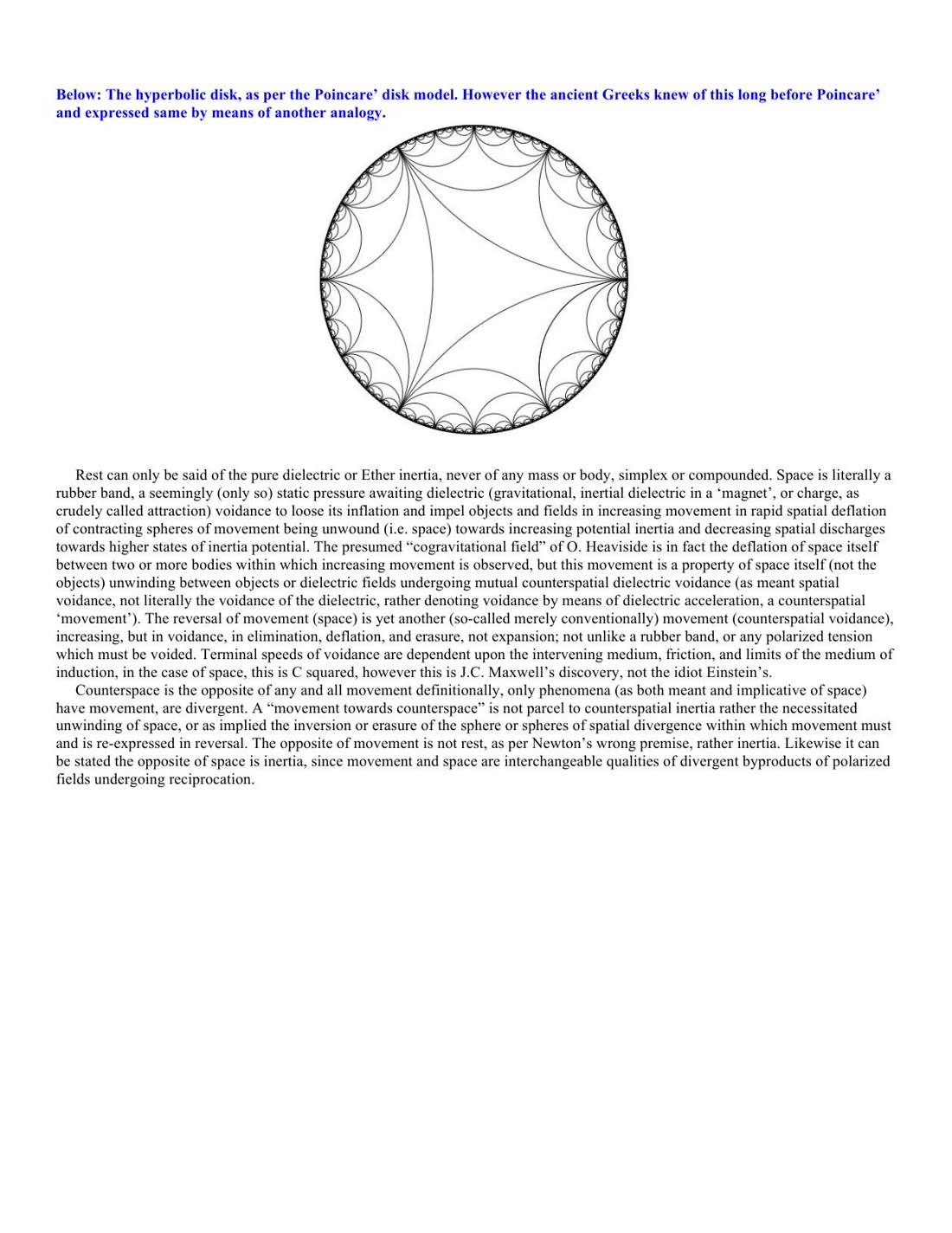
His answer starts with a drawing you have to see. Mother nature, he says, doesn't draw straight lines — he sketches the kind of line she refuses. What she draws instead are the sweeping curves that bow outward and return — hyperbolic paths. His homework assignment, delivered like a dare: go study the Poincaré disc model of projective geometry — a map of an infinite curved world inside a finite circle, where every 'straight line' arrives as an arc.
He's not being ornamental. He needs those arcs: they're the field lines every iron-filings photo shows, and he's about to read polarity itself out of the geometry that draws them.
His words — including the insult he throws at his own audience:
HIS WORDS — auto-captions, verbatim · 07:52–08:53
So now we have to give denotation definition and uh not mere definition but true definition because descriptions are what I can get from children. Well, you put two magnets together, they attract or they repel depending on how you put the poles. Well, let's define attraction, repulsion, and polarity. Human beings, there's not a single I've got every book on magnetism that exists. Human beings haveSetup for the charge: every textbook description of poles, he says, assumes the thing it's defining. Circular all the way down.never defined polarity. What does a pole mean? Well, it has two poles. Well, that's a description. Again, you're you're you're working in circularity here. Well, it's got two poles. That's what a magnet means. That's what polarity means. You know, a magnet's got north pole. No, it doesn't. Well, what does it mean then? wise ass. You know, you tattooed freak. What does it mean? It means that mother nature doesn't draw a line like this or like this or like this. Mother nature only knows how to draw a line like this or this or this. You get the point. And what does that mean? You have to understand and study the puare disc model of projective geometry.'Puare' is the captions garbling Poincaré. The Poincaré disc: an infinite hyperbolic plane mapped inside one circle — straight lines become arcs meeting the rim at right angles.
[08:32] The hyperboloid lowered over the ferrocell — his shape held against the instrument's pattern.[08:47] Field-line markings on the ferrocell: the curved lines he says are the only kind nature draws.[book, p. 117] The Poincaré disc, from his book: an infinite hyperbolic world tiled inside one circle — the homework he assigns on camera. source ↗
Whether or not the textbooks deserve the charge, notice the structure: he refuses the operational definition — poles are where the field enters and exits — and demands an ontological one, what a pole is. That demand is retroduction again. And the curves he drew are the bridge: next section, the 'loss of inertia' turns those arcs into poles by necessity.
Register note: Fact-check on the charge: physics does define poles operationally (field topology; and no magnetic monopoles — poles always come in pairs), which is a definition of behavior, exactly the kind he rejects. The gap is philosophical taste, not negligence.
If someone asks you at dinner, just say: Ask a textbook what a pole actually is and, he claims, you'll only ever hear what it does.
Part III · The walk · 9/16 · 08:53–10:18
Polarity is the loss of inertia
Here's his actual answer to 'what is a pole?' — and the cut-a-magnet-in-half puzzle every science teacher knows gets a very different reading.
His definition, finally: the loss of inertia necessitates polarity. He reaches for the Greek word ananke — usually translated 'necessity,' though he insists it runs deeper — something closer to fate. On his account, the moment that perfect stillness at the center is lost, two poles must appear. Polarity isn't a property a magnet has — his definition, not the textbook's — it's what the breakdown of rest looks like.
Then the famous puzzle. Cut a magnet in half, and you don't get a north piece and a south piece — you get two complete magnets, each with both poles. Cut it a 'million billion' times, same story. The textbook reads that as evidence poles come in inseparable pairs. Wheeler reads it as evidence about the middle: the plane of inertia isn't located anywhere — it's concentrated, the way pressure is. Water doesn't keep a list of where downhill is; it just flows there. Slice the magnet anywhere and, on his reading, a rest plane simply re-forms — because rest is what the geometry does, not where a part sits.
And the shape all this makes? A reciprocating, precessing hyperboloid — his full mouthful of a name for a magnet. Precessing, by the way, means slowly swiveling its spin axis, the way a tilted top wobbles in circles. He knows how it sounds; his defense is pure Wheeler: maybe the words aren't too big, maybe your vocabulary is too small. Then he hands you the plain version: centrifugal divergence, centripetal convergence — the shower spraying out, the drain pulling in. Every magnet, he claims, is doing both at once, forever.
His words — puzzle, insult, and all:
HIS WORDS — auto-captions, verbatim · 08:53–10:18
The loss of inertia necessitates as the Greeks have a famous term for necessity. But it doesn't really mean necessity. It means something far far deeper. The ancient Greek is called an necessitates polarity. The loss of inertia.The captions mangle the Greek — the word is ananke, necessity-as-fate. His claim compressed: lose perfect rest, and two poles are what you get. No choice about it.The single rest point. Here you can see the rest point. It's right in the middle. Right here in the center right right there. But it's not located there because I've already cut this magnet a million billion times. Each little slice will have a north pole and a south pole.True and uncontested — cutting magnets never isolates a pole. The fight is over why. Textbook: aligned atomic dipoles. Wheeler: the geometry re-forms its rest plane.It is concentrated there. Just like pressure.'Concentrated, not located' — his best phrase in the lecture. The middle isn't a part you could remove; it's a behavior, like the low point water finds.No difference in saying water flows downhill. So there is not an inertial plane here. It is forced located there. Why is it forced and located there? Because it is inverse to space. Inverse to force and motion. The inverse to force and motion is inertia and acceleration. Mother nature is not a cross-eyed crack or nor does she have a calculator. Okay. So when I speak about what defines the magnet as being a reciprocation reciprocating, excuse me, processional hyperbooid, what the hell does that mean? That sounds so complicated. People say, "Oh, you use these big ass words and you don't define them." Well, maybe it's the words aren't aren't that big that I'm using. Maybe it's your vocabulary is a little too small. Centrifugal divergence, centripedal convergence. Okay,Centrifugal = flying outward from a center; centripetal = pulled inward toward one. His shower-and-drain: one system, two directions, running simultaneously.it's no different than saying turning on the shower and pulling the drain plug. Centrifugal divergence, centripedal convergence. So,
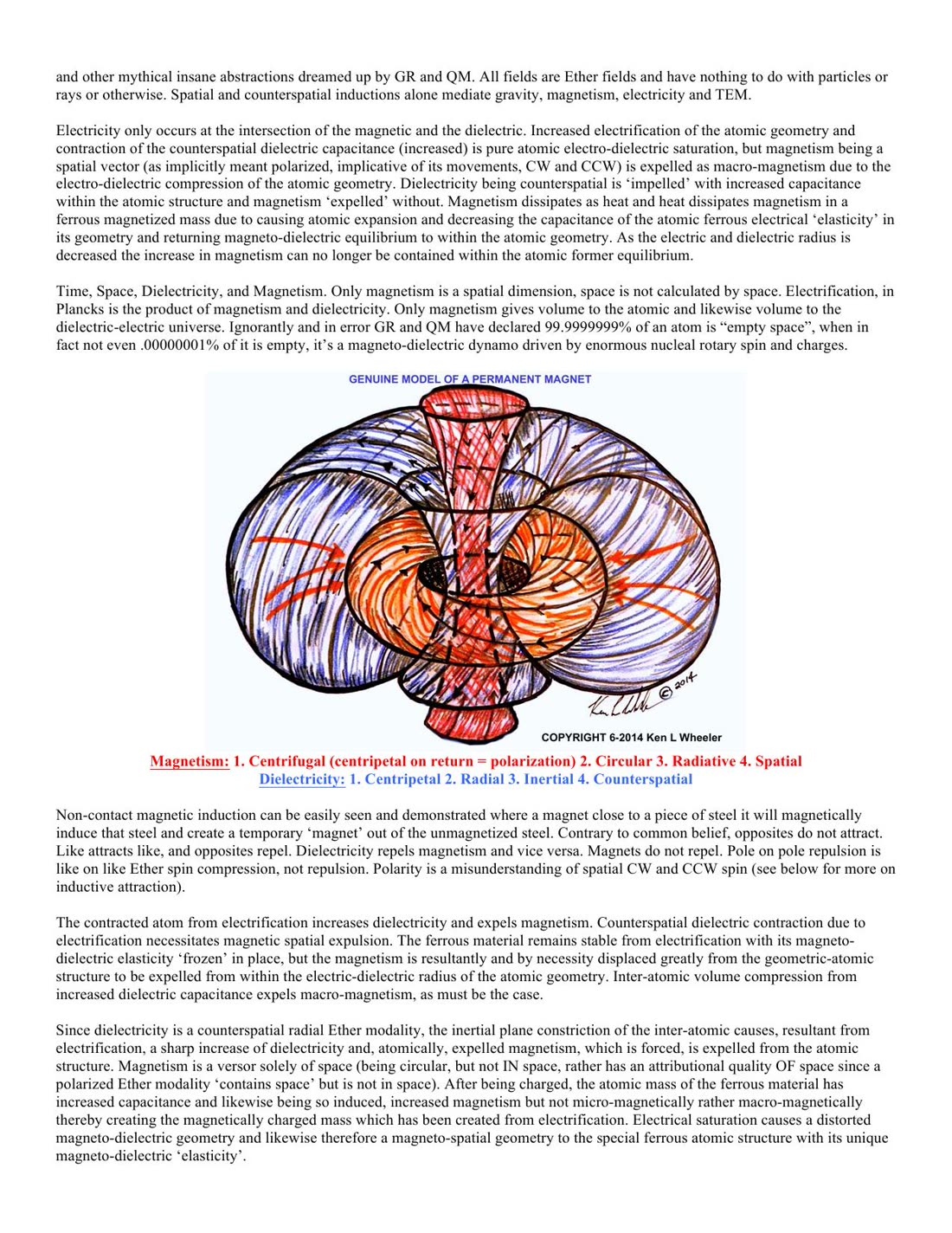
[09:07] The starburst under the ferrocell: outward spray and inward pull sharing one center.[09:57] The bar magnet, naked. Cut it forever, he says, and the rest plane just re-forms — concentrated, not located.[book, p. 29] Book plate: centripetal convergence over centrifugal divergence — the shower and the drain, as arrows. source ↗[book, p. 56] His hand-drawn 'genuine model of a permanent magnet': layered rest planes and flows in one cutaway. source ↗
Now his two teams from section two have jobs. In his system, magnetism is the outward spray, and the inward drain finally gets its name: dielectricity — the counter-field he's been hinting at since the gravity aside. The plane of inertia is where, he says, they trade. That trade — each field as the other's inside-out — is the conjugate reciprocity at the heart of our main document. What's left is to actually see the two shapes doing it, and that's the next demo.
Register note: The cut-magnet fact is textbook physics; both sides claim it. His 'concentrated not located' is a genuine alternative reading — but note it makes the same experimental predictions here, which is why this one types as re-description, not test.
If someone asks you at dinner, just say: Cut a magnet forever and you always get two poles — he says that's rest re-forming, not particles pairing.
Part III · The walk · 10/16 · 10:18–12:21
The two geometries
You've now heard the answer in words — polarity is what the loss of rest looks like. Here is where he stops talking and builds it: the lecture's centerpiece demo, the reason to watch the video and not just read it, as he assembles a magnet out of paper and wire on the table.
He starts with a claim of total scope: there are exactly two kinds of geometry in the universe — field geometry and physical geometry — and each defines the other. Then he builds the field kind with his hands.
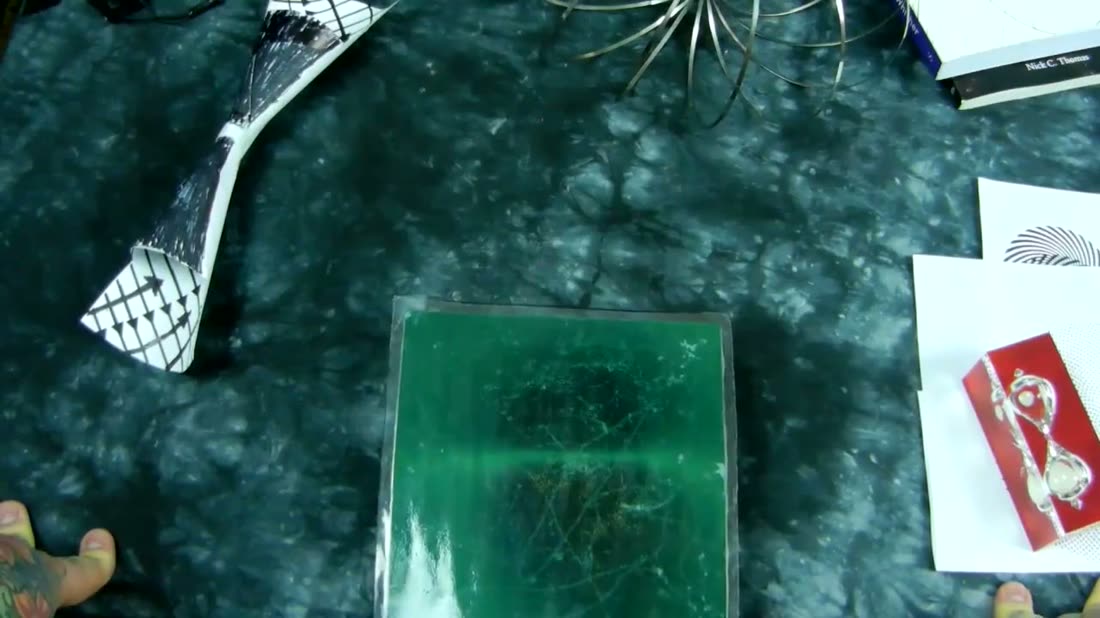
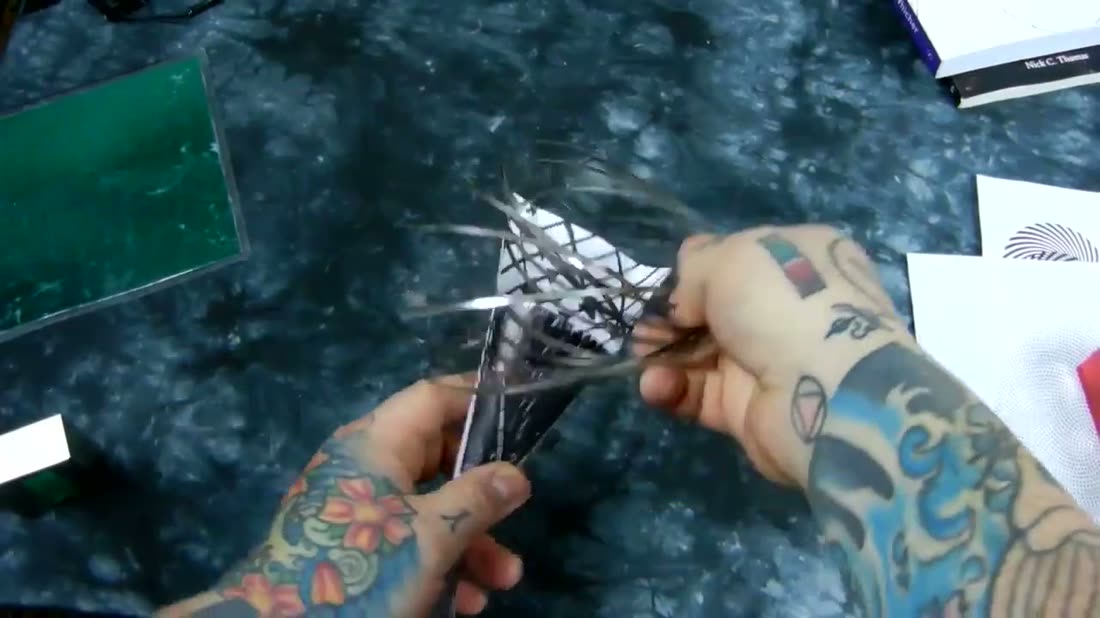
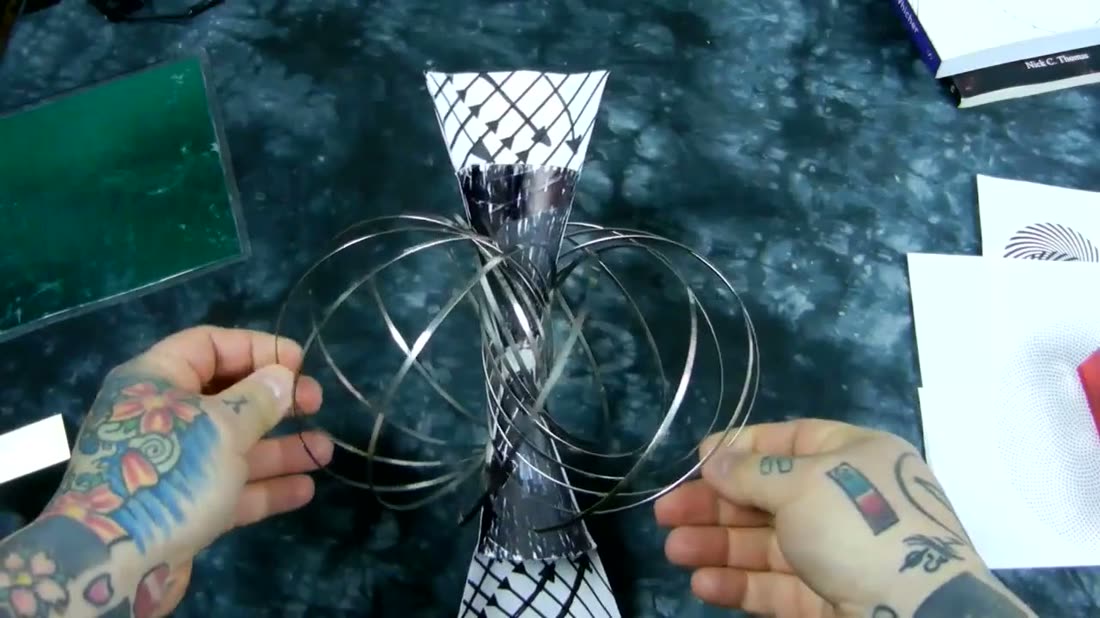
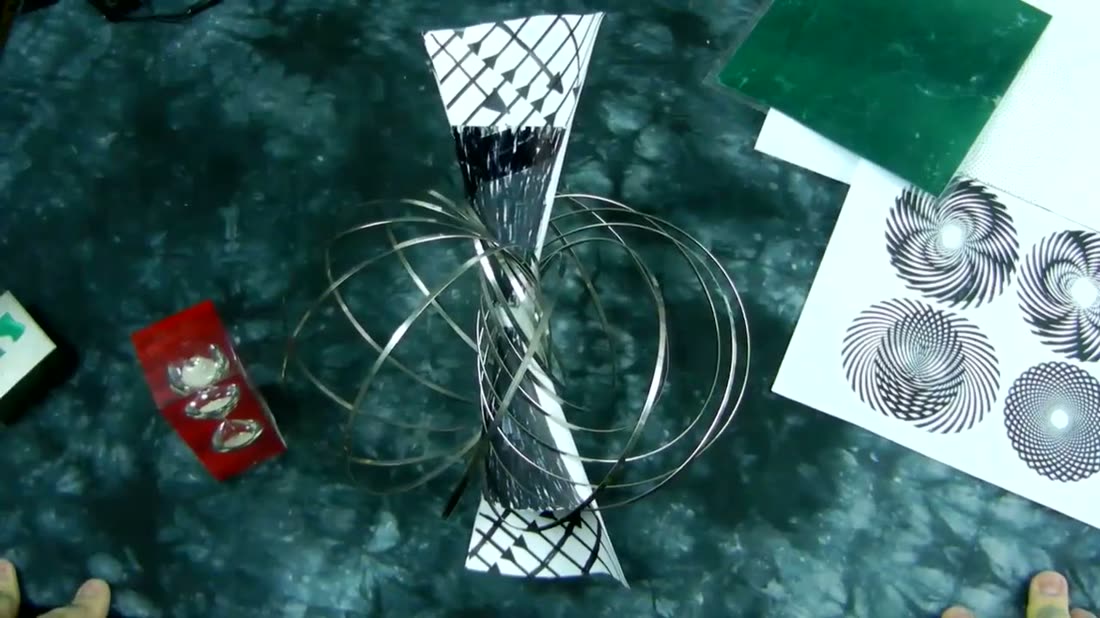
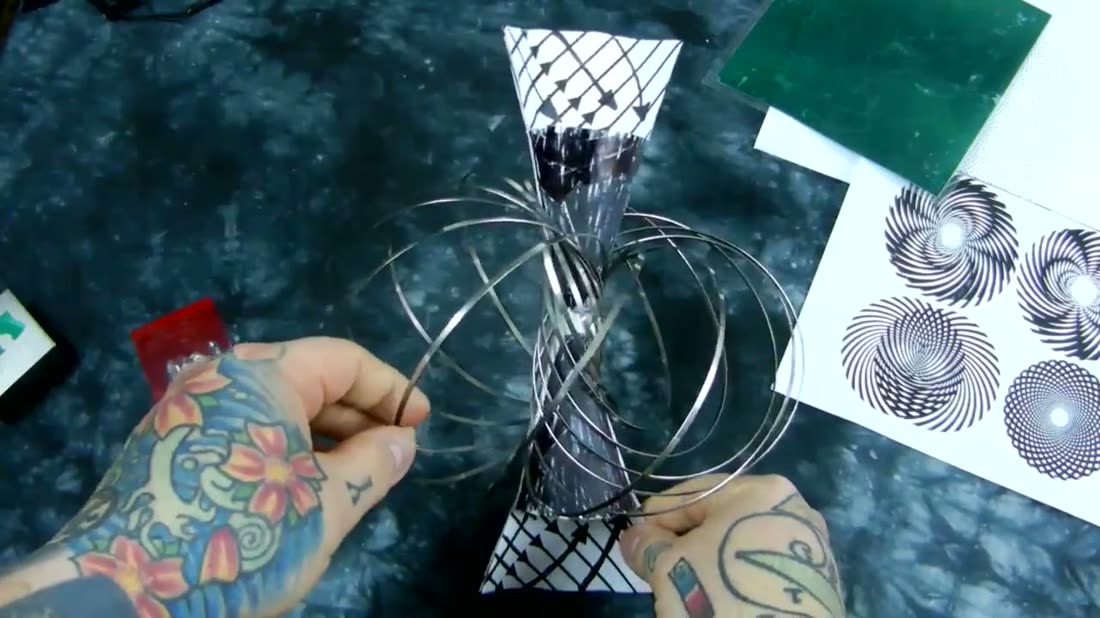
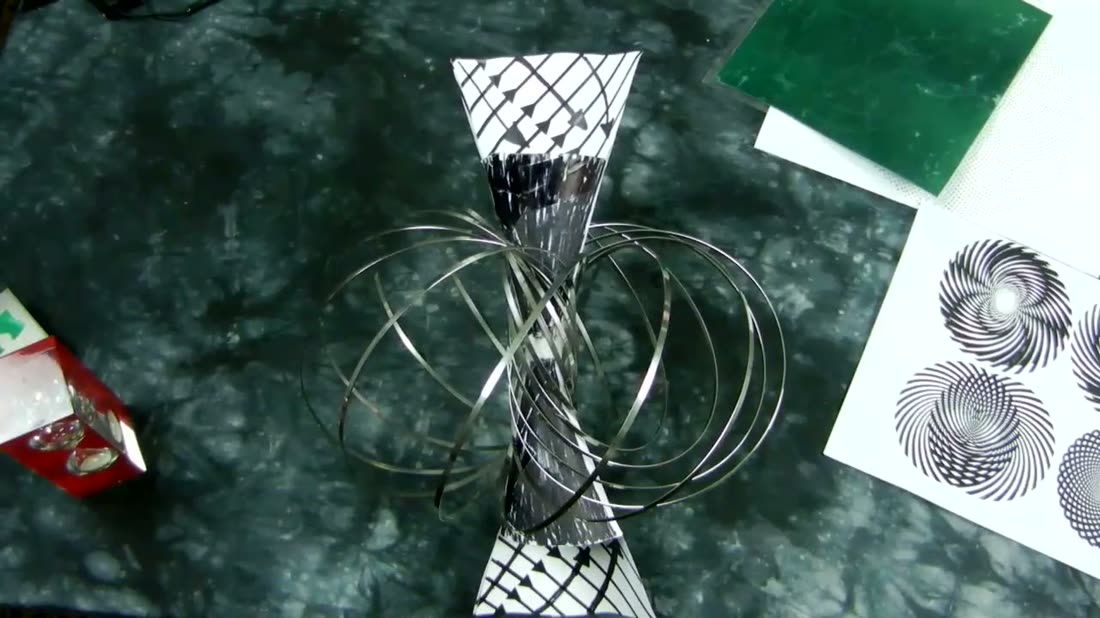
First the torus: the donut. Its spirograph pattern is, he reminds you, exactly what appears under a ferrocell. Then he asks the question the whole demo turns on: what's the inverse of a donut? His answer: the hyperboloid — the hourglass. And then he does the thing: he twists a checkered paper cone into an hourglass and inserts it through the wire donut. The two shapes nest perfectly — the hyperboloid's flaring horns fill the donut's hole, the donut wraps the hyperboloid's waist. One object, two inverse shapes — in his telling, force-and-motion wearing inertia-and-acceleration as its lining.
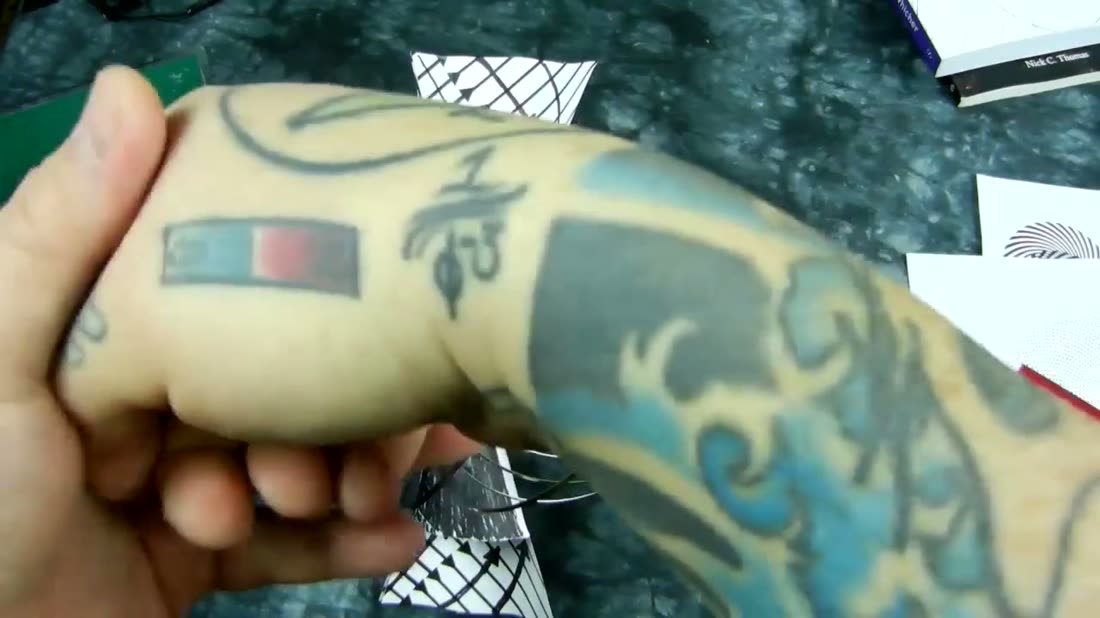
To see it truly, he says, you'd need endless layers of both, nested like onion shells — all of it, he says, reducible to one thing: inertia and its loss. Then he flashes the tattoo on his wrist — one over five to the power of negative three — and claims it encodes a discovery the ancient Pythagoreans made first. He declines to explain it: 'that would take a really, really long time.' In twelve hundred lectures, the full derivation never quite arrives.
What you're seeing: His magnet, built shape by shape — the composition the demo performs.
From the tape, mid-demo:
HIS WORDS — auto-captions, verbatim · 10:18–12:21
let's take a look at what this magnet looks like. Now there's two types of geometry in the universe and only two field geometry and physical geometry.Physical geometry is shapes of stuff — spheres, cubes. Field geometry is shapes of behavior — flows and pressures. His claim: the second kind runs the first.Okay? Only those two. One defines the other and the other defines the other. Sound kind of convoluted? Not really. Once again, let's define the Taurus and the hyperbole. You see that spyroraph pattern? It's the same thing you'll see underneath the fereral cell when you put a magnet underneath it. So what's the inverse of this Taurus? this donut shape. Okay, it's the hyperbooid just like this hourglass shape.Inverse here means what fills what the other leaves empty: the donut's hole is exactly where the hourglass lives. Watch the demo — the nesting is the whole argument.Okay, so let's insert the hyperbooid the negative image which is not so easy to do. Not while I'm messing with the camera anyway. Ta. There we go. the inverse image of force and motion, inertia, acceleration. Now, to see this really, we'd actually have to have multiple layers of these of the same thing. Force and motion and multiple layers of inertia, acceleration, but ultimately irreducible to this one thing only. You see this hyperbooid force in motion, inertia, acceleration. You can think of this bubble as the shower sprout, the the shower head, excuse me, and these two is the drain. Okay, this is the only way mother nature knows how to work. She only works off two principles, force and motion, inertia, and acceleration. They're both one in the same thing, which is inertia, and the loss of that inertia. And the loss of that inertia was a discovery I made that the ancient Pythagoreans discovered long long ago and is tattooed right there in my wrist. 1 over 5 to the^ of -3.His tattooed formula, 1/5^-3, equals 125 — he links it to golden-ratio structure. Offered as autobiography here, not derived. File under 'asserted.'Discussing that however would take a really really long time to do a long time. Okay,
[11:02] The demo of the lecture, step one: twisting a paper cone into the hyperboloid by hand.[11:12] Step two: the hyperboloid nested through the wire torus — his complete magnet, assembled on camera.[12:07] The tattoo: 1 over 5 to the power of −3 — the formula he says the Pythagoreans found first, and won't derive today.[book, p. 176] The spatial–counterspatial double toroid of a magnet — the book's version of the paper-and-wire demo, with the AC-line comparison panels alongside. source ↗[book, p. 65] Book plate: the magnetic field (hyperbola and cones) laid beside the dielectric field — the two shapes, side by side. source ↗
You've now seen his complete picture of a magnet: torus of magnetism outside, hyperboloid of inertia inside, plane of rest between. Our main document's Torus–Hyperboloid Conjugate Geometry concept — conjugate meaning two forms locked as mutual inverses, each defined by the other — is this section in slow motion, with the mainstream comparison: field lines around a bar magnet genuinely do trace these curves — iron filings agree with him on shape while every textbook disagrees on cause. Next, he claims the pattern is signed by nature's favorite number.
Register note: The shapes are real: dipole field lines do form nested tori, and the field's null structures are genuinely hourglass-like. What's his alone is the ontology — that the hyperboloid is a second, counterspatial field rather than a feature of one field.
If someone asks you at dinner, just say: A magnet is a donut of motion wearing an hourglass of stillness — that's his whole geometry.
Part III · The walk · 11/16 · 12:21–12:52
The golden angle
A thirty-second aside he can't resist: nature signs her work, and he claims he caught the signature.
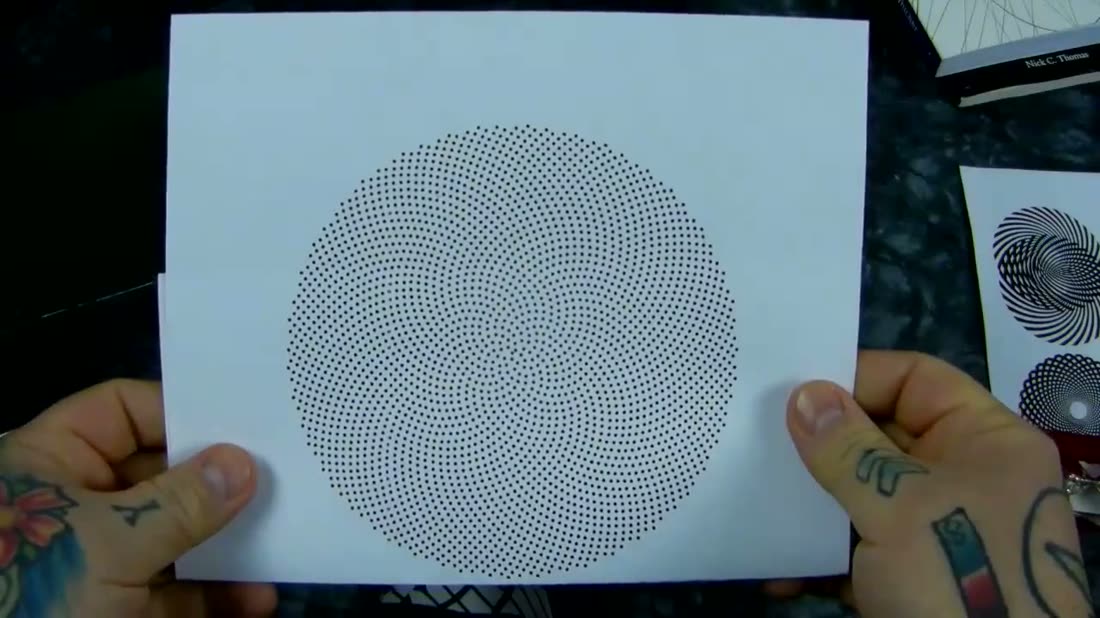
He holds up a printed sunflower-spiral pattern — the same pattern, he says, you'll see under a ferrocell — and reads two angles off the print — 85 degrees, and 137.5 degrees: the golden angle, the angle you get when the golden ratio carves up a circle. Then the personal flourish: he always wondered why a sand dollar is shaped the way it is, checked, and — he claims as his own discovery — it follows the same golden-angle geometry.
Why park this here? Because if magnetism's spirograph bloom and a sunflower's seed head share the same angle, then — in his logic — field geometry isn't just physics, it's nature's universal template. It's his version of a signature match.
Straight off the tape:
HIS WORDS — auto-captions, verbatim · 12:21–12:52
you see this sunflower pattern? It's the same thing you'll see underneath the fereral cell. If you look closely here, you'll see a golden ratio pattern that follows 85° 137.5°. That's the golden angle and 137.5°, which by the way is a discovery I made.Careful with the register: sunflower seeds at 137.5 degrees is textbook botany, documented since the 1830s. What he can claim is applying it to sand dollars and ferrocell patterns.I always wondered why a sand dollar was shaped that way. And you will notice that it follows 85° and 137.5°. The golden ratio, the golden angle, excuse me, as extrapolated out in an angle.
[12:22] The sunflower print: seeds advancing 137.5° per step — the golden angle he claims the ferrocell bloom shares.
This is the lecture's weakest evidentiary beat and worth seeing clearly: a real pattern — phyllotaxis, the botanists' word for how plants place seeds and leaves — a real angle, and an asserted link to magnetism that no measurement in the lecture actually establishes. The ferrocell bloom's petal count varies with the magnet and the cell — whether it follows the golden angle is exactly the kind of thing a camera and a protractor could settle. Noted for the register, then back to the main line.
Register note: Typed: the phyllotaxis fact agrees with standard science (and predates him by two centuries); the magnetism link is testable and untested; the discovery claim is over-clocked.
If someone asks you at dinner, just say: Sunflowers space seeds at 137.5 degrees — he claims magnets bloom at the same angle. Nobody's measured it.
Part III · The walk · 12/16 · 12:52–14:37
Attraction and repulsion, dissolved
Now the lecture's title claim gets cashed: what actually happens, on his account, when two magnets snap together or shove apart — with before-and-after pictures.
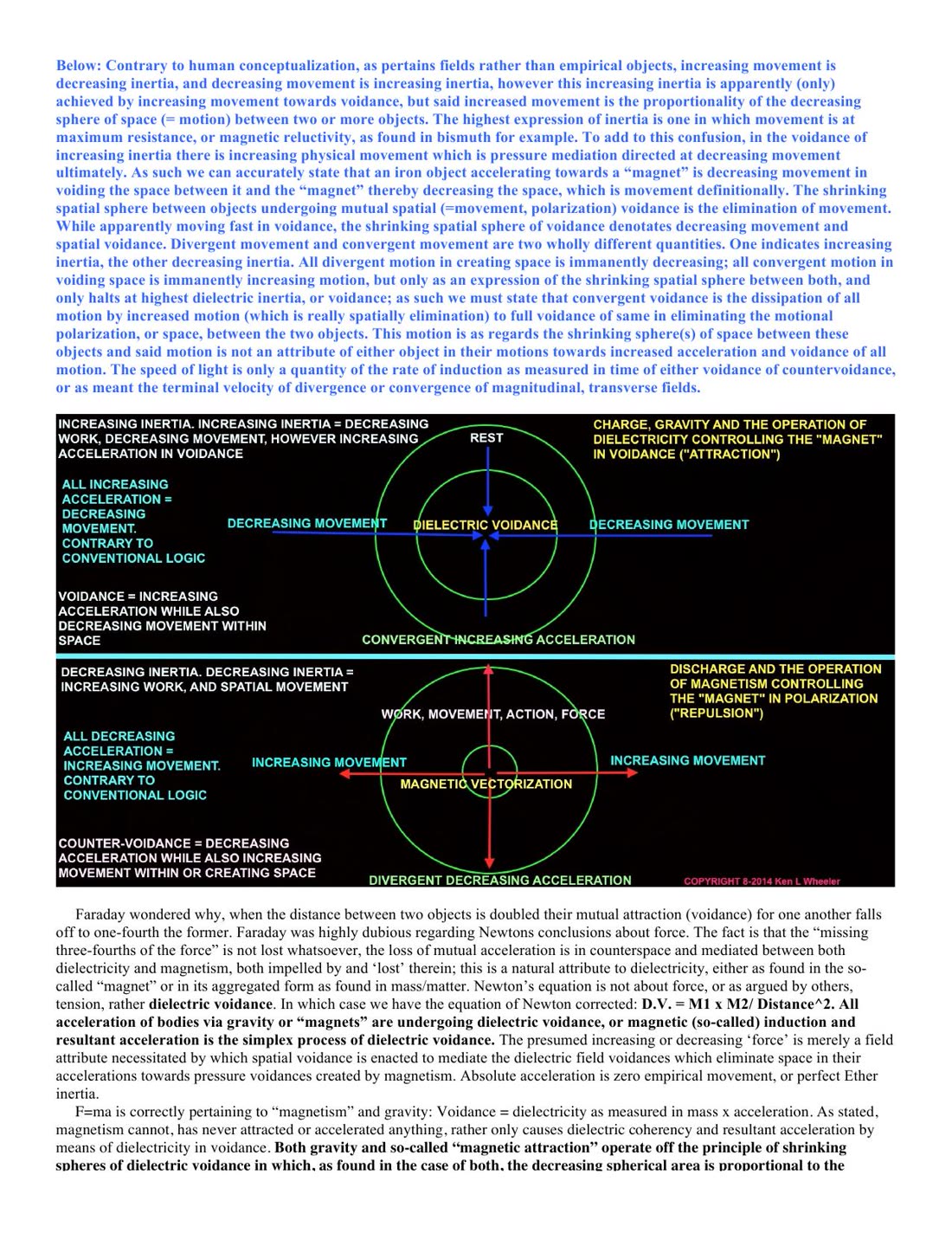
His terms: what you call magnetic attraction is dielectric voidance, and what you call repulsion is counter-voidance. Voidance: two magnets, opposite faces presented, aren't pulling on each other — both are accelerating into a shared void, a mutual rest point forming between them, like two streams joining at a drain. Counter-voidance: like faces presented, each magnet's outward spray meeting the other's head-on — force and motion piling up in the gap with nowhere to go.
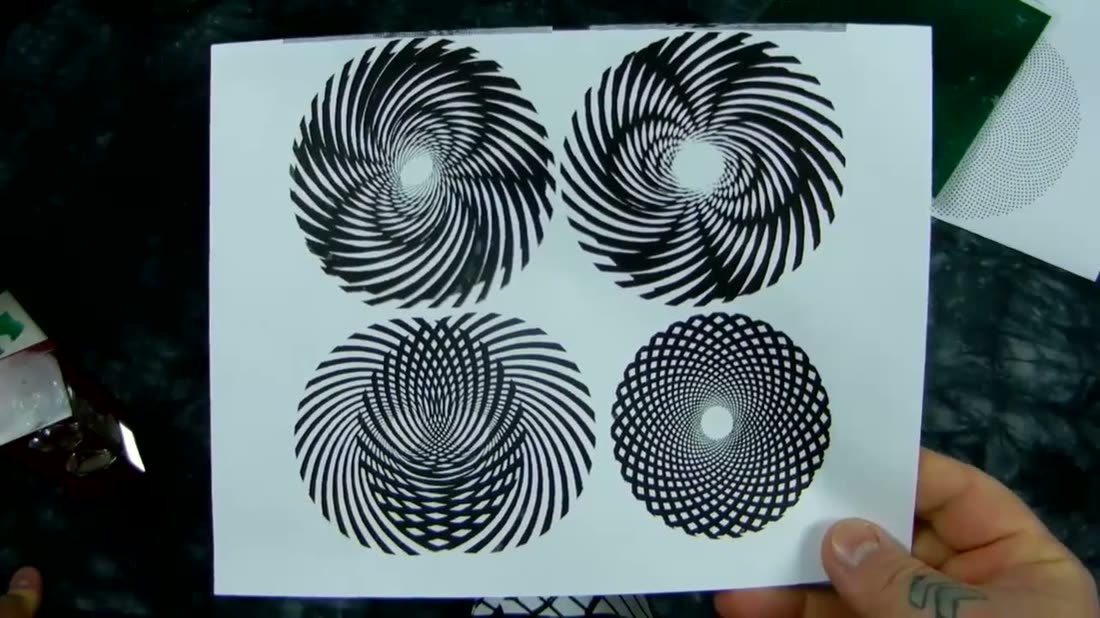
He runs it as a quiz with printed ferrocell photographs: two pattern sets, this one or that one — which is 'attraction'? The tell, he says, is the shape between the magnets. Coming together: a hypotrochoid — a spirograph rosette — blooms in the gap, which he reads as the two fields merging into one system with one shared rest plane. Pushed apart: bulging, compressed lobes stack up between them, the visual of increasing force and motion.
And the kicker he can't resist: press two like poles together hard enough — genuinely hard, if the magnets are strong — and the merged pattern that forms is, he says, exactly what his old equation predicted. Nature is a really simple broad, he concludes; it's humans who are really, really dumb.
What you're seeing: The two encounters, animated — what he says is really happening.
His words, mid-demonstration:
HIS WORDS — auto-captions, verbatim · 12:52–14:37
Let's take a look at something else. That which we call magnetic acceleration and magnetic repulsion do not exist. It is dialectric voidance and countervoidance.Voidance: both magnets accelerate toward a mutual rest point between them — nothing 'pulls.' Counter-voidance: two outward sprays collide and shove. Same vocabulary, both directions.What you will see underneath the ferro cell is this. Which one do you think we're looking at this versus this? Okay. Which one of these do you think is dialectric voidance or magnetic attraction? This set or this set? The set below is how a magnet normally looks. And this is also what you'll see as uh two magnets are undergoing dialectric avoidance or what you conventionally irrationally and incorrectly call magnetic attraction or acceleration. These are two magnets coming together. You'll see the hypertrocoid pattern forming.'Hypertrocoid' = hypotrochoid, the spirograph rosette — a point on a circle rolling inside another circle. To him, the field signature of two magnets becoming one system.And there we go. Up here you'll see increasing force and motion as two magnets with like polarity come together. that what you call uh magnetic repulsion is dialectric counter avoidance force in motion increasing force in motion and amazingly once you're able to press them together which unless they're weak magnets is really really hard to do the pattern that forms and you actually can see this underneath the fereral cell and it's exactly what I predicted in my equation cuz mother nature is a really simple broad it's just that human beings are really really really really really dumbThe prediction claim again — and again the equation stays offstage. What is on stage: the patterns themselves, which are real photographs of real ferrofluid.as you will see the exact same hyperbooid See this hyperbooid and Taurus that makes up. This is amazing. This is exactly like fractal field pressure geometry.Field pressure: his catch-all for forces as pressure differences in a field. Fractal: the same pattern, he says, repeating at every scale.Okay. Exactly like it. Exactly like it.
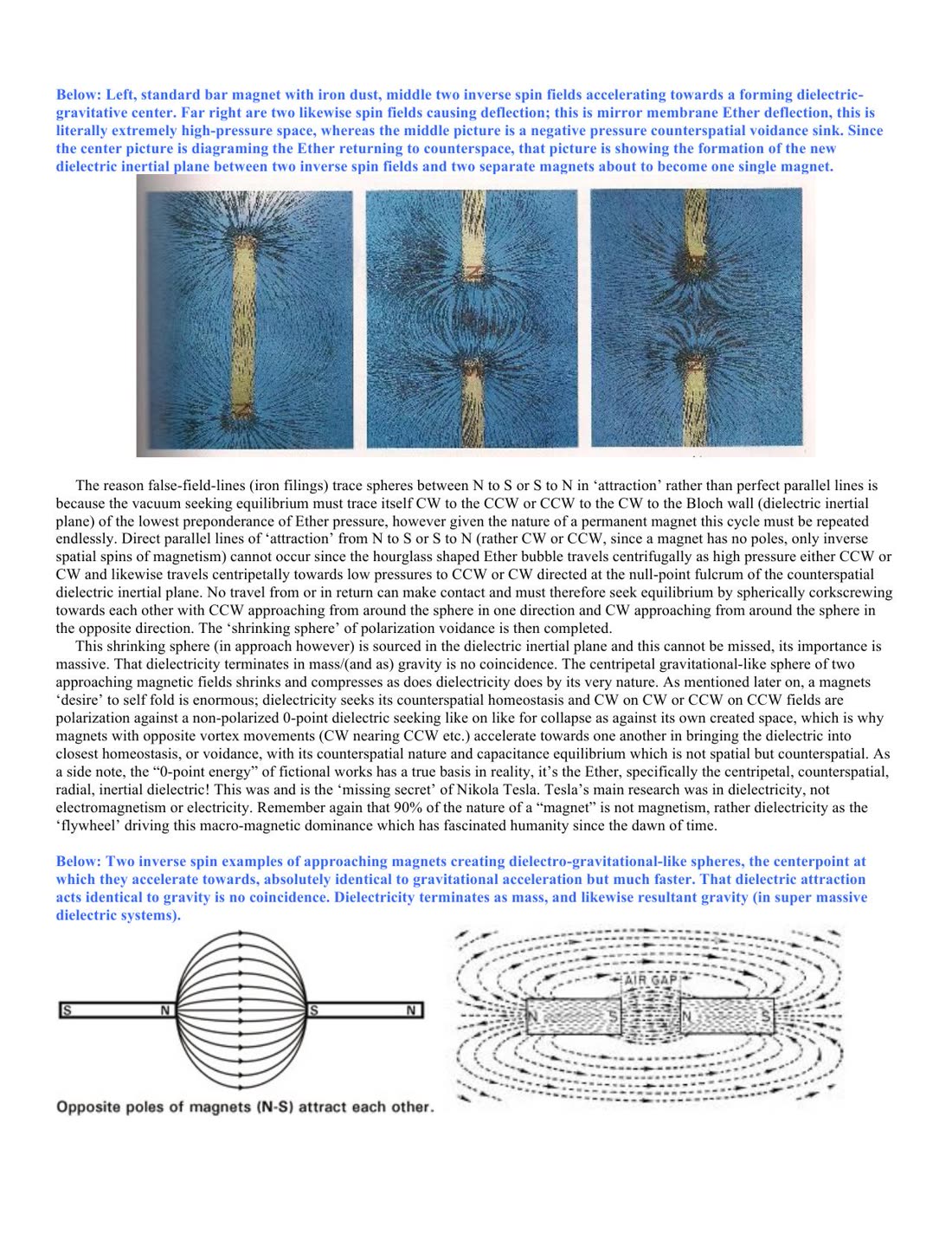
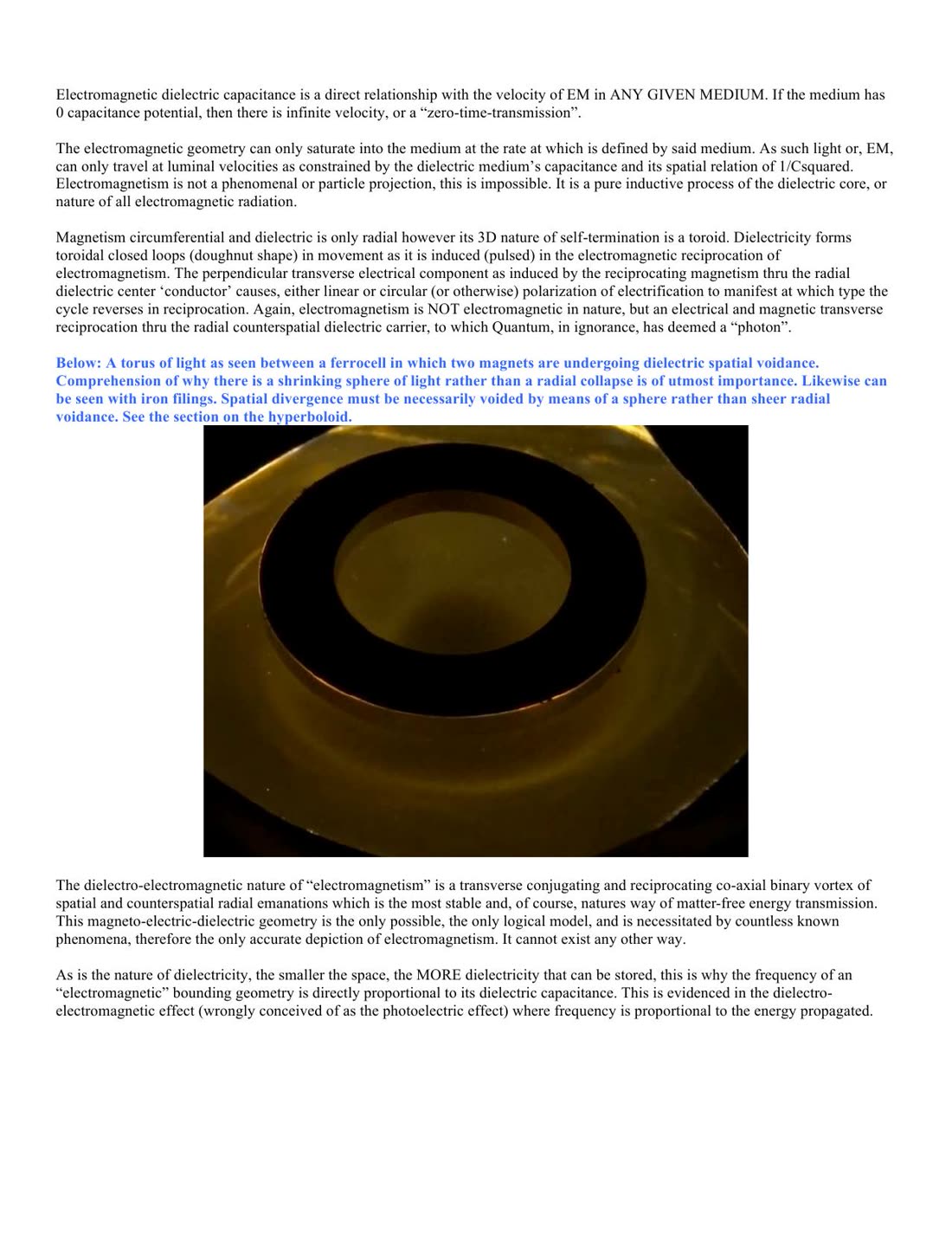
[13:02] The quiz he runs at you: two sets of ferrocell patterns — which one is 'attraction'?[14:22] The wire coil squeezed into an hourglass — two like poles pressed together, in steel.[book, p. 90] Book plate: a four-panel ferrocell sequence of two magnets approaching — the merge he calls voidance, frame by frame. source ↗[book, p. 70] Iron filings, the old-school instrument: one magnet, then two approaching — the same curves the ferrocell paints in light. source ↗[book, p. 214] Book plate: a torus of light forming between two joined magnets under the ferrocell — his photograph of 'two systems becoming one.' source ↗
This is the same move he made on gravity in section seven — replace 'pull' with 'acceleration toward rest' — now with pictures. Our main document treats this as his signature re-description: the forces measure identically either way, so no experiment in this lecture separates the stories. What the ferrocell genuinely shows is that the field between two magnets reorganizes as they approach — which both his story and Maxwell's predict. Next he leaves the tabletop and points out the window.
Register note: Re-description, typed as such: voidance and attraction predict the same forces here. The ferrocell photos are real; 'exactly what I predicted' rests on an equation never shown.
If someone asks you at dinner, just say: Magnets don't pull, he says — they both fall into a shared still point, like two streams finding one drain.
Part III · The walk · 13/16 · 14:37–15:36
The wires outside your window
One minute of proof-of-relevance now: the props go down and he points at something you've actually seen — power lines on your street, before and after an outage. Same geometry as the magnets, he claims, hanging over your sidewalk.
Take his drawing of the two-magnet pattern, he says, and read it differently: let the two shapes be two AC power lines running down your street, seen end-on, current flowing through both. The field pattern between them is the same family of curves.
Then an observation he invites you to check yourself — hold it loosely; the scorecard below files it as untested: when the power goes out, the lines sag back together; when it surges back on after a storm, they push apart slightly. Those, he says, are magnetic flux divergences — flux being field-flow, the very lines iron filings trace — the same counter-voidance from the last section, drawn at neighborhood scale — with dielectric acceleration running down the center line between the wires.
And one more re-reading of the same picture: this pattern, he notes, is also the side view — the cross-section — of any and every magnet. One drawing, three phenomena. That economy is the whole point for him: nature has one geometry and reuses it everywhere.
From the tape:
HIS WORDS — auto-captions, verbatim · 14:37–15:36
This is also by the way if you put a line here and a line here and these are AC currents running down your streetThe physics kernel is real and old: parallel currents exert forces on each other — Ampère measured it in 1820, and it anchored the SI definition of the ampere from 1948 until 2019.you know carrying um a bunch of voltage you know AC current lines. If you put a a a line here running down through the paper and a line here, this is the exact same thing you'll see on an AC current running down your street. That's why when the power goes out, the lines kind of sag back together. And when the current comes back on again, like after a power outage or during a storm, they'll go will push push apart slightly. Okay, these are magnetic flux divergences. And here isHis sag-and-push story is checkable but muddied: line sag also changes with heating and load. A current-force effect exists; whether you can see it from your porch is the open part.the dialectric acceleration here in the center. See this is a cross-section side view of this which is also what you'll see on the side view of any and every magnet. Okay. What you actually can't see without using this you have to use a ferro cell is to see this the hyperbooid and the Taurus.
[15:27] The scratched diagram: two AC lines end-on, the same curves he just called a magnet's cross-section.[15:32] The coil pinched into the same geometry — street wires and magnets, one shape.[book, p. 180] Book plate: AC lines with current in opposite versus same directions — the street-wire geometry, drawn. source ↗
Notice what this section is for: it's his reality anchor. After twelve sections of hourglasses and privations, he's saying — this geometry is in your street, doing work, right now. The wire-force fact is bog-standard electromagnetism, which is exactly why he uses it: it's the one claim in the lecture your utility company already bills you for. From here he climbs back up to the summit and names everything.
Register note: Agrees-with-standard at the level of the effect (forces between conductors); his causal story and the porch-visible sag claim are his own. The magnet-cross-section identification is his geometry doing its unification work.
If someone asks you at dinner, just say: Parallel power lines really do push and pull each other — Ampère proved it in 1820. He just re-draws why.
Part III · The walk · 14/16 · 15:36–18:04
The bubble of time
Now the shapes get their final, official names — and the lecture goes somewhere most physics talks won't: what it's like to be inside the picture.
The definitions land like verdicts. The torus is — definitionally, denotatively — magnetism. The hyperboloid is inertia and acceleration. And the null point at the center is — his verdict — total absence: no time, no space, no motion. Time, he adds, is a human contrivance anyway — merely a measure of magnitudes, a bookkeeping of change. Where nothing changes, there is nothing to book.
Then the line that tells you what lecture you've actually been watching: we physical, pathetic human beings live out here — in the bubble, the torus, the balloon from minute one. We don't live at the center. Ancient metaphysics, he says, called the center the spirit world and the bubble the material world — and field mechanics, on his account, draws exactly the same map. The ancients lacked iPhones, not wisdom.
Then he does something genuinely clever with the hourglass: he flips it. Sand starts running — and now you can measure time again, watching it pass from bulb to bulb through the waist. That passage through the still point, he claims, is where electromagnetic retardation and phase shift come from — the measured fact that fields take time to arrive, that effects lag causes. Cover the hourglass with your hand and you can't tell the time at all: everything you can measure, he's saying, is traffic through a point you can't.
The longest verbatim run in the chapter — worth reading whole:
HIS WORDS — auto-captions, verbatim · 15:36–18:04
The Taurus is definitionally and denotatively magnetism.'Definitionally and denotatively' is his way of saying: not an analogy anymore. The donut IS magnetism; the hourglass IS inertia. The props have become the ontology.The hyperbooid is definitionally and denotatively inertia and acceleration increasing inertia and acceleration with the null point right here being the total absence. These time has no meaning. Time is a human contrivance. Time is only a measure of magnitudes.A real philosophical position — relationism, held by Leibniz and Mach: time as change-counting, not a river. Respectable company, though they'd wince at the spirit world next door.There are two things that are absolutely nothing. Now they're absolutely something in a conventional sense to us physical pathetic human beings that were trapped within the bubble of time. us little human beings live out here. We don't live here. Okay? Now, ancient metaphysics would call this the spirit world andRegister check: this is where his physics and his metaphysics fuse in plain sight. The same diagram is doing duty as field theory and theology. Decide for yourself which is driving.this crap here, the balloon, the material world. The same is true in field mechanics. See, those ancient people that we all thought were stupid, they really weren't that stupid. They were actually pretty damn smart. You know, they didn't have microwaves and television sets and Apple uh iPhones and iPads, but they were very wise. Okay. Right here. Here. Here. Do you get it? Okay. I'm going to turn the hourglass upside down. Okay. I can measure time as it passes from here to here. This is where electromagnetic retardation and phase shift comes from.EM retardation is standard physics — fields propagate at light speed, so effects lag. 'Retarded potentials' is in every graduate textbook. The hourglass derivation of it is entirely his.That's a specific electromagnetic field of study. It's called EM retardation. Okay. Here we have time and space and motion. Here we have none of that. None of it here. Time is meaningless here. Time, excuse me, space is meaningless. Space has no meaning or existence here. Time has no meaning or existence here, right? You just block out this hourglass here. You're never going to be able to tell the damn time, are you? Nope. Can't I can't see ship. Nope. Can't tell the time. Nope. I I got no I got no way to understand anything. Well, why not? It's all passing right here, right through the point of inertia, you know, force in motion, inertia, and acceleration. Mother nature is really, really simple. She's been screaming out to you for ages and eons. But human beings, we're not that smart yet. Just not actually it's not smarts or empirical knowledge. It is nois. It is wisdom. Two totally different things.
[16:52] The hourglass again, now in close-up — about to be flipped to make time start running.[17:37] The paper hyperboloid from above: the throat is the null point where, he says, time has no meaning.[17:47] The composed model at rest — torus outside, hyperboloid inside, the geometry the whole lecture built.[book, p. 187] Book plate: four panels of crossing magnetic and dielectric hyperbolas — the traffic through the still point, mapped. source ↗
This section is why our main document keeps a register discipline at all: within ninety seconds you get a textbook term (retardation), a defensible philosophy of time, and the spirit world — delivered in one breath, with total confidence, as one system. The skill is real and so is the danger. One section left in the walk: the whole cosmology, recited as a creed.
Register note: EM retardation: agrees at the level of the phenomenon, his mechanism is unfalsifiable as stated. Time-as-contrivance: legitimate philosophy. Spirit world/material world: metaphysics, offered without apology — marked as such.
If someone asks you at dinner, just say: His map: matter lives in the bubble, the center is outside time — and the ancients, he says, knew.
Part III · The walk · 15/16 · 18:04–19:17
The creed: one field, four modalities
Eighteen minutes in, he stops arguing and starts reciting — the entire cosmology in ten sentences, the same creed that anchors every lecture he gives.
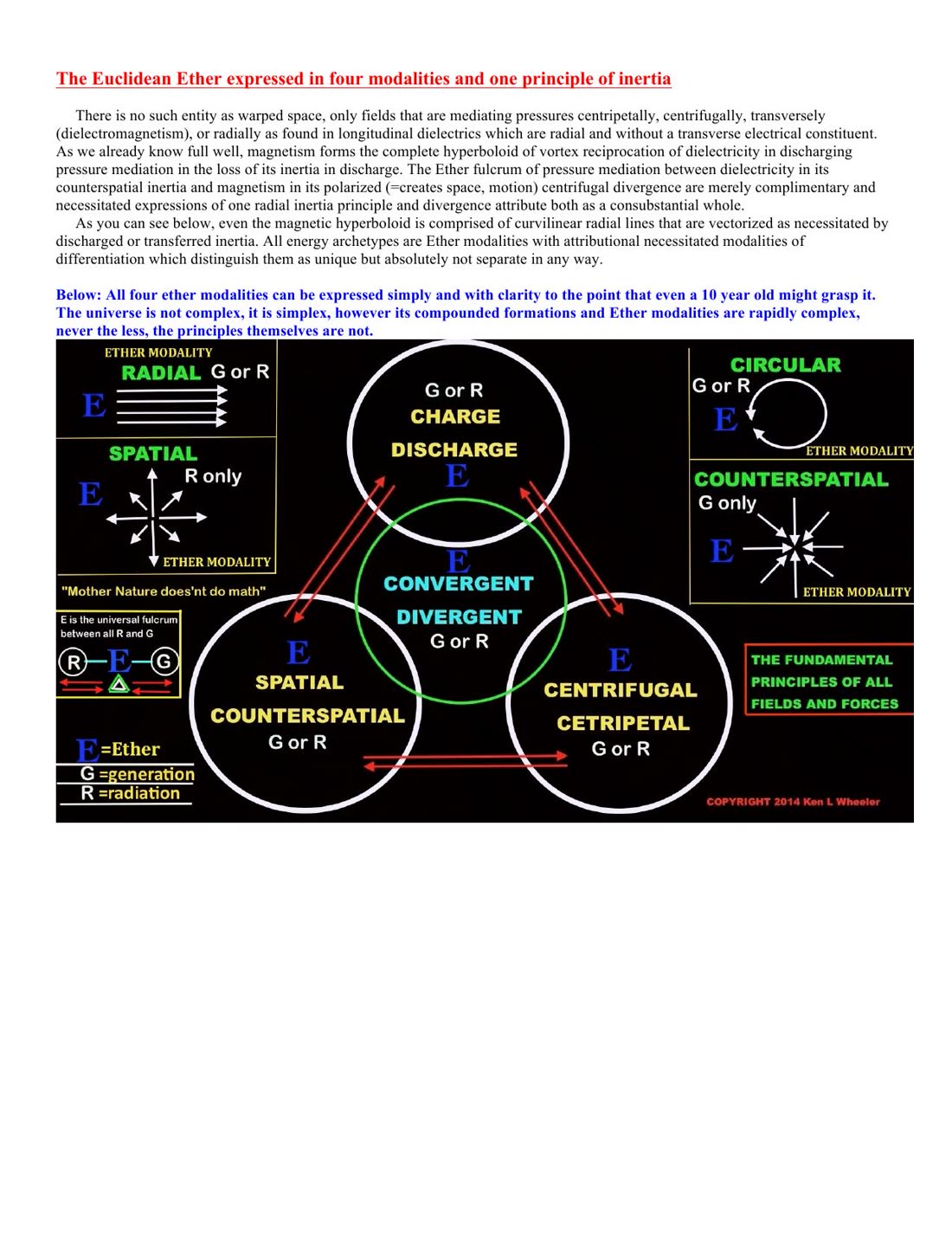
Here is the summary he wants you to leave with. There is ultimately one field with four modalities — four costumes. Everything is dielectricity: the inward, counterspatial charging principle. Magnetism is the loss of that inertia — the outward discharge, the spray. Gravity is nothing but dielectric acceleration — the drain, mislabeled as a pull. And electricity is the hybrid: dielectricity times magnetism, which he writes as phi times psi equals Q, seasoned with a nod to Planck and 'electrification.'
Space, one last time, is the absence of inertia — nothing, with no properties — and here he calls Tesla as his witness: Tesla did mock curved space, in a 1932 newspaper piece, decades before the modern tests arrived. And then the lineage flex, delivered while pointing at the studio lights: your entire electrical grid — the lights powering this video — came from Tesla, Steinmetz, Faraday, and Heaviside. Not from Einstein and his theories. Which are still theories, he adds, and — he claims — less supported today than twenty years ago.
If you've read our main Wheeler document, you'll recognize every clause: this seventy-second recitation is the entire worldview, compressed. This lecture earned its place as chapter nine by being the one where the recitation arrives with the geometry still warm on the table.
The creed, verbatim:
HIS WORDS — auto-captions, verbatim · 18:04–19:17
This is the nature of magnetism. This is how mother nature works. It's that damn simple. There's ultimately only one field and four field modalities.The four: dielectricity (inward), magnetism (outward), electricity (their hybrid), gravity (dielectric acceleration). One substance, four behaviors — his entire physics in one sentence.Okay? Everything is dialectricity. Magnetism is the loss of that inertia. Gravity is no different than dialectric acceleration. Electricity is a hybrid of dialectricity and magnetism. 5 * I equ= Q and plank of electrification.Caption garble: he's saying phi times psi equals Q — magnetic flux times dielectric flux yields electrification. His notation, borrowed from Steinmetz's symbols, not from any standard formula sheet.There's only inertia and the loss of inertia. Everything out here in the bubble of this Taurus, space is the absence of inertia. What is space ultimately? It is nothing. It is the absence of inertia. It has no properties. Just as Nicola Tesla said, the guy that gave you 100% of your electrical grid, Einstein didn't give you He didn't invent any of that stuff. Okay? It's powering all these lights. Tesla, Steinmets, Faraday, Oliver Heavyside, not Einstein and his theories. And they're still theories, by the way. Not only are they still theories, those theories are uh far less supported today than they were mere 10 or 20 years ago.For the record: relativity's experimental support grew through the 2010s-20s — gravitational waves detected, black holes imaged, clocks confirming time dilation at centimeter height differences.
[18:22] Final adjustments while the creed is recited: one field, four modalities, one tabletop.[book, p. 128] The Euclidean Ether chart from his book: one field, four modalities — the creed as a diagram. source ↗
Every thread of the lecture ties off here: the balloon from minute one is magnetism's torus; the white line is the plane where dielectricity rests; attraction, gravity, and power-line forces are all the drain; and the hierarchy — dielectricity first, everything else derivative — is the same spine our main document hangs its twenty-eight concepts on. What remains is his sign-off, and one piece of homework.
Register note: The creed is the claim structure our main document adjudicates piece by piece — follow the links for each verdict. The 'less supported' line about relativity is checkably false and typed accordingly. The grid lineage (Tesla, Steinmetz, Faraday, Heaviside) is broadly fair as engineering history.
If someone asks you at dinner, just say: The whole system: one field, four costumes — dielectricity charges, magnetism discharges, electricity hybridizes, gravity drains.
Part III · The walk · 16/16 · 19:17–20:10
Homework and a benediction
Fifty seconds of goodbye — and like every good teacher, he leaves you with the assignment rather than the answer.
The homework is specific: understand what a hyperboloid is and what it builds — the model of magnetism, force, motion, inertia, acceleration. Look up the Poincaré disc model of projective geometry. That's the door he wants you walking through after the video ends.
The last idea standing is field pressure mediation — his final unification. Everything, he says, is fields adjusting pressure, and it's no different from pulling the drain plug and watching water go where the stillness is. Nature is not a complicated broad; it's just that nobody understands what she's saying.
And then a benediction that the auto-captions garble into 'Luxas praise wisdom' — his sign-off praising wisdom above all else, the same note he's ended on a thousand times: this was never just about magnets. Thank you and goodbye.
His closing words:
HIS WORDS — auto-captions, verbatim · 19:17–20:10
But that's not the point of this video. You need to understand what a hyperbooid is. What does it make up as so far as the model of magnetism, force of motion, inertia, acceleration? Very simple. Look up pon disk model of projective geometry. Okay, mother nature is really, really simple. Everything is field pressure mediation, which isPressure mediation: forces aren't pulls between objects but pressure differences fields resolve — water heading for the drain. It's the lecture's physics compressed to two words.no different than saying you pull the plug on the drain, the water flows down the drain. You know, force in motion, inertion, acceleration. Mother Nature is not a complicated broad, but nobody understands what the hell she's saying. They just don't. Luxas praise wisdom above all else. Thank you and goodbye.The captions garble his sign-off; the audible sense is a benediction on wisdom — sophia — over cleverness. Watch the last twenty seconds and judge the words yourself.
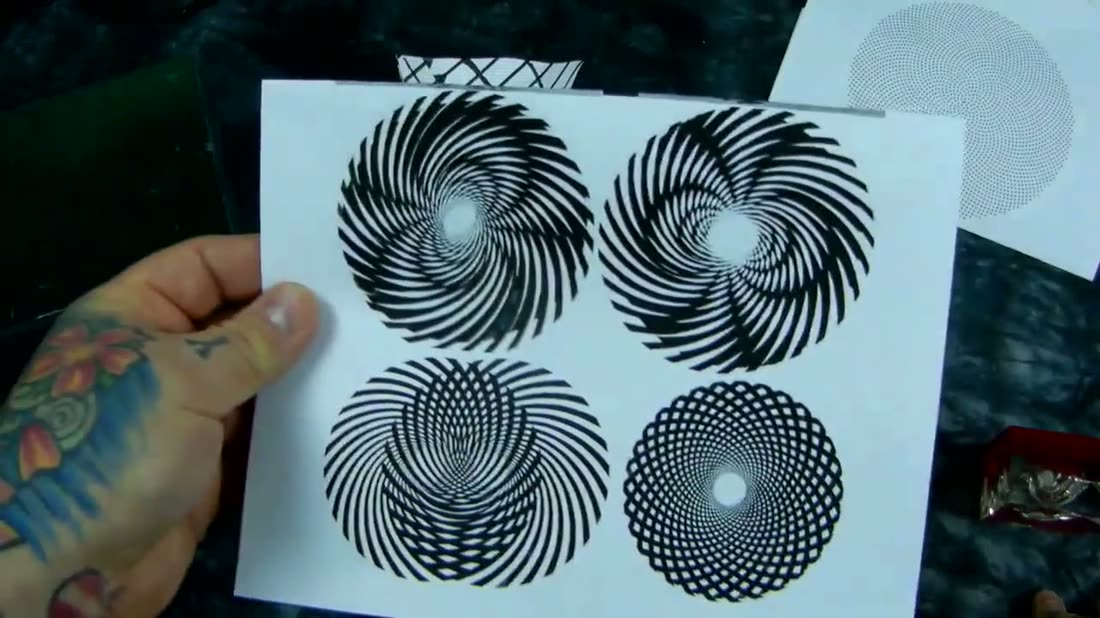
[19:42] The parting print: four hypotrochoid rosettes — the homework, in pictures.[20:07] The closing shot. Everything he claims a magnet is, still standing on the table.[book, p. 161] Book plate: ferrocell pairs labeled as field-pressure mediation — the drain-plug physics he leaves you with. source ↗
That's the complete walk — every sentence of the lecture is now behind you, in his order, with his props. The orientation line at the top promised this lecture introduces his entire field geometry; the creed in section fifteen and this benediction are your proof it delivered. Where to next: the claims register below types everything he asserted today, and every concept link leads back to its full treatment in the main document.
Register note: Pressure mediation links to the Pressure Mediation concept in the main document, where it's typed. The benediction is quoted with its caption garble flagged rather than silently fixed — the verbatim rule cuts both ways.
If someone asks you at dinner, just say: His parting shot: physics is easy, humans are the hard part — now go look up one shape.
17 · The register, settled
The scorecard
Before we let him go — the scorecard. Twelve claims crossed the table in twenty minutes. Here is each one, typed honestly: what agrees with standard physics, what could be tested, what can't be, and what's already been contradicted.
Claim: 100% of the visible universe holds its shape only due to magnetism. The opening balloon claim. Unfalsifiable as stated — 'due to' does no measurable work — but it is the load-bearing frame for everything after.
Claim: Fields have neither quantity nor quality; they can be quantified only over time. Maxwell's equations do describe field evolution; physics happily quantifies field strength at an instant. His narrower point — that this describes behavior, not essence — is philosophy, and fair as philosophy.
Claim: A magnet has no polarity; the plane of inertia is the fundamental feature. Same magnets, same forces, opposite ontology. No experiment in this lecture separates 'poles are fundamental' from 'the rest plane is fundamental.'
Claim: Space is the absence of inertia and has no properties. Collides with tested general relativity: lensing, GPS corrections, gravitational waves. The tests have gone against him. His rope-snake rebuttal is philosophical, not empirical.
Claim: Gravity does not exist as an autonomous force; it is dielectric acceleration. Predicts gravity should couple to dielectric conditions. No such coupling is observed. One of his few claims with genuine experimental teeth — currently unmet.
Claim: Magnetic attraction and repulsion do not exist; they are dielectric voidance and counter-voidance. Force measurements are identical under both stories; the ferrocell patterns are real and consistent with both. Typed as re-description, his best-argued one.
Claim: The ferrocell bloom follows the golden angle (137.5°). A camera and a protractor could settle this. Nobody, including him, shows the measurement in this lecture.
Claim: The golden-angle structure of sand dollars/sunflowers is his discovery. Phyllotaxis at 137.5° is documented botany since the 1830s. His sand-dollar observation may be his; the angle is not.
Claim: AC power lines sag together in an outage and push apart when power returns. Forces between parallel conductors are real (Ampère, 1820). Whether porch-visible line sag is dominated by that force versus thermal load is checkable and unchecked.
Claim: Electromagnetic retardation and phase shift originate at the null point of inertia. Retardation itself is standard physics; his hourglass mechanism adds no differing prediction, so it cannot be tested against the standard account.
Claim: Relativity is less supported today than 10–20 years ago. The 2015–2025 decade delivered gravitational waves, imaged black holes, and centimeter-scale clock tests of time dilation — the opposite of eroding support.
Claim: There is one field with four modalities; electricity is Φ × Ψ = Q. The organizing creed of his entire corpus. Not falsifiable as stated; its testable consequences are typed individually above and in the main document.
18 · In his voice
Quotes wall
“Mother nature is not a crosseyed hooker on crack. Nor does she have a calculator.
“Space is nothing. Space is the absence of inertia. You cannot give reification to something that doesn't exist.
“At the very center of the heart of gravity, there is no gravity.
“It is concentrated there. Just like pressure. No difference in saying water flows downhill.
“Well, maybe it's the words aren't aren't that big that I'm using. Maybe it's your vocabulary is a little too small.
“mother nature is a really simple broad it's just that human beings are really really really really really dumb
“us little human beings live out here. We don't live here.
“She's been screaming out to you for ages and eons. But human beings, we're not that smart yet.
19 · Take it to dinner
The cheat sheet
Scorecard closed. What's left fits in your pocket: the dinner-party cheat sheet — seven lines, everything you need to retell this lecture tonight.
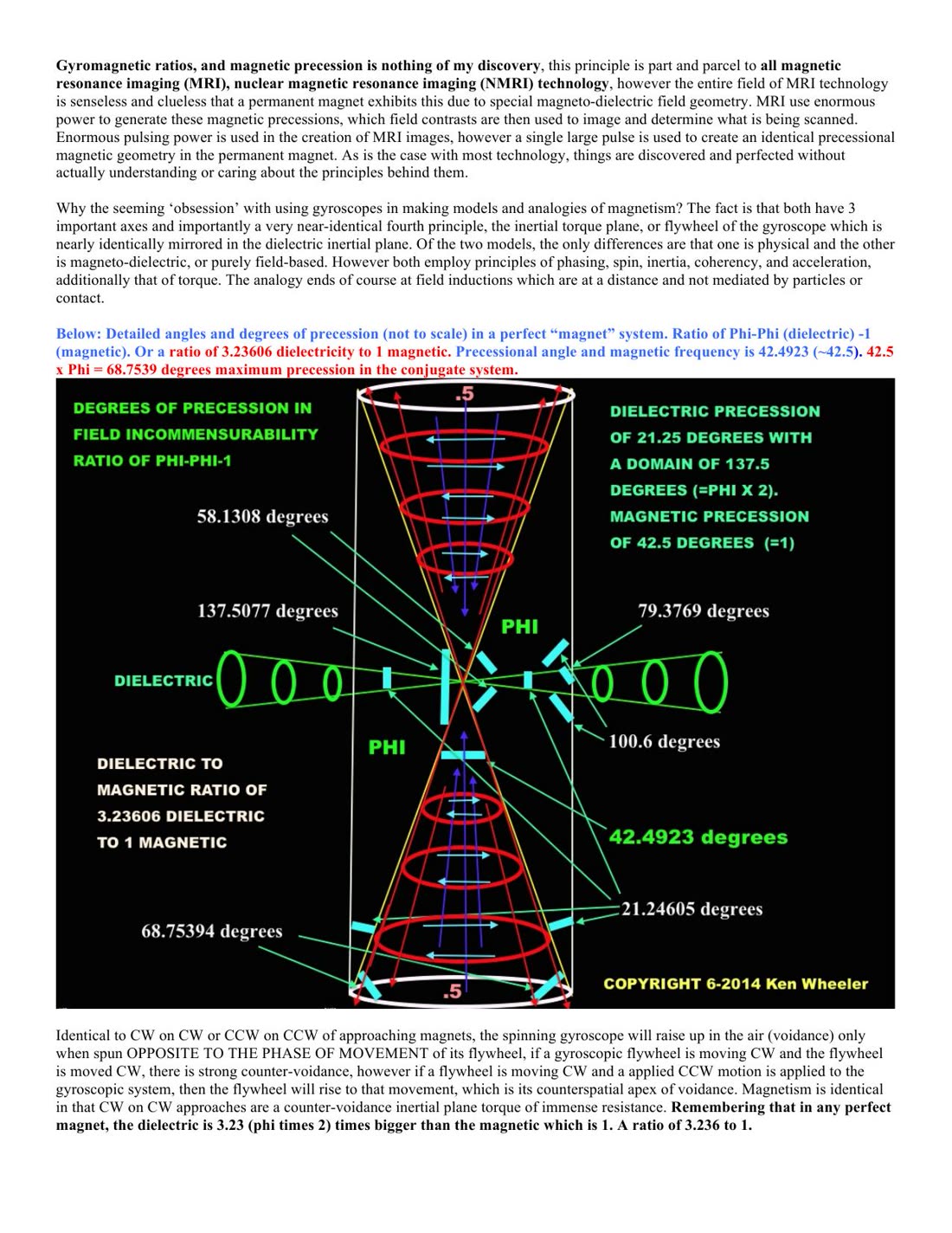
The claim of the day: a magnet isn't a thing with poles — it's a donut of motion wearing an hourglass of stillness.
The white line across a magnet's middle is his main character: the plane of inertia, where he says there's zero magnetism.
Space, on his account, is a shadow — an absence you can't give superpowers to. Einstein, he says, bent a shadow.
Gravity gets fired in one sentence: things fall, but 'gravity' is dielectric acceleration — a drain, not a pull.
His story: attraction is two magnets falling into one still point; repulsion, two sprays colliding. Nothing pulls.
His creed, complete: one field, four costumes — dielectricity charges, magnetism discharges, electricity hybridizes, gravity drains.
Best honest steal from the lecture: 'concentrated, not located' — the middle of a magnet is a behavior, not a part.
And that's the lecture — every sentence of it. The dinner-table version of the whole thing, if you want it: he thinks the universe is an hourglass wearing a donut. The donut is magnetism — outward force and motion, the stuff of the visible world. The hourglass is inertia — the inward stillness it all leans on. The white line where they meet is, for him, the realest thing on the table. Poles, attraction, gravity, even time: all traffic around that stillness. That's his story — told with his props, in his words. The claims register below keeps the score, and every concept links into the main Wheeler document for the long version. Chapter ten is waiting when you are.