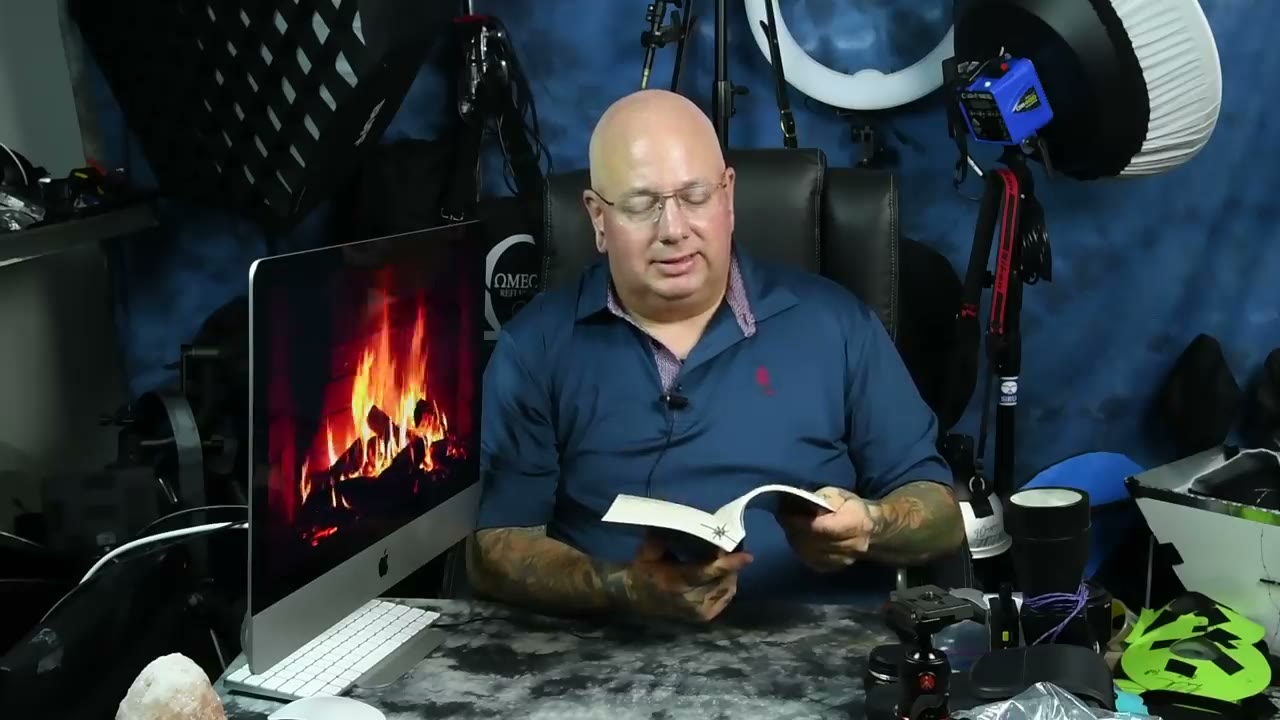
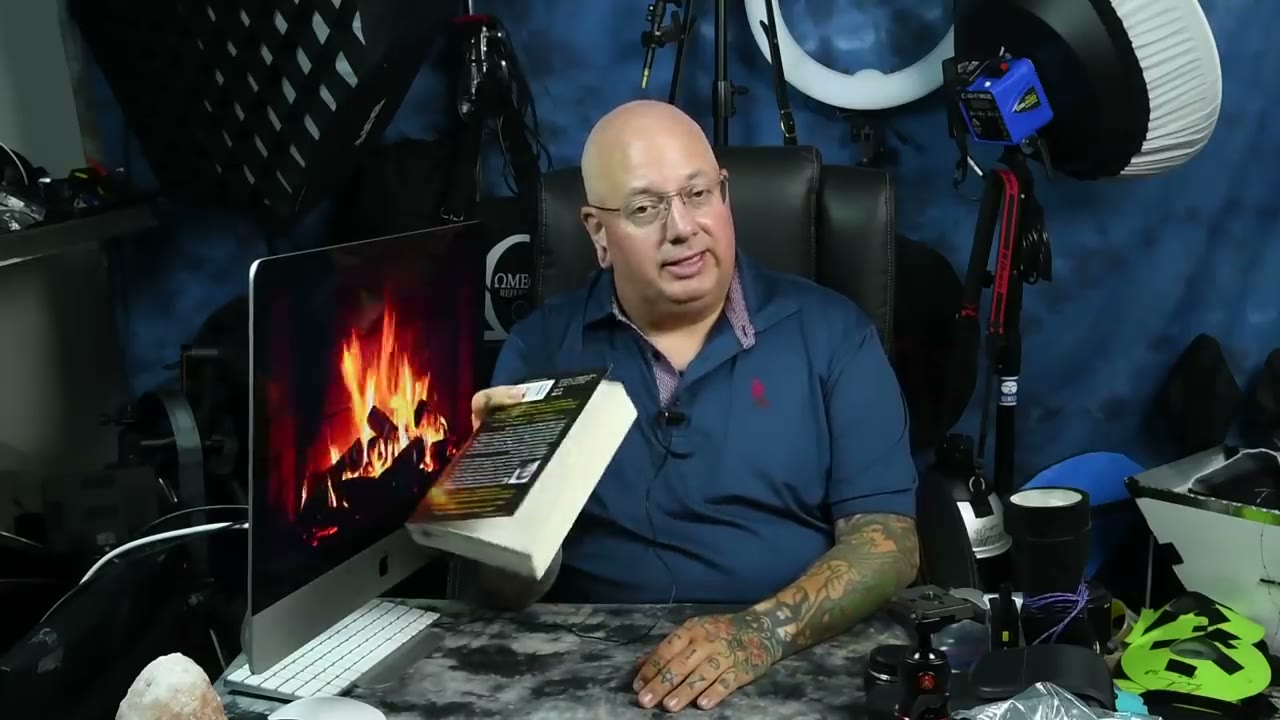
One book, one desk, fifteen minutes. Ken Wheeler holds up The Elegant Universe — the famous string-theory bestseller — and calls it a fantasy novel, then tells you what he thinks the universe actually is: irreducibly simple. We walk his argument end to end in his own words, every claim typed, every mangle translated.
~59 min listen1 lecture · 2,364 words of tape · every one on this pageUpdated 2026-08-15
00 · Start here
Before he speaks
What this lecture assumes: nothing — it is Part I of the series, the method-and-attitude chapter, and the first one you should read. What it introduces: his founding axiom (the universe is irreducibly simple), his six-word definition of a field, the ether-versus-atomism fork, the reification fallacy (treating a concept as a thing) he accuses Einstein of, and counterspace (his inward dimension) — the vocabulary his later geometry needs. Where it sits: the ground floor — every later chapter stands on words coined here.
He holds up the most famous physics book of a generation and calls it a fantasy novel — so what does he think the universe actually is, and can 'elegant' mean something more than a taste? Fifteen minutes later he has bet a thousand dollars on it.
How to read this chapter: three voices share the page and never blend. The specimen boxes are the lecture verbatim — auto-captioned from the tape, mangles and all, sliced never retyped; the ▶ on each box plays him saying it. The teaching between boxes is us: plain English, no allegiance. And the register notes keep the books: when a claim is his, it's marked his; when it's testable, unfalsifiable, or standard physics wearing his vocabulary, it says so. His claims get his best case and honest typing — that's the deal the whole series runs on.
Welcome to chapter one — the front door of the whole series. Fifteen minutes, one desk, one book. Ken Wheeler is sunburned, back from a roofing job in Florida, and in the mood to settle accounts: with school, with science, and with the most famous physics book of his lifetime, which he holds up to the camera and calls a fantasy novel. The deal for this walk: every word of the lecture appears on this page exactly as the auto-captions heard it — mangled Latin, misheard religions and all — with plain-English teaching between his steps, his claims typed honestly, and clips cued to the second so you can hear him say it. He thinks the universe is simple. Let's find out what he means.
Part I · The walk · 1/14 · 00:06–01:16
Sunburned, and suspicious since the library
He opens sunburned and grumbling about a Florida roofing job, and within ninety seconds the grumble becomes the thesis he'll spend fifteen minutes on: the universe is simple at the bottom, and school taught him otherwise.
Before any physics, you get the autobiography. Brought up, he says, not with an education — but they learned me stuff. And by learned, he means indoctrinated: the library kid with an innate sixth sense that the lessons were rubbish. Keep the register straight — that's his self-portrait, not evidence. But it tells you the stance the entire lecture is delivered from: the outsider who checked the foundations himself.
Then the thesis, the load-bearing sentence of the whole lecture: the universe must be irreducibly simple. Not simplex — he pauses to split those two words himself. The world on the surface is plenty complicated; his claim is that the foundation underneath the complexity is simple, undeniably so. Everything in the next fifteen minutes is him defending that one sentence.
Here's how he opens, word for word off the tape:
HIS WORDS — auto-captions, verbatim · 00:06–01:16
hi are you doing my sunburned faces back from Florida that was not a vacation at all by the way sweating your guts out on the roof and on the house it's not what I call a vacation you know I was brought up not with an education but they learned me stuffHis grammar, kept verbatim: 'learned' here means taught. He's saying he was schooled, not educated — and the schooling, he'll argue, was the problem. and my learning stuff I mean indoctrination and when I was young I spent an enormous amount of time in the library and I had an innate sixth sense that was extremely strong and I knew the crap that I was being taught was rubbish nonsense and BS fundamentally I knew and to me this seems blatantly obvious but apparently it's not obvious to everybody else is that the universe must be irreducibly simple not necessarily simplex in complexitySimplex is his word for one-layer simplicity. He concedes the world looks complex while claiming the root of it isn't — the split matters for everything he says later. of course things are not simple at all but the fundamental foundation of things is undeniably simple but all the stuff that I was taught in the same garbage that you were taught was indoctrination it was not how the universe works
[00:10] Sunburned and back from the Florida roof: the lecture opens mid-conversation, fireplace glowing on the studio monitor behind him.
This stance is what the whole series runs on. His method — retroduction, reasoning backward from an effect to the one cause it demands — only makes sense if you believe nature's foundation is simple enough to reason back to. The main Wheeler document opens with that method; this lecture is him telling you where the conviction came from.
Register note: His self-portrait and his founding axiom. The axiom — nature is simple at root — is a metaphysical commitment, not a measurement; but physicists from Newton to Einstein have held versions of it.
If someone asks you at dinner, just say: He starts with his origin story: the library kid who decided the textbooks were indoctrination — and the one belief that fell out, that the universe is simple at the bottom.
Part I · The walk · 2/14 · 01:16–02:20
Every epoch was sure it knew
Now the historical argument that justifies the suspicion: pick any era of science — they all thought they had the universe nailed, and they were all wrong.
His pattern-spotting runs like this. Every epoch — twenty years, two hundred, a thousand, it doesn't matter — the experts of that epoch agreed they knew how the universe worked. The content changed; the certainty didn't. Sometimes the agreed picture was religious, sometimes geocentric, sometimes mechanical. They always knew they were right. And a period of time afterwards — yeah, we didn't know what we were talking about.
Then the move that matters: he refuses to exempt the present. Right now is absolutely no different. If every previous epoch's certainty was delusion, why would ours be history's first exception? Philosophers call this the pessimistic induction — pessimistic, because it indicts even the successful present — and whatever you think of where he's going with it, this premise is not fringe. It's one of the standard worries in philosophy of science, and he lands on it in his own words, at his own desk.
The epoch argument, in his words:
HIS WORDS — auto-captions, verbatim · 01:16–02:20
an undeniable fact also is it every epoch of science and sometimes it's like 20 years and sometimes it's 30 years and during the dark ages epoch an epoch of science where he basically had everybody kind of agreeing on somethingBy epoch he means any long stretch where one picture of the universe ruled — geocentric, religious, Newtonian. The Dark Ages version lasted centuries; ours changes faster. was as long as I think up to like two or three hundred years and in ancient times it could have been even a thousand years we're making a lot of advances recently but the same thing whether it be 20 years or 50 or 100 or a thousand years the fact is that science itself agreed that they knew what the hell was going on I knew how the universe worked mostly it was based in religious nonsense of course the matter of it was heliocentric it doesn't doesn't matter what it wasCaption tangle. His point: the agreed model was once tangled with religion and wrong astronomy — the content changed every time, the certainty never did. they always knew that they were right that we nailed it we got it down now we know what's going on and a period of time afterwards like yeah we didn't know what we were yeah we're completely and right now is absolutely no different we're suffering under a cult of atomismAtomism: the belief that everything that happens is particles bumping particles. He names our epoch's doctrine out loud so he can file it in the same graveyard as the others.
[01:00] The epoch argument, delivered from the desk: every era of science was certain, and every era was wrong.
This is why he thinks the question in the next section is even askable. If certainty is the recurring disease, then our epoch's deepest commitment — atomism — deserves the same autopsy. The main document gives atomism-versus-ether its own concept; here you get the history speech that motivates it.
Register note: The pessimistic induction is a respectable, live argument in philosophy of science. What he builds on top of it — starting next section — is his own.
If someone asks you at dinner, just say: His history lesson: every age of science was certain, and every age was wrong — so why would ours be the exception?
Part I · The walk · 3/14 · 02:20–03:04
The cult of atomism — and what he doesn't deny
So what exactly is our epoch's doctrine — the one he says will look deluded in a century? Here he names it, and draws the line his whole system is built on, more carefully than his reputation suggests: he is not denying that atoms exist.
The distinction, and it's genuinely important to getting him right: atoms, fine. Atomism — the philosophy that everything that happens is bumping-particle interaction — that he calls a false philosophy, palpably incorrect. He's separating a thing from a theory-of-everything built on the thing. The Greeks, he notes, fought this same fight before us.
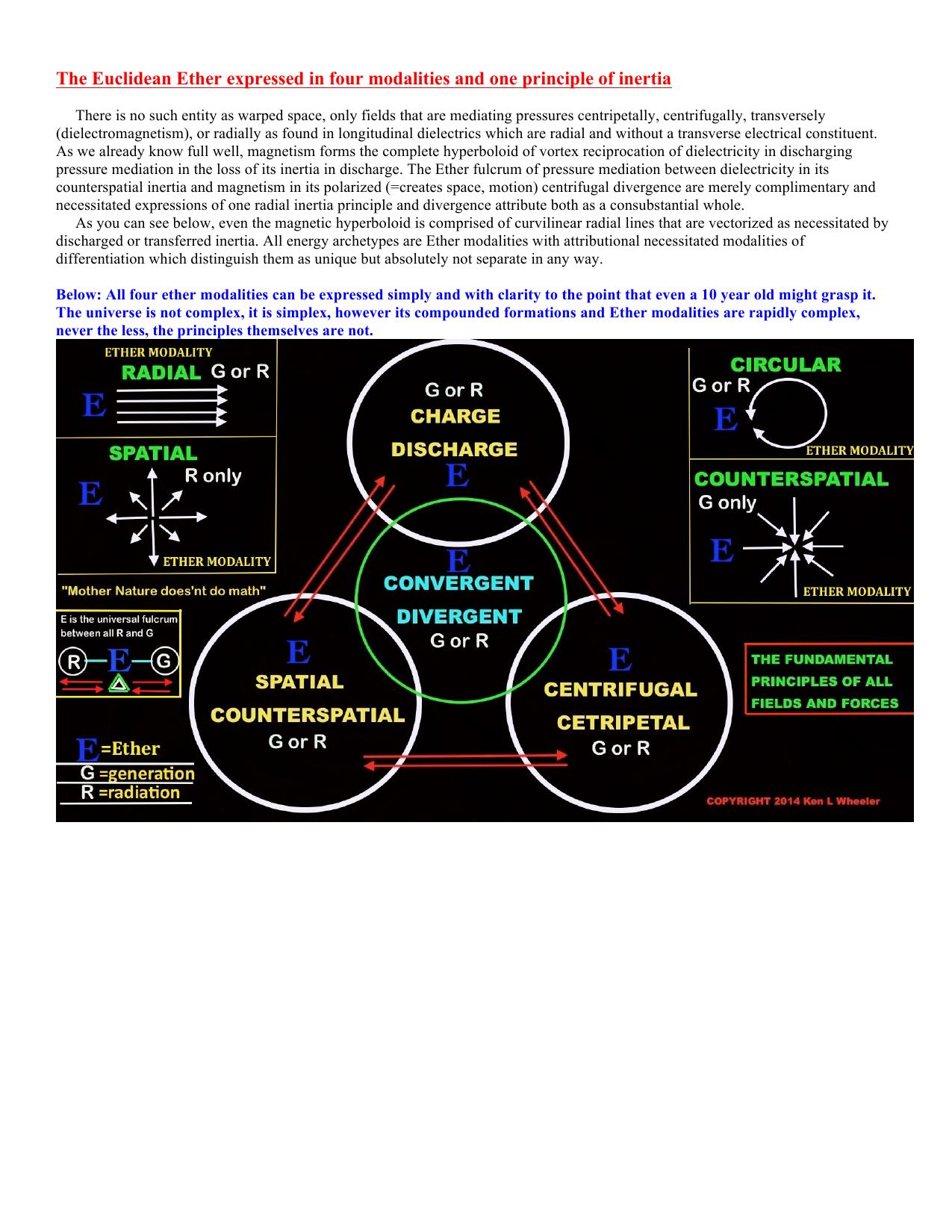
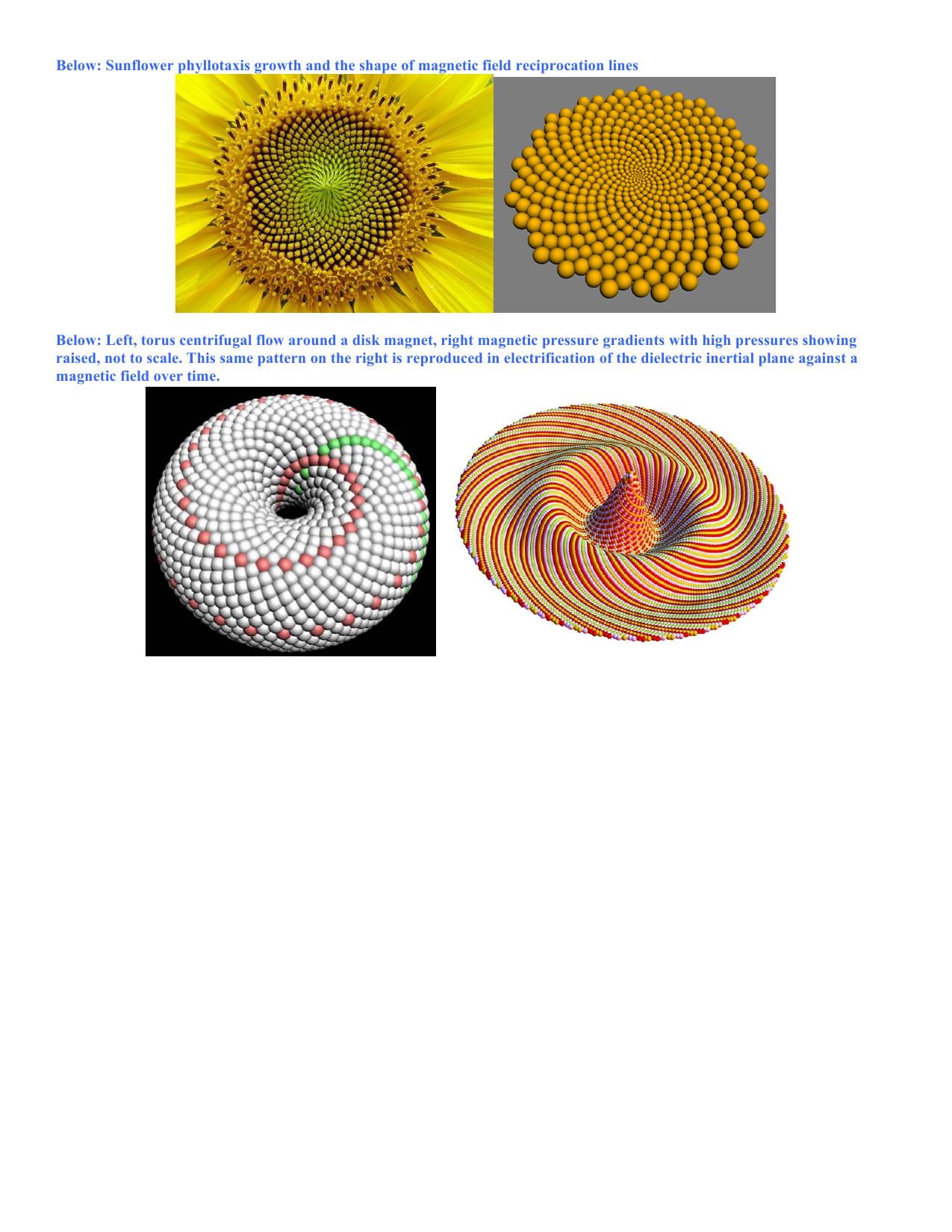
Then, almost in passing, he drops the sentence his entire system hangs on: a field is an ether perturbation modality. No branch of science, he says, has ever defined the term field — and he just did, in six words, so casually you could miss it. Unpack it. The ether is the medium nineteenth-century physics believed filled all space and carried light, the way water carries waves — abandoned after Einstein, revived by him. A modality is just a mode, a pattern. So a field, in his six words, is not an object at all: it's a disturbance pattern in a medium. And the assembly matters — one medium, many modes: his gravity, his magnetism, his electricity are all, he'll argue across this series, different perturbation modalities of the same ether.
Hold onto that definition. He's going to bet a thousand dollars on the undefined version later.
The line-drawing, verbatim:
HIS WORDS — auto-captions, verbatim · 02:20–03:04
the ancient Greeks actually suffered under Adam ISM beforeThe auto-captions hear 'Adam-ism.' He means atomism — and the 'Adams' a moment later is atoms. He never denies the particles; he denies the philosophy. and by the way I need to be very specific I had no point in time ever denied Adams Adam ISM itself the refutation or the down putting of atomism is not a denial of Adam's it is a false philosophy a viewpoint on cosmic mechanics which is palpably incorrect no branch of science has ever defined the term field I'll do it for you very simply right now by the way a field is an ether perturbation modalitySix words, his whole system: a field is a mode or pattern of disturbance in the ether — not a thing, a behavior of a medium. but science never defined a field the refutation of atomism is the denial that everything is a bumping particle interaction mutual particle interThe tape clips the word — interaction. He's mid-sentence describing the bumping-particle worldview he rejects. and by the way this sounds completely ludicrous
[book, p. 128] From his book: the ether's four expressions in four modalities — the framework behind his six-word field definition. source ↗
Two threads to follow from here. The field definition gets its full treatment in the main document under Field (redefined), and the ether it presumes has its own concept page. The atomism-versus-ether fork is the oldest split in his system — as he says, the Greeks had it too.
Register note: His framing. Atomism as he defines it is a real philosophical position with a long history; whether modern physics still holds it is the argument of the next two sections.
If someone asks you at dinner, just say: His careful line: atoms exist, but atomism — everything is bumping particles — he calls a false philosophy. And he defines a field in six words: an ether perturbation modality.
Part I · The walk · 4/14 · 03:04–03:43
Unicorns between the magnets
And with the doctrine named, the target practice begins. He picks the strangest-sounding claim in mainstream physics first: what it says is actually happening between two magnets.
First, his claim about the mainstream — and here's the uncomfortable part: it's roughly accurate. Quantum field theory does model the electromagnetic force as an exchange of virtual photons. He dares you to Google it, and if you do, you'll find he's reporting the textbook correctly.
His objection isn't the math; it's the ontology — what the math is supposed to be a picture of. Virtual photons have never been observed, and here he's also right, almost by definition: virtual particles are devices inside the calculation, undetectable in principle. Where he jumps is from unobservable bookkeeping trick to unicorns and leprechauns — from 'this is a model' to 'this is a fantasy everyone mistakes for reality.' That jump is the argument of his life, compressed into one joke.
The Google dare, verbatim:
HIS WORDS — auto-captions, verbatim · 03:04–03:43
but it's absolutely true and you could do a google search or a Bing search on this to validate it is that all modern science and this is a fact it sounds crazy but this is what they believe they think that what's going on between magnets whether be repulsive or accelerative is an exchange of virtual photonsReal term, real theory: quantum electrodynamics describes magnetic attraction and repulsion as virtual-photon exchange. His dare checks out — search it. something that has never been observed never been documented is completely a conceptual fabrication to make equations balance outHis read: the particles exist to make the math work. Physicists would say the math predicts, and this is how. Same observation — opposite conclusion. these things don't exist it would be as ludicrous of saying unicorns and leprechauns microscopic ones are flying back and forth between virtual photonsThe captions mangle the landing: microscopic unicorns flying back and forth between the magnets — those are the virtual photons, in his telling.
Watch the collision: retroduction turned against the mainstream. He reasons backward from 'never observed' to 'doesn't exist'; physics reasons forward from 'the equations work' to 'good enough.' The main document's method chapter is where this collision gets its full hearing — and the magnetism chapters are where he offers his replacement mechanism.
Register note: His reporting of the mainstream is fair; his verdict on it is his. Whether virtual particles are real or bookkeeping is a live dispute in philosophy of physics — he didn't invent the question.
If someone asks you at dinner, just say: His best gotcha: physics says magnets work by exchanging virtual photons — particles no one can ever observe. He calls them unicorns; physicists call them accounting.
Part I · The walk · 5/14 · 03:43–05:47
The book on his desk
And now the prop this lecture is named for. He holds up a famous popular-science book — he never names the author — and delivers the most quotable insult of the series.
The book is The Elegant Universe, Brian Greene's famous popularization of string theory. Wheeler identifies it by television — the author did some shows for Nova, he says, and he's right: Greene's Nova specials were a phenomenon. He also says he's read it cover to cover. His review is not mixed.
Strip the theater and there's a real argument inside the insults. His charge: string theory is mental machination — mathematics unmoored from mechanism, a fantasy novel wearing a lab coat. And that charge is not his alone. Critics inside physics — Peter Woit, Sabine Hossenfelder, Lee Smolin — have spent twenty years making a politer version of the same point: string theory makes no testable predictions and may fail the falsifiability standard of science.
Then the sentence that gives this chapter its title. Books like this, he says, paint mother nature as — his words, verbatim — a cross-eyed hooker on crack. Crude, and he'd own it proudly. But notice the claim underneath the slur: nature is actually elegant. It's the book's universe of magic bumping particles that he finds deranged. He and Greene both worship elegance; they just mean opposite things by it.
The review, word for word:
HIS WORDS — auto-captions, verbatim · 03:43–05:47
I have a book here and I'm not trying to single out the author and there are many many books like this talking about cosmic mechanics and the title of this book is the elegant universeBrian Greene's 1999 bestseller on string theory. He keeps saying he's not singling out the author — the title does it for him. and I'm really not trying to single out this author he's done some TV shows for Nova I think one at least I remember seeing it within the pages of this book on the elegant universe and I've been through this book cover-to-cover and of course it reads like the Marx Brothers and somebody that's drunk or high or drunk and high is the most ludicrous nonsensical poppycock rubbish twaddle insanity illogical abstruse conceptual fabrications you is basically a fantasy novel this this is not science and by science I actually mean TecnaTechne — the Greek word for craft or skilled art, which is the root he's reaching for. In his mouth, science 'in the original sense' means the quest for truth, not a creed — that's his framing, whatever the Greek says. the original connotation and denotation of science both Aristotelian Pythagorean a platonic which is the quest for truth this is a religion this is this is poppycock based upon mental machinations this if you were to believe this book and I don't want to show the author you could look the book up I'm not trying to single out the author he was brainwashed like they tried to brainwash me but I was too smart to be brainwashed with rubbish and nonsense this paints mother nature is a cross-eyed hooker on on crackVerbatim, mangle and all — the tape stutters 'on on.' His image: nature as these books paint her isn't elegant, she's deranged. literally she's an insane whack job with a bag of magic bumping particles the universe is elegance yes stuff like this paints the universe as complete insanity fairy tale twaddle complete ludicrous insanity
[02:30] The exhibit enters: he reaches down and lifts the book the lecture is named for.[04:05] The Elegant Universe, held to camera. He never says the author's name — the cover does it for him.
This is the emotional core of the chapter and its title. The elegance he's defending isn't decorative — it's the irreducible-simplicity axiom from section one, now with a villain attached. When he lists his own 'elegant' ingredients next, hold them to the standard he just set.
Register note: His opinion of the book, loudly. The underlying critique — string theory's lack of testable predictions — is shared by credentialed physicists in politer vocabulary. Neither fact makes his alternative correct.
If someone asks you at dinner, just say: The book takedown: he holds up The Elegant Universe and calls it a fantasy novel — and under the insult sits a critique that credentialed physicists also make.
Part I · The walk · 6/14 · 05:47–06:32
Nature's short ingredient list
Having trashed the fantasy novel, he owes you his alternative — and here it comes at full speed: four properties, two moves, two dimensions.
The list, in his order. Everything in cosmic mechanics reduces to four things: capacitance, resistance, magnetic permeability, dielectric permittivity. The last two you may not have met since physics class. Permeability measures how much magnetic field a medium supports; permittivity, how much electric field it permits — they're real, measured constants of nature, and in the standard picture they set the speed of light. His list isn't random.
Then the two moves: everything is either force in motion or — the captions say nursing, he says inertia and acceleration. Force-and-motion is the expanding, doing side; inertia-and-acceleration is the returning, storing side. That pairing should surprise you — in textbook physics, inertia resists acceleration. It pairs them because in his usage inertia means rest itself, and acceleration is the return toward it. This binary shows up in nearly every lecture he ever recorded.
And finally the two dimensions — which is where he leaves the mainstream entirely. Cartesian space, the three directions you can point, and its opposite, which the captions mangle into anti-cartridge and he names properly a beat later: counterspace. Not a place. His word for the inward, center-seeking direction he thinks stillness lives in.
The whole inventory, verbatim:
HIS WORDS — auto-captions, verbatim · 05:47–06:32
everything in cosmic mechanics is irreducible to the Furies of very few simple pointsCaption wreck — he says a series of very few simple points, and then names the four. capacitance resistance magnetic permeability and dielectric permittivity everything is either force in motion or nursing accelerationHe says inertia and acceleration — nature's second move. Inertia in his mouth means rest itself, the stillness things return to — not the textbook's resistance to a push. there's only two dimensions the dimensions of Cartesian space and anti cartridgeThe captions give up. He means anti-Cartesian — then hands you the usable names himself: subspace, counterspace. you can say subspace you could say counter space doesn't matter what term you use for it there's only two dimensions and these two dimensions of course follow respectively the the dimensions of force and motion and the dimensions which is an anti dimension and kind of creating a word there but it's extremely accurately put to speak of it as an anti dimensional dimensional of course we're talking about mass and magnitude when you actually have mass and magnitude then you have the creation of something else which does not exist which is time
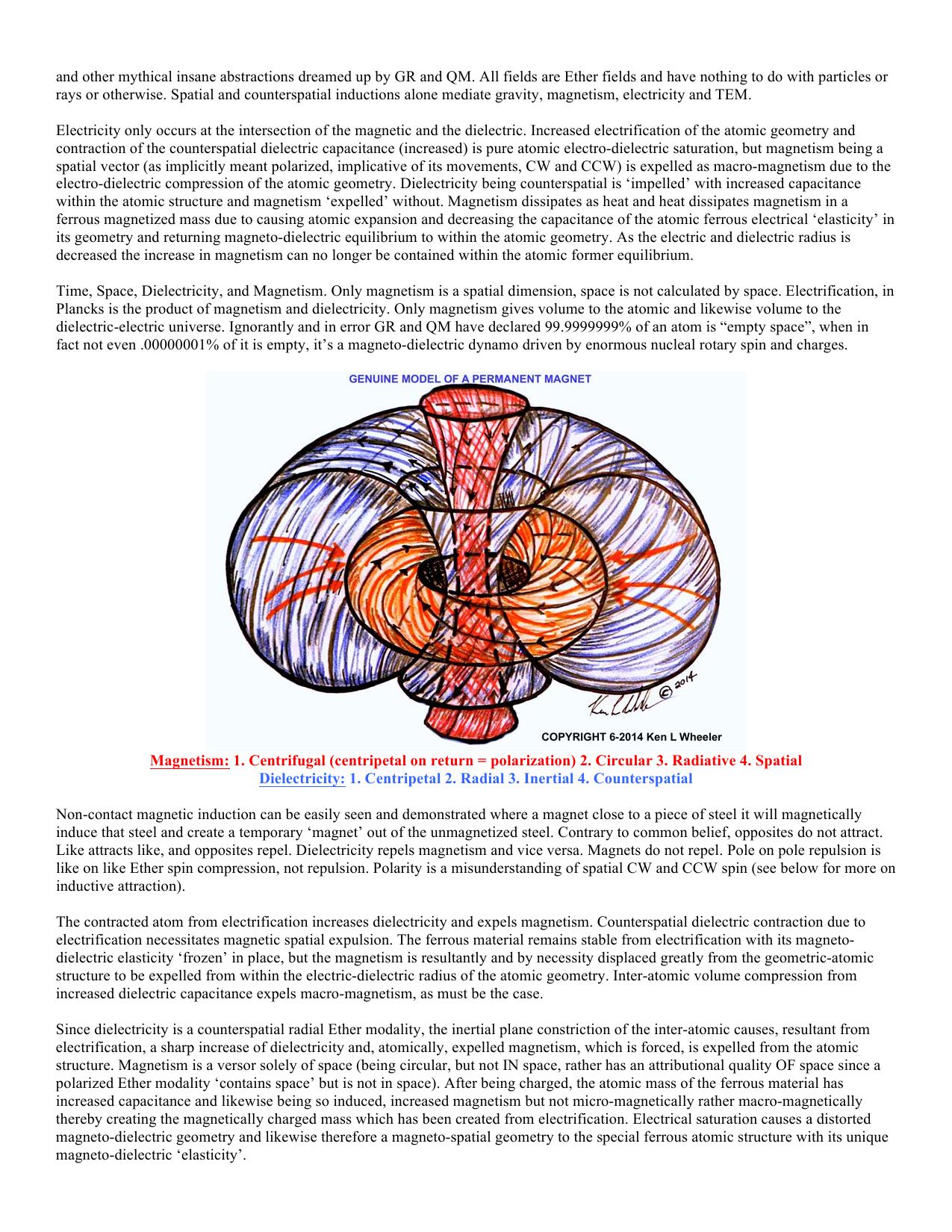
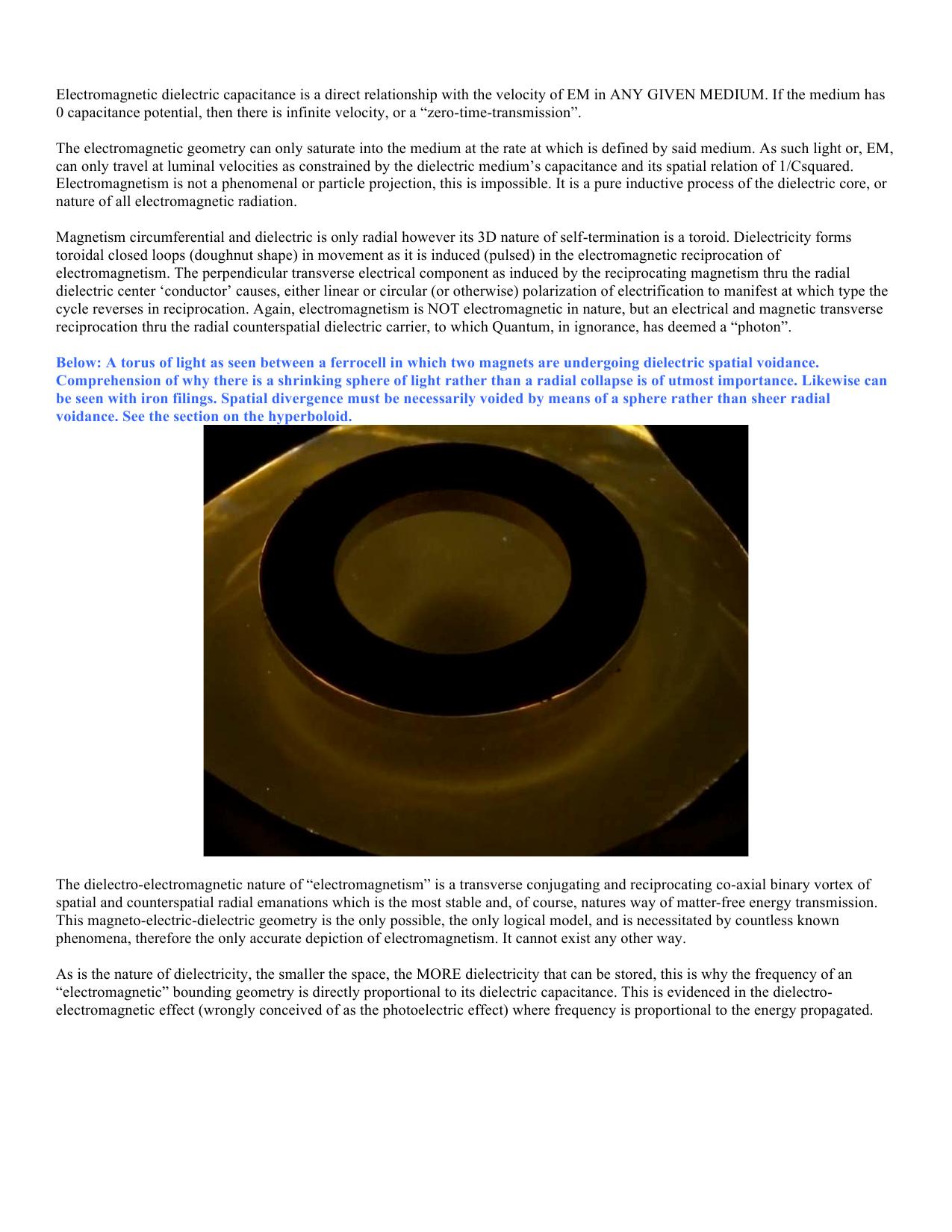
[05:50] Hands clasped for the inventory: four properties, two moves, two dimensions — his whole universe on one napkin.[book, p. 56] Book plate: his unified dielectric-magnetic cosmos — centrifugal magnetism (spatial) against centripetal dielectricity (counterspatial). The two dimensions, drawn. source ↗[book, p. 214] Book plate: the dielectric toroid inside a magnet — his picture of where capacitance and permittivity live in the ingredient list. source ↗
You've now met the skeleton his whole system hangs on. The main document gives each piece its own concept — inertia, counterspace, and dielectricity, his name for the counterspace side. The magnetism chapters are where this skeleton gets drawn on a whiteboard.
Register note: His framework. Permeability and permittivity are standard constants; the two-moves binary and counterspace are entirely his. Nothing here is derived on camera — it's asserted as the frame.
If someone asks you at dinner, just say: His whole universe on one napkin: four properties, two moves — force-and-motion, inertia-and-acceleration — and two dimensions, space and counterspace.
Part I · The walk · 7/14 · 06:32–07:01
The missing four
Straight out of the two-dimensions claim comes the reason he brought up time at all — mass and magnitude create it, he just said. Now he swerves into numerology, and the honest thing is to call it that: he thinks a missing number in the Fibonacci sequence says something about time.
The argument: ancient cultures spoke of time as the number four. The Fibonacci sequence opens one, one, two, three, five — and four is the number missing from those first five digits. Therefore, in his telling, time doesn't exist. Then he checks himself mid-sentence — I'm not here to talk about time — and moves on.
So what's actually on offer? A coincidence, plus a historical claim. The historical claim — that ancient cultures coded time as four — has grains: four seasons, four directions, four ages recur across cultures. The numerological move — a missing digit proving nonexistence — is not an argument, and nothing else in his system depends on it. Notice he seems to know it: he's the one who cuts himself off.
What you're seeing: The Fibonacci opening, built square by square — and the absent four.
The Fibonacci minute, verbatim:
HIS WORDS — auto-captions, verbatim · 06:32–07:01
all ancient cultures spoke of time as the number 4 and the missing in the first five digits the Fibonacci sequence is the number 4 1 1 2 3 5 8 13 sonís 1 1 2 3 5 let's go over that againThe captions choke on the counting. He recites Fibonacci — one, one, two, three, five, eight, thirteen — then restarts: the first five are one, one, two, three, five. Four is absent. 1 1 2 3 5 time doesn't exist but I'm not here to talk about timeHe flags his own digression. Time gets its own lecture later in the series; here it's a drive-by. you and I also grew up you know watching this science fiction well it's entertaining and amusing to watch it's just rubbish talking about bending space-time space-time
[06:50] Counting off the Fibonacci opening — one, one, two, three, five — and asking where the four went.
File this under register discipline: it's his mystical aside, and even he won't spend a full minute on it. The serious version of 'time doesn't exist' — time as a measure of change, not a thing — comes back in section eleven with an actual argument attached.
Register note: Unfalsifiable as stated — numerology, honestly labeled. The philosophical claim under it, that time is a measure rather than a substance, is a real position in physics' own debates.
If someone asks you at dinner, just say: His numerology minute: four is missing from Fibonacci's opening, the ancients called time the four — so time doesn't exist. Even he cuts himself off.
Part I · The walk · 8/14 · 07:01–07:30
Space is a shadow
And from time to its partner. Space-time is the phrase that truly offends him, because it requires space to be a thing that can bend — and the next ninety seconds are his case that space is nothing of the kind. The main document treats this idea as a headline concept.
His exhibit is Tesla's famous contempt for Einstein — the fuzzy-haired crackpot line. Tesla's public attacks on relativity in the 1930s are documented; that specific wording circulates on the internet unverified, so treat it as his ammunition, not the record. The accusation: Einstein reified space — treated it as a thing with properties, something that can curve and bend.
His counter is the best image in the lecture. Space, he says, is like a shadow. A shadow has attributes — length, direction, shape — but no properties, because a shadow is not a thing: it's an absence of light. You can't bend a shadow, store energy in one, or curve one. And bending space-time — the phrase he and you both grew up on in science fiction — is exactly that mistake: giving an absence the powers of a substance.
The name for the mistake, and he gives it correctly, is reification: treating a concept as a concrete thing. That's a standard term in logic, not his invention — and he's applying it the way a philosopher would.
What you're seeing: The shadow argument, animated — attributes versus properties.
The shadow argument, verbatim:
HIS WORDS — auto-captions, verbatim · 07:01–07:30
well space has no properties the reason why Nikola Tesla called Einstein a fuzzy haired crackpot is because Einstein and the psychopathic lunatics of his elkHis ilk. Tesla's contempt for Einstein's relativity is documented; the exact 'crackpot' wording is unverified — and the diagnosis is Wheeler's. in quantum tried to reify space as having properties and in space has no properties it has attributes just like a shadow but a shadow has no propertiesThe key split: attributes describe, properties do. A shadow's length is an attribute; it can't push anything. because the shadow is not a thing a shadow is an absence of light this is called the fallacy of concept reificationReification: mistaking an abstraction for a physical thing. Standard term in logic and philosophy of science — he didn't coin it, he wields it. in humans of course are extremely guilty of this on countless countless fronts
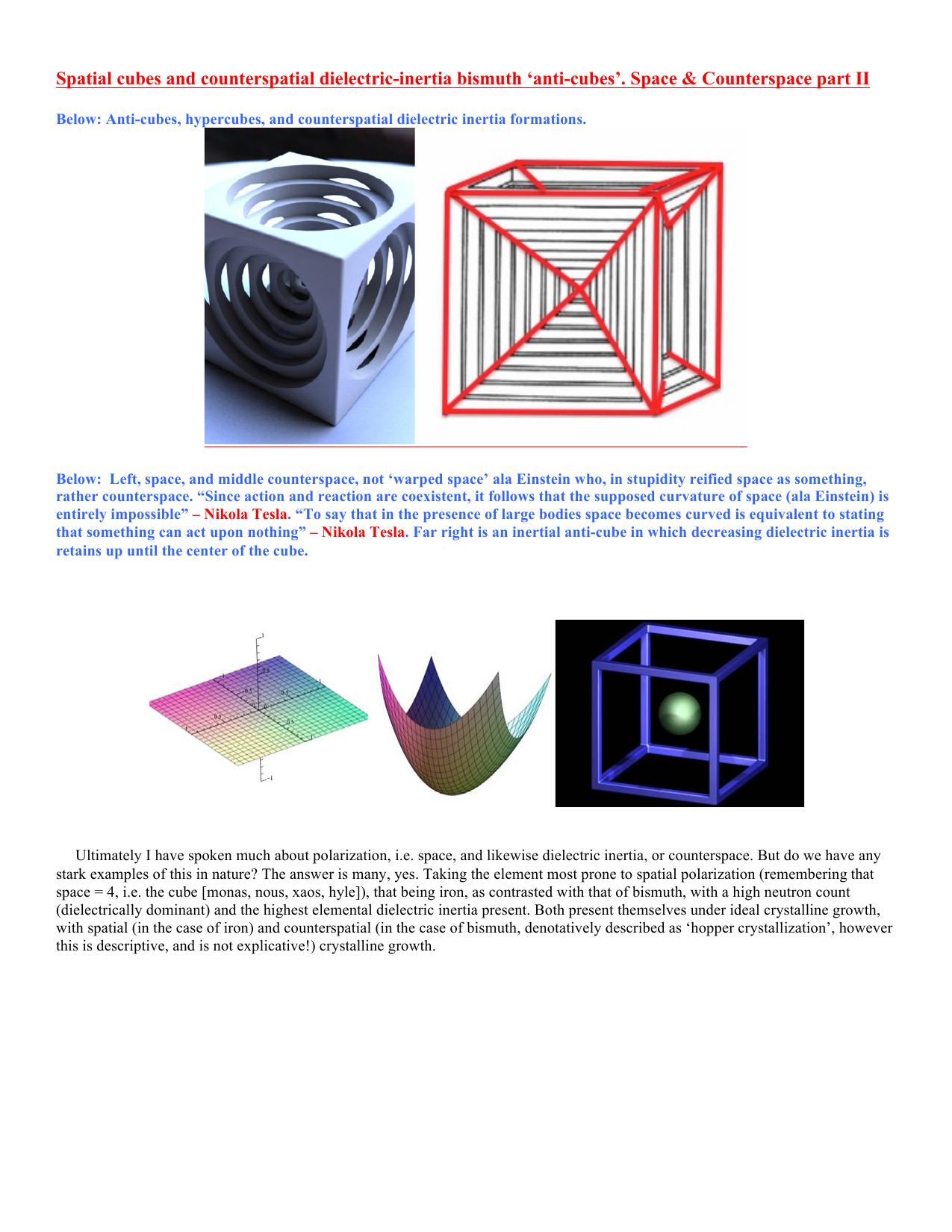
[book, p. 103] Book plate: spatial cubes against counterspatial 'anti-cubes' — his counterspace, the dimension he says a shadow of space can't have. source ↗
This is concept five in the main document — Space Has No Properties — where it gets his full vocabulary. It also sets up his Einstein grudge match later in the series: if space can't bend, then general relativity's geometry is, for him, a category error.
Register note: Contested, and worth holding both sides: relativity measures spacetime geometry and its predictions pass; relational philosophers have argued his side for centuries. Tesla's documented contempt for relativity is real; the exact wording and the insult are his.
If someone asks you at dinner, just say: His shadow argument: space has attributes like a shadow but no properties, because it's an absence, not a thing — so you can't bend it.
Part I · The walk · 9/14 · 07:30–08:19
You are not your beliefs
Then the pivot the tape doesn't announce. Reification, he says, isn't just a physics mistake — and without warning the physics lecture becomes a psychology one: the most personally revealing ninety seconds he records.
His pivot: reification isn't just a physics mistake. Humans do it with beliefs — we reify our beliefs as who we are. An attack on a belief then feels like an attack on the self, so people defend beliefs like territory. Hence, in his accounting, ninety-nine point nine percent of war, strife, misery, depression, materialism.
Now — the number is pure rhetoric, and the psychology is ancient: the Buddhists he admires built an entire practice on not being your thoughts. But hear this section against section one. This is a man explaining how he can say every physicist alive is wrong without anger: he's telling you he doesn't identify with his beliefs. Whether that's true of him is yours to judge from fifteen minutes of tape. That he sees the trap clearly — that much is on the record.
The pivot inward, verbatim:
HIS WORDS — auto-captions, verbatim · 07:30–08:19
it's also the reason and basis as per the consciousness and the human being the own thoughts of man or beings is that we actually reify beliefs as who we areThe same sin as bending space, one level down: treating an abstraction — a belief — as a concrete possession: you. we think we are our beliefs and of course people attack it attack insane beliefs and since people think that they are their beliefs then this is a basis for 99.9% of war strife misery depression materialism everything that's miserable in the world is due to the fact that people think they are their beliefs but you're an every year beliefsCaption salad for the punchline: you are not your beliefs. and beliefs of course as a construct of selfhood that we actually have in our heads well I believe this and I believe this crap and I believe this other crap and therefore those beliefs are who I am but that is not who we are
This is the lecture's hidden key. The house-of-the-answer parable that closes the tape only lands if you've heard this part: knowing is dangerous, for him, precisely because people become what they know.
Register note: His frame, unfalsifiable as quantified. The underlying practice — dis-identifying from belief — has a long lineage in the Buddhism and Stoicism he openly admires.
If someone asks you at dinner, just say: His psychology aside: people think they are their beliefs, so they fight for them — and that, he says, is most of the world's misery.
Part I · The walk · 10/14 · 08:19–09:41
Only two foundations
And that inward turn sets up the emotional peak. After the trap, the treasure: he starts describing what he found at the foundation — and it's the closest this guarded man comes to reverence.
First the feeling, because he leads with it: the irreducible simplicity he found is beautiful, sublime, jaw-dropping — the payoff of years of quest. Say what you want about his physics; this is a man describing a genuine aesthetic experience, the same kind mathematicians and physicists report. That data point stays real even if every conclusion he drew from it is wrong.
Then the house image. He was never interested in the fancy rooms — the timber, the plumbing, the wiring, the complexity. Only in what the house is built on. And at that foundation, he says, there have only ever been two substrates, two first theories: everything from nothing — bumping particles, spontaneous auto-creation — or the ether.
The captions butcher the Latin, so here it is clean: ex nihilo — from nothing — and its cousin, from nothing, nothing comes. He rejects that as worse than a belief system. His foundation is the other one: the ether, which he calls hyper-logical, simplex, beautiful. One continuous medium, against the void-and-particles picture he spent the first four sections mocking.
What you're seeing: The two foundations, side by side — the fork he demands you pick.
The fork, in his words:
HIS WORDS — auto-captions, verbatim · 08:19–09:41
the irreducible simplicity I will tell you this and I hope you're listening closely the irreducible simplicity of cosmic mechanics and mother nature is so beautiful is so sublime it is absolutely jaw-dropping and absolutely amazing it's far and above anything I ever and make countless years of a quest to realize what it was and it's in its foundation you know we see all the complexity in nature and things we make like computers and countless complexity incredibly but I was never interested in that crap like people looking like how fancy houses and how many rooms and the timber is and the plumbing and the wiring I never cared about any of that crap because I was only interested in the foundation the absolute substrate the nature of what the house was built upon and there has only ever been two substrates to cosmic mechanics as the forest theory goesCaption tangle — he says the first theory: the one about what everything stands on. one is based in bumping particles and knee hillocks knee hello you need to look that up by the way neol ex nihilo from knock comes not spontaneous auto genesisThe captions lose a knife fight with Latin. He's saying ex nihilo — from nothing — and from nothing, nothing comes. Something-from-nothing is the creed he rejects; spontaneous generation is his name for its origin story. of a no just completely ludicrous it that's a religion by the way it's not science and it's even worse than a belief system there's only ever been two foundations one built upon the ether which is hyper illogical and simplex and beautifulContext says he means hyper-logical — the ether foundation is, in his words, simplex and beautiful. The caption's 'illogical' is the opposite of his claim. and sublime and the others built on bumping particles
This fork — ether versus atomism — is concept three in the main document and the deepest layer of his system. Every magnetism lecture assumes you took the ether branch at exactly this junction.
Register note: His framing, and a contested fork — physicists would list more than two options. But the aesthetic experience he describes, simplicity as beauty, is one he shares with the mainstream he attacks.
If someone asks you at dinner, just say: His fork in the road: either everything comes from nothing — bumping particles — or from the ether. He calls the first a religion and the second sublime.
Part I · The walk · 11/14 · 09:41–10:46
Elegant, or in-elegant
Now he cashes the title from section five. The universe is actually elegant — it's the book's version that's in-elegant, a word he resurrects from decades out of circulation.
First, the time drive-by from section seven gets its serious version. Time doesn't exist at all, he says — it exists conventionally, for beings of mass and magnitude like us, as a measure. But ultimately, nothing. Strip the absolutism and that's a defensible philosophical position — time as bookkeeping for change rather than substance — held in some form by physicists he despises and mystics he admires alike.
Then the elegance verdict, and the emotional arc completes. The universe is elegant. The bumping-particle picture — magic particles, invisible messengers, infinite dimensions — is, in his recovered word, in-elegant. He's not angry at science for being wrong; he's angry at it for being ugly, for painting mother nature as a cross-eyed lunatic when the real thing, he insists, is simple enough to be beautiful.
Hold him to his own standard, though. Elegant is an aesthetic judgment. It has persuaded every physicist who ever lived — including every member of the cult he condemns.
The verdict, verbatim:
HIS WORDS — auto-captions, verbatim · 09:41–10:46
also to the reification of space and time is being something but time doesn't exist at all time is only a measure magnitudesA measure of magnitudes — time as bookkeeping for change, not a substance. The conventionality concession matters: clocks work, appointments stand. time in no way exists it exists conventionally for beings of mass and magnitude which you are and i am and so is everybody else but time ultimately does not exist at all mass and magnitude of course is in conglomeration of mass but when you actually have this present the i have time and they haveCaption pileup — the tape is clean, the captions aren't. His point survives: once mass and magnitude exist, time appears as their measure, and the road to complexity begins. and then we go down the road of road of complexity but the universe is actually elegant but books like this and there are many books like this I'm not trying to single this book out paints mother nature is a you know a crazy cross-eyed lunatic it's a cult of bumping particles literally that's what it is the cult of bumping particles it's not science it's not logical it's not sensible it's not elegant one thing it is definitely not it is not elegant at all it is completely in elegantHis reclaimed word, spoken almost as two: in-elegant. The opposite of the book's title — the insult and the thesis in a single word. there's a word you I haven't actually heard in elegant in a really really really long time it's not elegant but the universe actually is elegant it's simple
The elegance standard cuts both ways, and this series keeps applying it — including to him. The main document's concept two, no duality in nature, is his own elegance argument: nature, he says, shouldn't need paradoxes. Later chapters check whether his geometry stays as elegant as his standard.
Register note: Aesthetic argument, honestly his. Physicists from Dirac to the book on his desk use the same standard; the disagreement is over which picture is actually simpler.
If someone asks you at dinner, just say: His verdict: the universe is elegant — it's the bumping-particle picture that's in-elegant, his resurrected insult-word.
Part I · The walk · 12/14 · 10:46–12:15
Five school days
So how simple is simple? The axiom from section one finally gets a number put on it — and since the boast is a teaching claim, this series gets to grade it: he could teach a child the fundamental mechanics of the entire universe in five school days.
The claim, precisely: a twelve-year-old, a week; an adult, a day. Learn it and you'd never believe the bumping-particle picture again. That's the strongest form of his simplicity axiom — not just that the foundation is simple, but that it's teachably simple.
This series is, in a real sense, the experiment. The main Wheeler document is our attempt to teach his system plainly; these chapters walk the source lectures end to end. If he's right, you should finish the book able to explain his mechanics to a friend. If his system resists plain explanation, that tells you something too.
And notice the turn he makes immediately — from the boast back to the indictment. Modern science isn't science at all, he says, not in the old connotation: it's a religion, in quest not for truth but for indoctrination. Charge-carrying particles, virtual photons, the multiverse — the captions trail off into infinite dimensions. The anger isn't decorative. It's the conclusion of the argument from section one: they learned him, and he declined.
The boast, verbatim:
HIS WORDS — auto-captions, verbatim · 10:46–12:15
I could teach a twelve-year-old boy or girl whatever roughly right around there how the universe works in its entirety and then adult it would take like a day a child it would take a week you could teach them the fundamental mechanics of the entire unit I could not you I get teaching the fundamental mechanics of the entire universeCaption pileup. The boast stands clean: five school days for a child, about a day for an adult. and it's simplex beauty in a week less than a week really five school days it's so simple it's so beautiful anybody that actually learned it would never go they would never believe in this crap again you would never believe this stuff because it's completely farcical this book and many many many like it is a Sikh religionThe captions mishear him — he says sick, and repeats it a word later. Sikhs are not involved. it's just a it's a twisted crazy sick it's a belief system religious text this is nothing other than and modern science is not science at all it's science not in connotation or denotation it's a religion it's not in quest for truth it's about in quest for indoctrination and belief talking about crazy nonsense like charge carrying particles and virtual photons and met in the multiverse you know infinite dimensionsCaption fade-out — he's listing the cult's extravagances: charge-carrying particles, virtual photons, the multiverse, infinite dimensions.
[11:40] The boast, hand raised: five school days to teach a child the fundamental mechanics of the universe.
His teaching claim is this series' exam question. The main document and these twenty chapters are the curriculum — by chapter twenty you'll know whether five school days was rhetoric or report.
Register note: Testable in principle, untested in fact — the scorecard types it that way. The 'science as religion' charge is his sociology, argued from the epoch pattern of section two.
If someone asks you at dinner, just say: His boast: a child could learn the whole universe's mechanics in five school days — and this series is the test of that.
Part I · The walk · 13/14 · 12:15–13:33
The thousand-dollar definition
The boast hangs on a single premise: that his side has definitions and theirs doesn't. The lecture's climax makes that literal — a wager: a thousand dollars says you can't find a branch of science that has defined the word field.
Set the claim up fairly, because it's better than it first sounds. Of course physics uses the word field, and of course it has working definitions: a field is a quantity with a value at every point in space. Ask a physicist and that's what you'll get. But push one level down — what is the thing itself, the stuff that takes the value — and you get what he says you'll get: a vector, an equation, joules and watts and volts. Two different kinds of answer are in play here, and the jargon-free version is simple: an operational definition says what a thing does and how to measure it; an ontological one says what it is. Physics has the first kind for field. He's betting nobody has the second — a description of behavior, not a definition of being. That gap is what his thousand dollars is really buying.
And he's right about the gap. Physics is famously silent on what its fundamental objects are — the equations say what fields do; what fields are is philosophy. Where he overplays is the never defined: the operational definition exists; what doesn't exist is the ontological one. And notice his own answer, back in section three — an ether perturbation modality. His bet isn't really that nobody defined a field. It's that nobody but him claimed to say what a field is.
Then he doubles it — energy, same challenge — and draws his conclusion about the species: it tells you where humanity is as far as its understanding of cosmic mechanics.
The wager, verbatim:
HIS WORDS — auto-captions, verbatim · 12:15–13:33
every observed phenomena in the universe be it super huge reflector or Cassegrain telescope or refractor telescope or radio telescope fits within the simplicity of what I understand about cosmic an absolutely everything geomagnetic precession of cosmic Jets everything there's no branch of science I have to reiterate that's ever defined a field I'll give any of you a thousand bucks and you're never gonna do it to go find a definition of what a field is now the four maxwellian field equations don't define a field to talk about a field in terms of a vector with a period of time and a net result in joules watts volts amps so on and so forth they don't define a field or the ancient Greek word koraPlato's khora — the receptacle, the closest ancient word for field-like space. His point: even the Greeks' word didn't define it. they don't define a field if you want to really piss off a scientist especially a PhD one sigh excuse me sir what's the fieldHis social experiment, verbatim — the 'sigh' is 'say.' Try it: the operational definition is what you'll hear. Oh or ask them to define the term energy there's another term they've never defined energyThe doubled wager. Physics defines energy by what it does and conserves; what it is stays open. everything is fields and fields are not particles and there's no branch of science that's ever to find a field that's extremely profound that actually tells you where humanity is as far as its understanding of cosmic mechanics
[12:50] The book open on the desk again as the thousand-dollar wager lands: define a field.[book, p. 49] Book plate: field incommensurability and the torus — his drawn answer to the thousand-dollar wager, from the PDF he distributes. source ↗
The main document opens concept eleven — Field (redefined) — on exactly this wager: his six-word definition against the operational silence. This section is where the bet was first laid on tape.
Register note: Half right, honestly split: physics has operational definitions and lacks an ontological one. His claim conflates the two — and his own definition is the unfalsifiable kind the scorecard types separately.
If someone asks you at dinner, just say: His thousand-dollar bet: no branch of science can define a field — what it is, not what it does. He says only his six words do it.
Part I · The walk · 14/14 · 13:33–15:08
The house of the answer
He closes not with physics but with a warning — and a parable that reframes the entire lecture you just heard.
The warning first, and it's gentler than anything else on the tape: it's okay not to know. It's good not to know — because not-knowing, with a lust for knowledge, is what sends you seeking. Then the diagnosis: the cult's sickness isn't stupidity; it's certainty. When you think you know the answer to a profound question, you will never go looking for it.
And then the parable, the best-constructed minute of the tape. If you're inside your house, you would never go looking for your house. You're in it — there's the walls, the ceiling. These people, he says, think they sit inside the house of the answer, so they never search. That image does real work: it explains the epoch pattern from section two, the beliefs-as-self trap from section nine, and his own method — stay outside, keep looking.
He ends where a fair reader should hold him. His closing insults are as certain as the certainty he condemns. The parable is excellent advice — and the test of this series is whether he, and we, can follow it.
The close, word for word:
HIS WORDS — auto-captions, verbatim · 13:33–15:08
but most importantly and it's okay not to know and I've said this many times it's good not to know because in you if you have a lust for knowledge you will seek after the answer but this sick cult and its multispectralMultispectral is his coinage — the cult spans every spectrum, every branch of study at once. this crazy sick cults I'm not singling this book out this sick cult thinks it knows the answers to things and when you think this is an undeniable fact listen closely when you think you know the answer answers an answer to profound questions you will never go seeking the answer to that which you think you already know the answer to yeah if you're inside your house you would never go looking for your house would you you're in it right there's my house right here there's the walls the ceiling you would never look for it these people are the same way they think they sit inside the house of the answer to XYZ question of cause Mima CanadaThe captions surrender completely — he's saying the answer to such-and-such a question of cosmic mechanics. they don't go looking for the answers because they think there it is I know it that's why these people are intellectually stifled and they are depleted not depleted depleted would mean they had it to begin withHis final precision: not depleted — absent. You can't empty what was never filled. they are absence of wisdom there they have no common sense they're barely intelligent they built an insane belief system based upon rubbish and poppycock anyway I'll make this video short and sweet thanks so much for watching and looks over at us okay bye
[14:00] The book's last cameo, cover to camera, as the house-of-the-answer parable closes the lecture.
This is the register the whole series tries to keep: his ideas taught at full strength, his certainty held at arm's length. The scorecard next does the bookkeeping — every claim from these fifteen minutes, typed honestly.
Register note: The method moral — and it applies to him too. That is the series' discipline: his certainty is marked as his, everywhere it appears.
If someone asks you at dinner, just say: His closing parable: you never search for the house you're sitting in — certainty is what stops the seeking. Good advice, for his targets and for him.
15 · The register, settled
The scorecard
Before we let him go — the scorecard. Thirteen claims crossed the desk in fifteen minutes. Here is each one, typed honestly: what agrees with standard physics, what could be tested, what can't, and where the framing is purely his.
Claim: The universe is irreducibly simple at its foundation. The founding axiom. Unfalsifiable as stated — simplicity here is a metaphysical commitment — though versions of it have guided mainstream physics from Newton to Einstein.
Claim: Every epoch of science believed it had the answers, and every one was wrong. The pessimistic induction — a genuine, much-debated pattern in the history and philosophy of science. His refusal to exempt the present is the standard version of the argument.
Claim: Atomism — everything is bumping-particle interaction — is a false philosophy. A philosophical position, not a measurement. He explicitly does not deny atoms; whether modern field theories still count as atomism is precisely the dispute.
Claim: A field is an ether perturbation modality. His six-word definition, the load-bearing one. It presumes the ether, which no experiment has detected — but note it is a definition, the very thing he says science lacks.
Claim: Mainstream physics says magnets work by exchanging virtual photons. His reporting is accurate: quantum electrodynamics models the electromagnetic force this way, and virtual photons are unobservable by construction. 'Therefore fantasy' is the contested step.
Claim: Everything in cosmic mechanics reduces to capacitance, resistance, magnetic permeability, and dielectric permittivity. Permeability and permittivity are real, measured constants of nature. The reduction itself is asserted on camera, not derived — the derivations live in later lectures.
Claim: There are only two dimensions: Cartesian space and counterspace. Counterspace is his coinage, given no operational definition in this lecture. It becomes load-bearing geometry in the magnetism chapters.
Claim: Time doesn't exist — the number four is missing from the Fibonacci opening. Numerology, and he half-says so himself by cutting the digression short. The serious version — time as a measure of change, not a substance — is a live position inside physics itself.
Claim: Space has no properties, only attributes, like a shadow. Relativity treats spacetime geometry as measurable and its predictions are confirmed; whether that geometry is a thing or bookkeeping is a genuine philosophical dispute. Tesla's documented contempt for relativity is real; the exact 'crackpot' wording is unverified.
Claim: People reify beliefs as the self — the basis of most war, strife, and misery. A psychological-spiritual claim with a long Buddhist and Stoic lineage he openly admires. The 99.9% figure is rhetoric, not data.
Claim: There have only ever been two foundations: something-from-nothing particles, or the ether. A fork with a false-dilemma risk — modern physics uses neither picture in his terms. Framing, not finding.
Claim: A child could learn the fundamental mechanics of the entire universe in five school days. A testable boast, never tested. This series is the closest thing to the experiment: by chapter twenty, you'll know.
Claim: No branch of science has ever defined the term field — or energy. Operational definitions exist (a quantity with a value at every point; what the equations conserve). Ontological ones — what a field IS — genuinely don't. His bet is safe on a technicality, and the technicality is the point.
16 · In his voice
Quotes wall
“the universe must be irreducibly simple not necessarily simplex in complexity
“a field is an ether perturbation modality
“it would be as ludicrous of saying unicorns and leprechauns microscopic ones are flying back and forth between virtual photons
“this paints mother nature is a cross-eyed hooker on on crack literally she's an insane whack job with a bag of magic bumping particles
“there's only two dimensions the dimensions of Cartesian space and anti cartridge
“time doesn't exist but I'm not here to talk about time
“a shadow has no properties because the shadow is not a thing a shadow is an absence of light
“I'll give any of you a thousand bucks and you're never gonna do it to go find a definition of what a field is
“if you're inside your house you would never go looking for your house would you
“it's okay not to know
17 · Take it to dinner
The cheat sheet
Scorecard closed. What's left fits in your pocket: the dinner-party cheat sheet — seven lines, everything you need to retell this lecture tonight.
The axiom: the universe is irreducibly simple at the bottom — everything else in this lecture is that one sentence unpacked.
The history: every epoch of science was certain, and every epoch was wrong — he refuses to exempt ours.
The line he draws: atoms, fine; atomism — everything is bumping particles — is the false philosophy.
The six words: a field is an ether perturbation modality — his definition, the one he bets a thousand dollars science can't match.
The image: space is a shadow — attributes but no properties; you can't bend an absence.
The boast: five school days to teach a child the mechanics of the universe — and this series is the test of it.
The parable: nobody searches for the house they're sitting in — certainty is what stops the seeking.
That's chapter one — the attitude and the axioms. Everything after this in the series assumes you were here: the field definition, the counterspace, the suspicion of certainty itself. Next up the curriculum goes deeper into how he thinks before it shows you a single magnet. If the cheat sheet makes sense at dinner tonight, the ground floor held.